How to Evaluate an Esddi Led Video Light
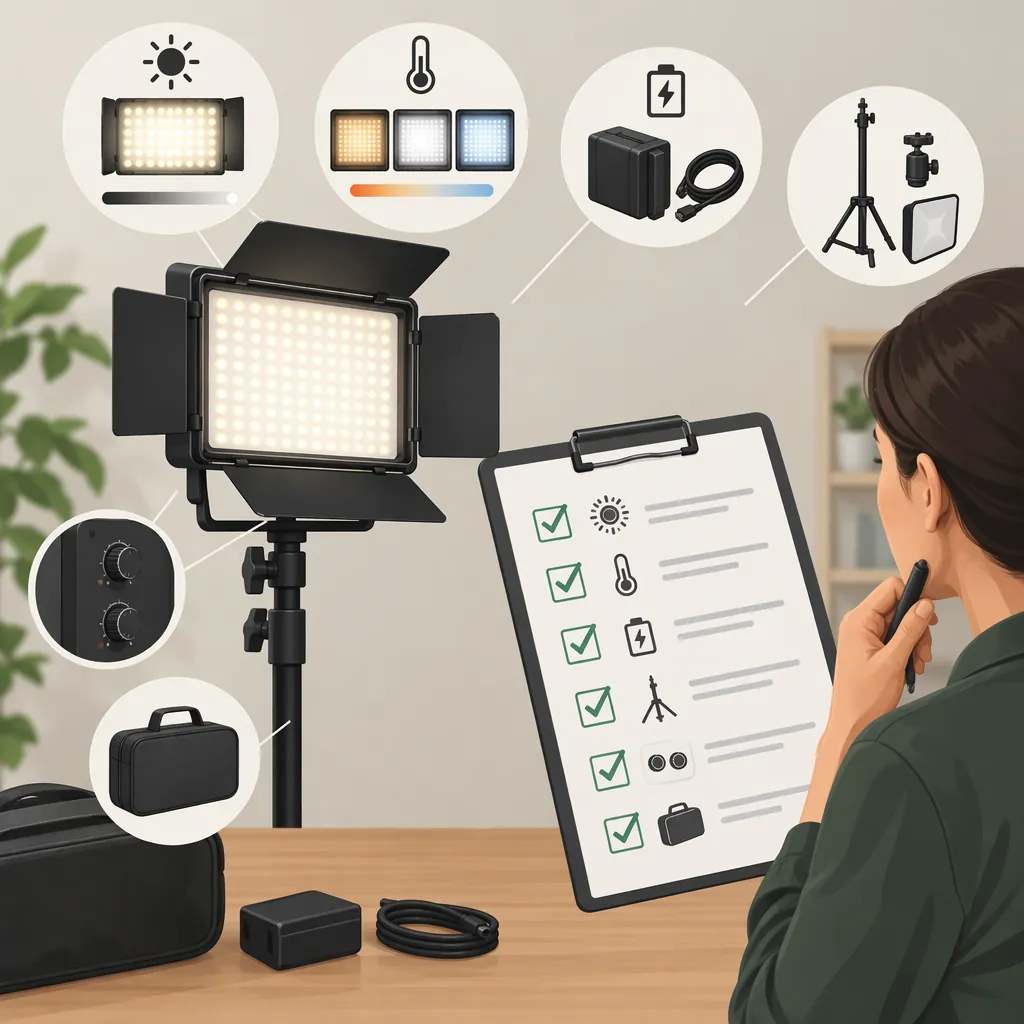
To choose an ESDDI LED video light, identify the exact model, separate essential requirements from optional preferences, and compare its documentation with your filming setup. Then test any unresolved questions about image quality, operating noise, and recording duration. Treat missing information as unknown—not as evidence that a feature is included.
Evidence scope: The Amazon “esddi light” search page includes other brands and several lighting formats, so it is not model-specific ESDDI documentation. The Amazon Live page titled “Watch Review of the ESDDI Photo Studio Light Box” has no review transcript or model specifications in the page text available for this article. These two references do not establish a specification set, camera-test results, or a recommended ESDDI video-light model. [src_search] [src_review]
Confirm the Product Before Comparing Specifications
Start with the product’s exact identity. A search term, brand name, or similar-looking kit is not enough to establish which light you are evaluating.
Record the model identifier and check that each manual, specification document, and kit description refers to that model. Keep the light itself, the kit contents, and optional accessories as separate entries. If descriptions conflict, mark the detail unresolved rather than choosing the more favorable claim.
In particular, do not transfer another brand’s specifications to ESDDI because the product appears in the “esddi light” search results. That page contains mixed-brand results. [src_search]
Model Identity Worksheet
- Exact brand and model: ____
- Product type: standalone video light / lighting kit / light box / other: ____
- Matching manual or specification document: ____
- Document location and relevant page or section: ____
- Exact kit contents: ____
- Optional accessories, recorded separately: ____
- Documented power requirements: ____
- Unverified or conflicting details: ____
- Identity status: confirmed / insufficient information
If you cannot establish the model or its required power source, pause the suitability assessment. Do not resolve those gaps by borrowing information from a different light.
Match the Light to Your Filming Requirements
Before comparing candidates, write down your subject, working distance, available space, recording duration, and intended camera settings. Label each requirement essential or optional.
An essential requirement is one you cannot leave unmet in the planned setup. An optional preference is a tradeoff you can accept. For example, if your planned location has no usable outlet, a documented compatible power arrangement would be essential; a preferred control layout might be optional.
Use the following as general evaluation principles, not as claims about ESDDI products.
| Area | What to verify | How to interpret it |
|---|---|---|
| Lighting task | Intended subject, placement, and coverage | Evaluate the candidate for your actual face, tabletop subject, or wider scene—not an unspecified “video” use. |
| Output | Illumination at a stated distance, brightness setting, and configuration | Compare figures only when their measurement conditions are sufficiently alike. Otherwise, mark them as not directly comparable and check your working setup. |
| Color controls | Documented color-temperature settings and dimming controls | Match the available controls to your planned lighting environment and camera settings. Do not treat a wider adjustment range alone as proof of better results. |
| Color evaluation | Any color-rendering claim and its stated test method | Record the method and conditions. Treat an unexplained rating as an unresolved comparison point, not a guarantee of the recorded appearance. |
| Power | Required adapter or battery, compatibility, and inclusion | Separate “supported” from “included.” Verify that the documented arrangement can serve your location and recording duration. |
| Mounting | Mount type and documented support requirements | Confirm compatibility with your intended stand or camera support before testing. Do not infer compatibility from appearance. |
| Light shaping | Included diffusion and explicitly compatible modifiers | List supplied accessories separately from compatible optional ones. Assess the configuration you actually intend to use. |
| Sound and handling | Operating noise, control access, and placement | Check these in the recording setup. Decide whether any observed limitation violates an essential requirement or is an acceptable tradeoff. |
Requirement Comparison Template
Complete one row for each requirement and one worksheet for each candidate.
Candidate model: ____
Subject and lighting task: ____
Working distance and available space: ____
Recording duration: ____
Intended camera settings: ____
| Requirement | Essential or optional? | Acceptance condition | Evidence location | Result |
|---|---|---|---|---|
| ____ | ____ | ____ | Document and page/section, or test-log entry: ____ | Met / not met / unknown |
| ____ | ____ | ____ | ____ | ____ |
| ____ | ____ | ____ | ____ | ____ |
Also record:
- Included accessories: ____
- Optional accessories needed for this setup: ____
- Conflicting information: ____
- Acceptable tradeoffs: ____
- Untested conditions: ____
Interpret the Comparison Before Choosing
Use explicit status rules so that a completed checklist leads to a decision rather than a collection of specifications.
Documented Fit
Use this status only when the exact model is identified, all essential documentation-based requirements are met, and no relevant conflict remains.
This means the candidate can proceed to any necessary camera checks. It does not mean its recorded performance has been verified.
Needs Testing
Use this status when the essential documentation-based requirements are satisfied, but suitability still depends on an observation—for example, visible banding at your camera settings, the appearance of shadows, or operating noise in your recording.
Write down the unresolved question and the test that would answer it. Keep performance conclusions pending until that check is complete.
Insufficient Evidence
Use this status when key identity, power, mounting, or other essential information is missing or contradictory. Do not make an affirmative suitability judgment until the gap is resolved.
Distinguish missing evidence from a confirmed mismatch: if documentation shows that an essential requirement is not met, mark the candidate not a fit for this setup, rather than merely “unknown.”
Optional preferences should not override an unmet essential condition. Once essential conditions are satisfied, compare acceptable tradeoffs without implying that one candidate is universally better.
Use a Repeatable Camera Test
If you have access to a candidate light, use a controlled recording check. The procedure below is a proposed evaluation method, not a report of testing an ESDDI product.
- Confirm setup requirements. Follow the model’s documented power, mounting, and operating instructions. Resolve essential compatibility questions before operating it.
- Re-create the intended scene. Use your planned subject position, light distance, and modifier configuration.
- Record camera settings. Note frame rate, shutter speed, exposure, and white balance. Keep them unchanged within each comparison.
- Check intended light settings. Record samples at the brightness and color settings you expect to use. Note any change between samples.
- Inspect the footage. Look for visible brightness variation, banding, unwanted color, reflections, and whether the shadows meet your stated requirement.
- Check recorded sound. Record room audio with the light operating and listen for unwanted noise in the intended microphone setup.
- Check duration. Repeat for your planned recording duration, within documented operating limits, and note interruptions or changes.
If you change camera settings, light placement, or modifiers to address a problem, log the change and repeat the comparison. Do not combine results from different conditions as though they were one unchanged test.
Camera Test Log
- Model: ____
- Requirement being tested: ____
- Acceptance condition: ____
- Power source: ____
- Light distance and position: ____
- Modifier configuration: ____
- Brightness and color settings: ____
- Camera, frame rate, shutter speed, exposure, and white balance: ____
- Microphone position and recording settings: ____
- Clip duration: ____
- Visible brightness variation or banding: ____
- Color, reflections, and shadows: ____
- Recorded operating noise: ____
- Interruptions or changes during the test: ____
- Result: acceptable / unacceptable / inconclusive
- Conditions not tested: ____
Describe the conclusion narrowly: an acceptable sample supports suitability for the tested setup and duration, not every camera setting or filming environment. An inconclusive result remains unresolved.
FAQ
Which Esddi Led Video Light Is Best for Filming?
The two references used here do not support ranking ESDDI models. [src_search] [src_review] For a specific candidate, first confirm its identity and essential documented requirements, then test the unresolved performance questions in your intended setup.
Can I Use Amazon Search Results as Esddi Specifications?
Only after confirming which exact product the information describes. The “esddi light” search page includes other brands, so the search term alone does not establish that a displayed specification belongs to ESDDI. [src_search]
Does the Esddi Light Box Review Verify Standalone Video-Light Performance?
Not on the evidence available here. The referenced page is titled as a photo studio light box review, and its available text contains neither a review transcript nor model specifications. It does not establish standalone video-light output, color accuracy, flicker behavior, or battery runtime. [src_review]
What Should I Do If an Essential Specification Is Missing?
Mark it unknown and record the missing evidence. If the gap concerns model identity, power, mounting, or another essential condition, classify the candidate as insufficient evidence and postpone a suitability conclusion. Missing information is not a confirmed failure, but it is also not a pass.
Does a Successful Camera Test Prove the Light Will Work in Every Setup?
No. Limit the conclusion to the camera settings, light configuration, placement, and duration you tested. Recheck unresolved or changed conditions before extending that conclusion. The references used in this article provide no model-specific camera-test results. [src_search] [src_review]
Sources
-
[src_search] Amazon.com : esddi light
-
[src_review] Watch Review of the ESDDI Photo Studio Light Box on Amazon Live