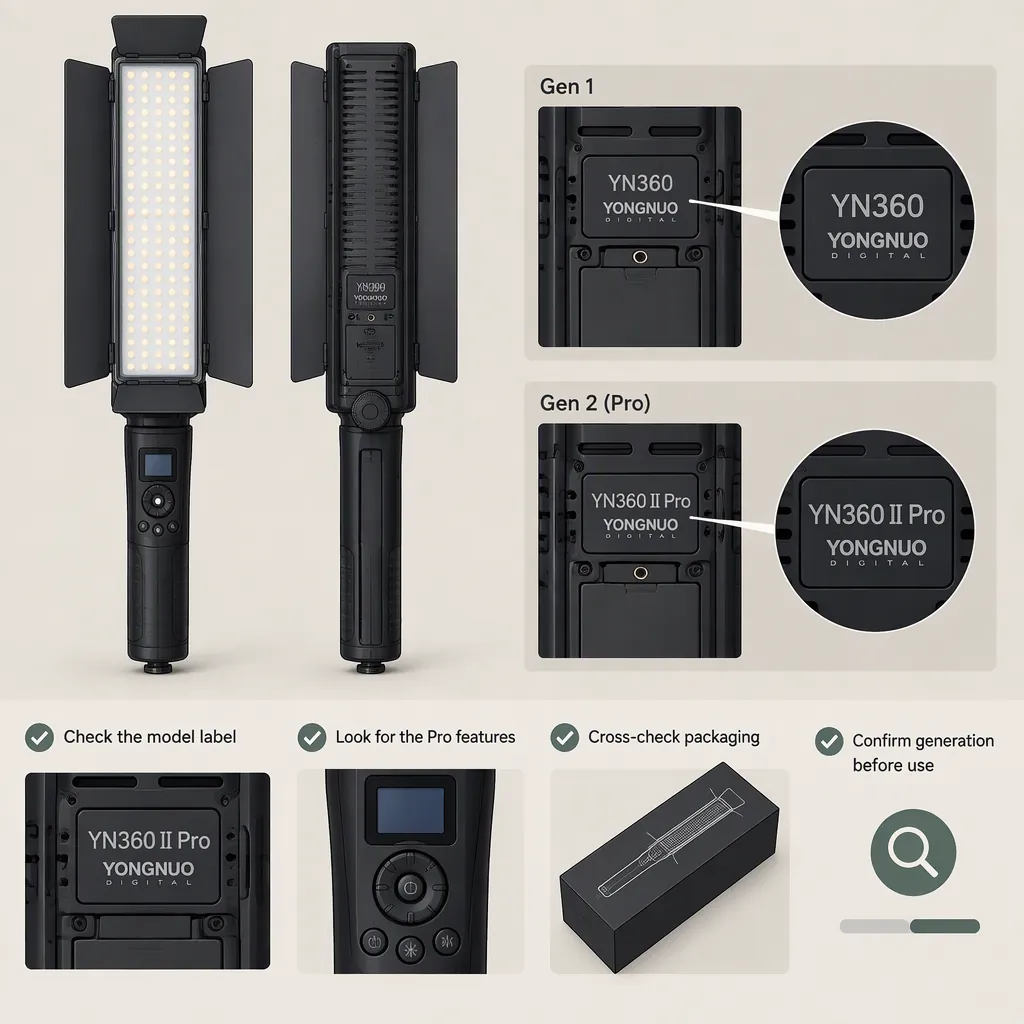
Yongnuo Yn360 Ii Pro: How to Select a Second-Generation Model
For a second-generation Yongnuo YN360 selection, first confirm the exact model, then check whether its documented capabilities meet your filming requirements. Treat a unit as a candidate only when its identity and every essential requirement have matching evidence; pause the decision when a critical detail remains unknown.
The FlashGear.net page cited here describes Yongnuo YN360 III Pro, not a confirmed “YN360 II Pro.” It does not establish the II Pro designation or justify transferring III Pro specifications to a second-generation unit. This is an evidence limitation—not proof that the name does not exist. This guide therefore provides a selection process, not a recommendation for a specific second-generation model. [c1]
Confirm the Exact Second-Generation Model
Before comparing features, establish which unit and variant you are evaluating:
- Read the model marking on the unit. Use a legible label photograph rather than relying only on a listing headline.
- Preserve the full name. Record II or III, whether Pro appears, and any variant marking. Do not silently combine or correct names.
- Match the documentation. Look for a manual that explicitly identifies the same model and variant.
- Record accessories separately. Keep the unit’s identity distinct from included batteries, power supplies, controllers, and other items.
- Flag conflicts. If the label, listing, and manual disagree, leave the identity unresolved until the discrepancy is explained.
These steps are a verification method, not evidence that any particular “II Pro” configuration exists.
Model Identity Worksheet
| Field | What to record |
|---|---|
| Search or listing name | The name as written, including suffixes |
| Unit model marking | The exact text visible on the unit |
| Generation | The marking shown, or “unreadable” |
| Pro suffix | Present, absent, or unreadable |
| Variant | The exact marking, if present |
| Matching manual | Title and model designation |
| Included items | An itemized accessory record |
| Conflicts | Any disagreement among the label, listing, and manual |
| Identity status | Confirmed or unresolved |
If the available evidence identifies the unit as III rather than II, do not count it as a confirmed second-generation candidate.
Turn Your Filming Task into Selection Requirements
Once identity is resolved, define what the light must do for your scene. Separate essential requirements from preferences before comparing candidates.
Write requirements in terms you can check. For example, “usable away from an outlet for the planned session” is more actionable than “portable.” It still requires evidence about the exact unit and intended power setup; it is not a claim that the model supports that use.
| Selection area | Requirement to define | Evidence to seek |
|---|---|---|
| Light and color | What white-light or color adjustment does the scene require? | Documentation for the exact model and variant |
| Output | What result is needed at the planned subject distance and camera settings? | A relevant documented measurement or controlled test of the exact unit |
| Power | Where will power come from, and how long must the setup operate? | Matching power requirements and evidence for the intended power setup |
| Controls | How must settings be adjusted during filming? | Instructions for the unit and any separate controller |
| Positioning | Where and how must the light be supported? | Documented mounting provisions and limits |
| Included equipment | Which items are needed to make the planned setup complete? | An itemized contents record and matching accessory documentation |
For each requirement, record both its priority and evidence status:
- Essential: must be met for the planned task.
- Preferred: useful, but not necessary.
- Documented: supported by material explicitly matching the model and variant.
- Observed: checked on the exact unit; record the conditions and limits of the observation.
- Unknown: not established by the evidence available.
A label photograph can help establish identity, but it does not establish brightness, runtime, or color consistency. Likewise, a manual describing a function does not necessarily establish its measured performance under your filming conditions.
Apply a Clear Candidate Decision Rule
Use the same rules for every unit being considered. Do not let a generation number or the word “Pro” substitute for evidence.
| Finding | Selection status | Next step |
|---|---|---|
| Exact second-generation identity is unresolved | Pause | Resolve the model and variant before comparing capabilities |
| Identity is confirmed, but an essential requirement is unknown | Pause | Obtain matching documentation or a relevant controlled test |
| Evidence shows an essential requirement is not met | Exclude from this task | Keep the reason tied to the requirement, not a general judgment about the model |
| Identity is confirmed and all essential requirements have matching evidence | Eligible candidate | Compare preferences and setup completeness |
| The unit meets essential requirements, but a needed accessory is missing or unresolved | Candidate; setup incomplete | Confirm the accessory and its documented compatibility before final selection |
“Eligible candidate” means the unit has passed your stated screening criteria. It does not mean it is universally better than another generation or suitable for every filming workflow.
If multiple confirmed second-generation candidates pass, compare the preferences you defined in advance. If a preference cannot be verified, leave it unknown rather than using it to rank the candidates.
Candidate Comparison Worksheet
| Requirement | Essential or preferred? | Candidate evidence | Meets requirement? |
|---|---|---|---|
| Exact second-generation model and variant | Essential | Yes / unresolved | |
| Required light and color controls | Yes / no / unknown | ||
| Required output in the planned setup | Yes / no / unknown | ||
| Power for the planned session | Yes / no / unknown | ||
| Required adjustment method | Yes / no / unknown | ||
| Suitable positioning and support | Yes / no / unknown | ||
| Necessary accessories confirmed | Yes / no / unknown |
Do not count an unknown essential requirement as a pass. If no candidate clears all essential checks, the outcome is insufficient evidence to select, or no evaluated candidate meets the task, depending on what the evidence shows.
Keep Accessories Separate from Model Identity
Evaluate two things independently:
- The unit: exact model, variant, and evidence for required capabilities.
- The setup: confirmed power equipment, controls, mounting equipment, and other necessary items.
A listing’s accessory bundle should not be used to infer the generation of the light. Conversely, confirming the light’s model does not establish that every pictured accessory is included or compatible.
Record missing items as setup gaps. Do not automatically reject an otherwise eligible unit because an accessory is absent, but do not consider the filming setup complete until the gap is resolved.
Write the Selection Conclusion
A useful selection note makes the reasoning explicit:
Identified model and variant:
Filming task:
Essential requirements:
Evidence for each requirement:
Unresolved details:
Required accessories and setup gaps:
Decision: eligible candidate / pause / exclude from this task
Reason:
The cited FlashGear.net III Pro page does not provide the matching second-generation evidence needed to complete this worksheet or recommend a specific “YN360 II Pro.” Use it only within that source boundary, not as a II-versus-III selection comparison. [c1]
FAQ
What Should I Do If the Listing Title, Unit Label, and Manual Disagree?
Record all three names without editing them to match. Obtain a legible model-label image and documentation identifying the same model and variant. Leave the generation unresolved until the conflict is explained; do not infer it from appearance alone.
Can the Flashgear.net Page Fill Gaps in a Second-Generation Comparison?
Not for model-specific second-generation facts. The cited page concerns YN360 III Pro and does not establish that its specifications or accessories apply to a unit labeled II. Mark those second-generation details as unknown unless matching evidence is available. [c1]
What If a Candidate Meets Every Requirement Except One That Is Unknown?
If the unknown requirement is essential, pause selection. Identify exactly what evidence would resolve it, such as matching power documentation or a controlled test under the planned filming conditions. If it is only a preference, keep it marked unknown and do not use it as an advantage in the comparison.
Does a Missing Accessory Mean the Model Is Unsuitable?
Not necessarily. Separate model suitability from setup completeness. A unit may pass the essential capability checks while still needing an accessory, but the final setup remains incomplete until that item’s availability and compatibility are confirmed.
What If No Second-Generation Candidate Can Be Confirmed?
State that there is insufficient evidence to make a second-generation selection. Do not replace the intended model with III Pro merely because the cited page documents that name. The page’s subject is III Pro, not confirmation of the searched II Pro designation. [c1]