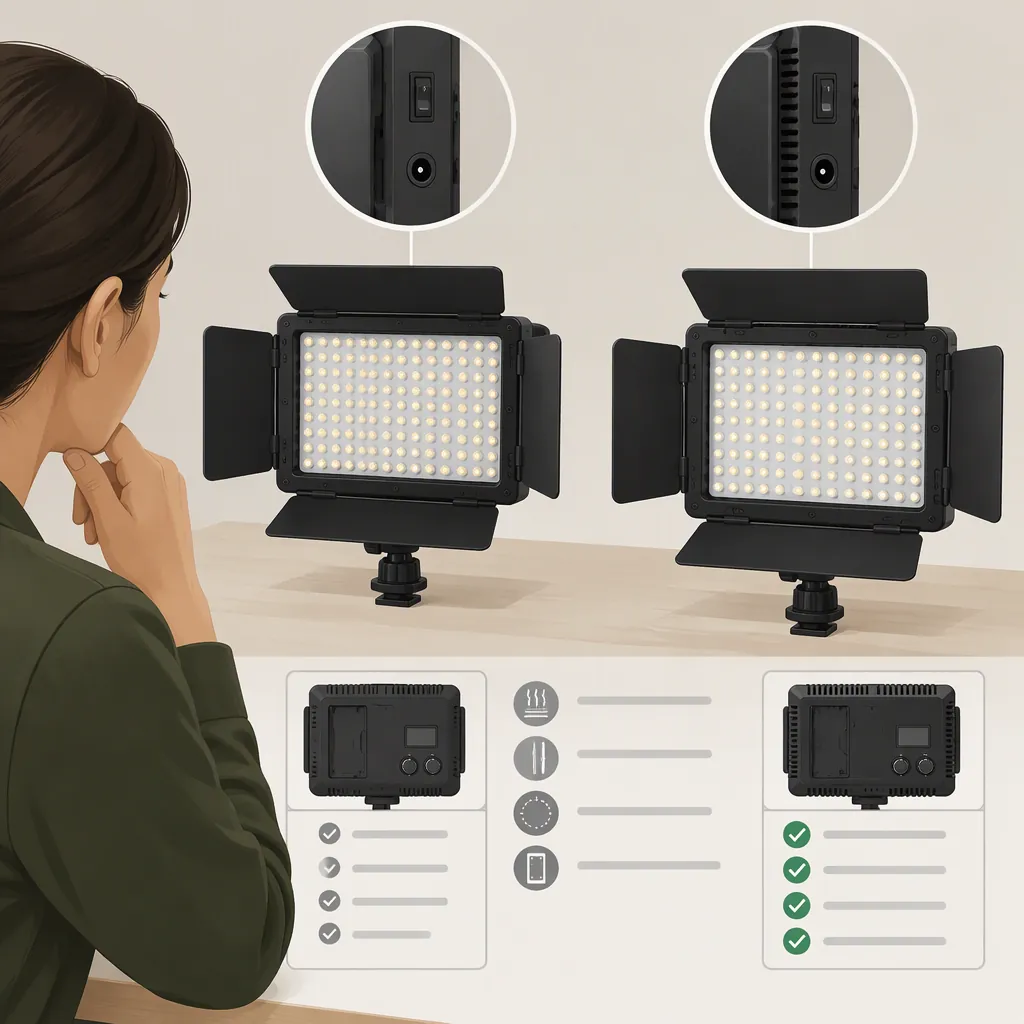
Yn 300 Ii: A Guide to Second-Generation Model Selection
The YN 300 II can enter your shortlist if you need warm/daylight white lighting, based on the configuration described in the November 2015 tuxoche review. Confirm that the actual unit provides adequate exposure at your working distance and has documented, compatible power options before making a selection. If RGB is essential, that review does not establish that the YN 300 II meets the requirement. [ref_2]
Start by checking the full model name. YN 300 II and YN300Air II are distinct names in the available documentation, with different described lighting configurations. The YONGNUO YN300Air II product page explicitly lists RGB operation; do not transfer that specification to the YN 300 II or treat the shared “II” suffix as proof of an upgrade relationship. [ref_1] [ref_2]
Identify the Exact Model and Its Documented Features
Match the label on the unit to its manual and listing before comparing features. Keep “Air” in the name when searching for documentation.
| Selection check | YN 300 II | YN300Air II |
|---|---|---|
| Evidence source | Third-party tuxoche review dated November 19, 2015. [ref_2] | YONGNUO product listing; its specifications are listing claims, not independently verified measurements. [ref_1] |
| Recorded white-light configuration | Two separately controlled groups: 150 LEDs at 5500 K and 150 at 3200 K. [ref_2] | Listed white-light range of 3200–5600 K, with 108 LED beads. [ref_1] |
| RGB evidence | RGB operation is not documented in the review. This is an evidence gap, not proof that a feature is absent. [ref_2] | A separate RGB full-color mode and 100 RGB SMD beads are listed. [ref_1] |
| Power evidence | The reviewer discusses a separate battery and charger purchase, but the review does not provide a complete power-compatibility specification. [ref_2] | The listing specifies NP-F battery power or a 12 V, 2 A DC adapter. [ref_1] |
| Details still requiring verification | Exact unit identity, power compatibility, included accessories, control compatibility, and performance in your scene. | Exact kit contents, power connector and polarity, accessory compatibility, and performance in your scene. |
What the Evidence Can—And Cannot—Establish
These sources help identify configurations, but neither provides a controlled first-versus-second-generation comparison or a head-to-head test of the two named models. They do not establish a direct replacement relationship, interchangeable accessories, or comparative brightness, flicker behavior, color accuracy, and runtime under identical conditions. The 2015 review is dated third-party evidence; the YONGNUO page is a product listing. [ref_1] [ref_2]
Match the Yn 300 Ii to Your Lighting Task
Use your scene requirements to decide whether the YN 300 II remains a candidate.
| Your requirement | Conditional selection guidance | Next check |
|---|---|---|
| Warm/daylight white illumination | The two separately controlled LED groups described in the 2015 review make the YN 300 II a candidate to evaluate for this task—not a confirmed performance match. [ref_2] | Check exposure and color balance at your intended distance, placement, and camera settings. |
| RGB accents or colored backgrounds | Do not treat the YN 300 II as a confirmed match based on the review. RGB is explicitly documented for the differently named YN300Air II. [ref_1] [ref_2] | Consult documentation matching the exact unit and verify the required color controls. |
| Battery-powered filming | The reviewer's battery use establishes experience with that setup, not a complete compatibility guide or guaranteed runtime. [ref_2] | Confirm supported batteries and evaluate runtime with your intended brightness settings. |
| A demonstrable upgrade over a first-generation model | The two references do not establish a second-generation performance advantage. [ref_1] [ref_2] | Compare documented features and equivalent test conditions, rather than relying on “II.” |
For ordinary white-light filming, the practical decision is whether the unit can illuminate your subject adequately while allowing the placement and control access your setup needs. If those checks remain unresolved, keep the selection provisional.
Check Power and Accessories Before Use
For the YN 300 II, obtain power specifications that match the exact unit. The tuxoche reviewer discusses separately acquired batteries and a charger, but that account is not a complete compatibility specification. Do not use the Air II's listed power requirements as a substitute. [ref_2]
For the YN300Air II, the YONGNUO page lists NP-F batteries or a 12 V, 2 A DC adapter. It states that the battery and adapter are not included in the basic package while also showing adapter-kit variants with regional plugs. Package contents therefore need to be checked against the exact kit, not inferred from the page headline. [ref_1]
Before connecting power, verify:
- Documented battery compatibility.
- DC voltage, polarity, connector, and required current rating.
- Contents of the exact kit.
- Mounting hardware suitable for your intended placement.
- Remote-control compatibility, if remote operation is required.
Model Verification Worksheet
- Full model name on the unit: ______
- Matching manual or documentation: ______
- Required lighting modes: ______
- Documented battery compatibility: ______
- Documented DC voltage, polarity, connector, and current requirement: ______
- Contents of the exact kit: ______
- Mounting and control accessories confirmed: ______
- Unresolved details: ______
- Selection status—candidate, verified for the task, or unresolved: ______
Evaluate the Actual Unit in Your Filming Setup
If a demonstration unit is available, use a repeatable evaluation:
- Define the scene. Record your intended subject, light placement, and working distance.
- Fix the camera settings. Use the intended frame rate, shutter speed, ISO, aperture, and fixed white balance.
- Record relevant settings. Film the same subject at several brightness levels and the color settings you expect to use.
- Inspect the footage. Look for adequate exposure, visible banding, unwanted color shifts, and unsuitable shadows.
- Record power and accessories. Note the battery or adapter, mounting arrangement, and controls used.
- Decide against your requirements. Keep the unit as a candidate only if the observed setup meets the task; leave untested requirements unresolved.
These are proposed evaluation steps, not reported test results for either model. The 2015 tuxoche review includes exposure observations and battery-runtime experience from the author's setup; those results are not guarantees for another unit, battery, or scene. [ref_2]
FAQ
Is the Yn 300 Ii the Same Model as the Yn300air Ii?
No—the references identify them by distinct names and describe different lighting configurations. Match documentation to the full name, including “Air” where present. [ref_1] [ref_2]
When Should the Yn 300 Ii Stay on My Shortlist?
When your requirement is warm/daylight white illumination, the configuration described in the 2015 tuxoche review is relevant. Keep the choice provisional until you verify exposure in your scene, compatible power, and the required accessories. [ref_2]
Does the Yn 300 Ii Have RGB Lighting?
The 2015 review documents 3200 K and 5500 K LED groups, not RGB operation. RGB is explicitly listed for the YN300Air II. If RGB is essential, verify the exact model's documentation rather than inferring support from “II.” [ref_1] [ref_2]
Can I Use the Yn300air Ii Power Specifications for the Yn 300 Ii?
Do not assume that you can. The Air II listing specifies NP-F batteries or a 12 V, 2 A adapter, while the YN 300 II review does not provide a complete compatibility specification. Use documentation matching your unit. [ref_1] [ref_2]
Do These References Prove That the Second Generation Is Better?
No. They describe the YN 300 II and YN300Air II without a controlled first-versus-second-generation comparison. The “II” suffix alone does not establish an upgrade benefit. [ref_1] [ref_2]