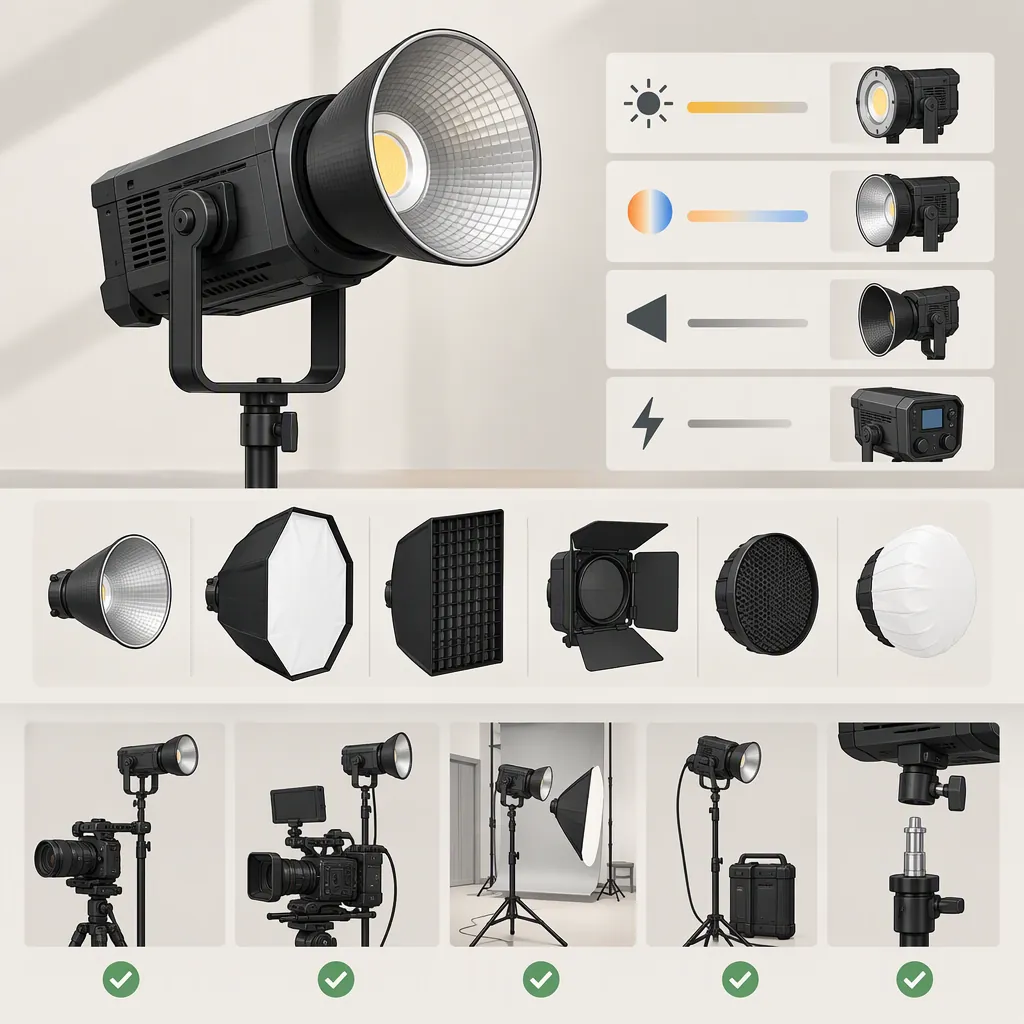
Smallrig Rc 450D: Filming Light Selection and Compatibility
Evaluate the SmallRig RC 450D against your scene’s color requirements, intended modifiers, available power, support equipment, and recorded sound. Provided sources describe a daylight-balanced fixture with a Bowens mount, but they do not establish compatibility with every accessory or performance in your setup. Treat published specifications as planning information, then verify the exact unit and test the complete configuration. [c1] [c2]
Identify the Model and Color Requirements
Start with the exact model name rather than assuming all RC 450 fixtures have the same capabilities. CineD’s December 2022 launch coverage distinguishes the daylight-balanced RC 450D from the adjustable-color-temperature RC 450B. The supplied RC450D listing specifies 5600K with a stated tolerance of ±200K. These are documented specifications, not measurements made for this article. [c1] [c2]
For selection, write down whether the scene needs a daylight-balanced source or frequent changes between warmer and cooler lighting. If adjustable color temperature is a requirement, do not assume the D model provides the B model’s adjustment range. Test the intended camera white balance alongside any practical lights before deciding whether the configuration meets your needs.
The evidence here consists of launch reporting and a product listing, not a current independent laboratory evaluation or firsthand filming test.
Verify Modifier and Support Compatibility
Both supplied technical sources describe a Bowens mount. That identifies a modifier interface; it does not establish that every Bowens-labeled softbox, Fresnel, reflector, or adapter is suitable for this particular fixture. The references do not provide an exhaustive accessory compatibility list. [c1] [c2]
Before fitting a modifier, verify its documented compatibility, mounting clearance, locking engagement, and any operating restrictions. Check the support arrangement with the full assembly, including the modifier and cables, rather than considering only the lamp head.
The listing gives a lamp weight of 3356g and lists an adapter and stand adaptor in the package. Its separate gross-weight figure should not be treated as the load mounted on the stand. Confirm the actual supported assembly and the stand manufacturer’s limits for the intended position. [c1]
Do not force an accessory into place or use an improvised attachment when fit or support requirements remain unresolved.
Check Power, Regional Plugs, and Controls
The supplied UK listing states an adapter input of AC 100–240V at 50/60Hz, a fixture operating voltage of DC 49V, and maximum power of 499.8W. It lists adapter-based operation from AC power or a portable power station. This does not establish a direct battery connection or compatibility with an arbitrary battery plate. Verify the supplied adapter, connectors, and power-source requirements before use. [c1]
The same listing identifies regional SKUs as 3970-US, 3971-EU, 3972-UK, 3973-AU, and 3974-JP, stating that their plug specifications differ. Check the actual package rather than assuming a UK listing represents a US kit. [c1]
Onboard controls, the SmallGoGo app, and an optional control panel are described in the references. Those descriptions do not verify present-day phone, operating-system, app-version, or accessory compatibility. Confirm remote operation separately, and include an onboard-control check in the setup test. [c1] [c2]
Test the Complete Filming Setup
CineD reports a manufacturer-claimed maximum illuminance of 172,000 lux at one meter with the included 55° reflector. It also reports a stated cooling-noise figure of 32dB at one meter. These figures are not independent measurements in the supplied article and should not be treated as guarantees for a softened key light or your microphone placement. [c2]
Use a repeatable test that reflects the actual scene. Keep the camera settings, modifier, distance, microphone position, and ambient lighting documented. Judge the recorded image and audio against the production’s requirements, rather than accepting a headline output or noise specification as the decision.
Leave unverified items marked as unresolved. The provided references do not settle flicker behavior at your chosen frame rate and shutter setting, current app compatibility, or every modifier pairing.
Setup Verification Worksheet
1. Record the exact model, regional SKU, adapter label, and included accessories.
2. Confirm modifier compatibility and support limits from the relevant documentation.
3. Record modifier, light-to-subject distance, brightness setting, and ambient lighting.
4. Record camera, frame rate, shutter setting, ISO, aperture, and white balance.
5. Capture a sample with the intended subject and inspect exposure, color, shadows, and any visible flicker or banding.
6. Record dialogue and room tone at the intended microphone position; listen for unacceptable equipment noise.
7. Check onboard operation and, if required, the intended remote-control method.
8. Mark each requirement as met, not met, or unresolved. Keep unresolved safety or compatibility items out of the production setup.
FAQ
Is the Smallrig Rc 450D a Bi-Color Light?
The supplied sources describe the RC 450D as daylight-balanced at approximately 5600K. CineD identifies the RC 450B, not the RC 450D, as the adjustable-color-temperature model. [c1] [c2]
Will Every Bowens Modifier Work with the Rc 450D?
The references describe a Bowens mount, but they do not establish compatibility with every modifier. Verify the exact accessory’s fit, restrictions, and support requirements before mounting it. [c1] [c2]
Can the Rc 450D Connect Directly to a V-Mount Battery?
The supplied listing documents adapter-based AC or portable-power-station operation; it does not document direct V-mount battery operation. Do not infer direct battery compatibility without explicit documentation for the exact power arrangement. [c1]