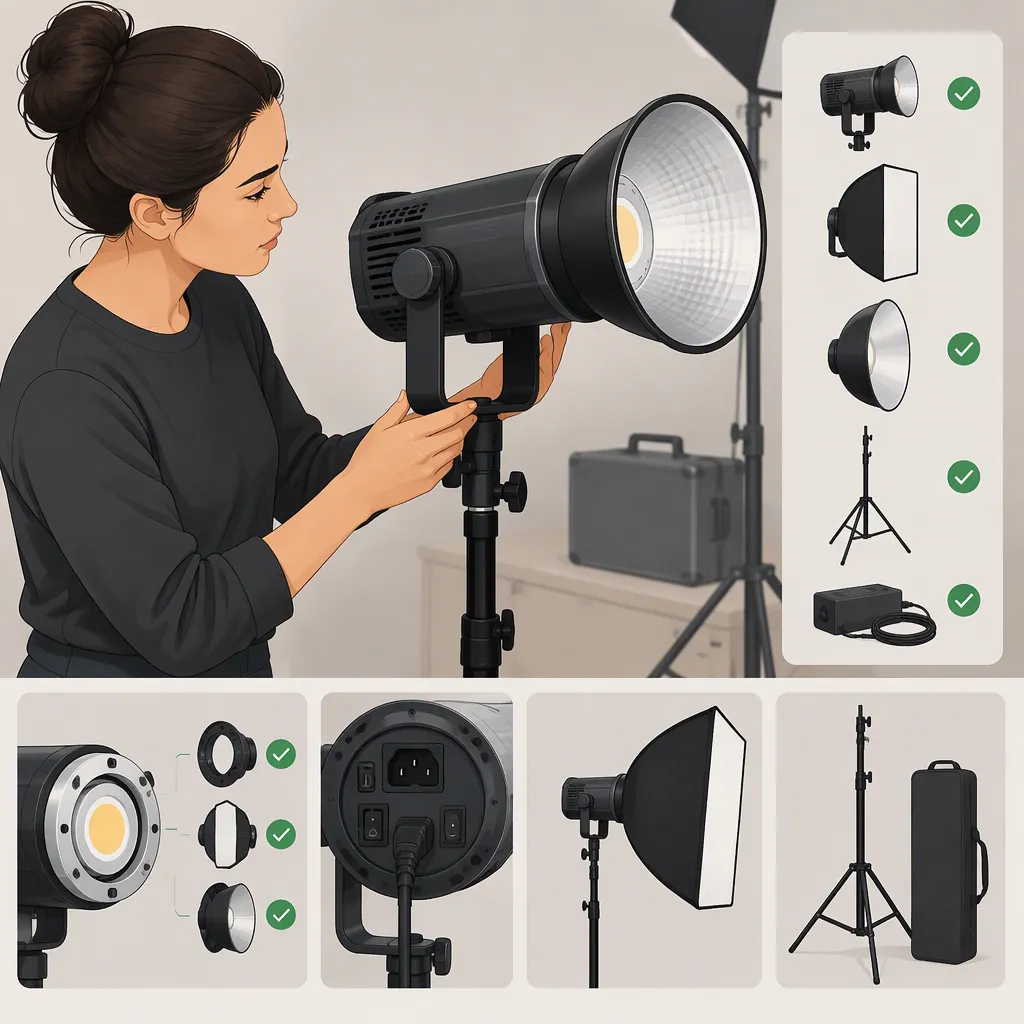
Neewer Sl80 Lighting Selection and Compatibility Guide
Before choosing a light labeled NEEWER SL80, confirm its exact identity and documented power, support, and accessory requirements. Then test whether the confirmed setup meets your filming needs.
Evidence limit: The supplied Walmart Neewer studio-lighting category-page excerpt lists other lights but does not identify an SL80 or establish its specifications or compatibility. This guide is a verification workflow—not a confirmed SL80 specification sheet or product recommendation. Do not transfer specifications from the listed ring lights or 660 LED kits to an SL80. [source_1]
Confirm the Exact Model First
Compare the model label on the fixture with its packaging, product listing, and manual. Record the designation exactly, including any suffix or revision. A similar name or appearance is not enough to establish that documentation applies.
Find Applicable Documentation
- Record the fixture label. Photograph the accessible label and note the full model designation, revision if shown, and printed electrical input information. Do not open the fixture to find identifiers.
- Compare the available records. Check whether the packaging, listing, and manual name the same model. Note discrepancies rather than choosing whichever document appears most complete.
- Look for matching public manufacturer documentation. Search using the complete designation. Check the document’s model coverage and revision information, where provided, rather than relying only on a search-result title.
- Request clarification if the match remains uncertain. Through a verified manufacturer support channel, provide the label information and describe any conflicting identifiers. Request the applicable manual and clarification of the exact fixture’s requirements. No support address or model-specific document is verified here.
- Keep unresolved combinations unused. If no applicable documentation can be identified, do not infer power, mounting, or modifier compatibility from another model.
A retail category page cannot resolve the identity of this fixture: the supplied excerpt contains neither an SL80 listing nor an SL80 manual. [source_1]
Model Verification Record
- Model printed on the fixture: ______
- Revision and electrical input information, if shown: ______
- Model printed on the packaging: ______
- Model and revision covered by the manual: ______
- Documentation location and relevant page or section: ______
- Identifiers agree: Yes / No / Unresolved
- Documentation applies to this exact fixture: Yes / No / Unresolved
- Conflict, missing document, or clarification needed: ______
Check Each Compatibility Interface Separately
Use applicable documentation for both the fixture and the proposed equipment. These are general checks, not verified SL80 features.
| Interface | What to Compare | Stop Condition |
|---|---|---|
| Power | Fixture input type, voltage, required current or power, approved supply, connector specifications, DC polarity where applicable, and any documented battery arrangement | Do not connect a supply with conflicting specifications. Leave it unused if required ratings or approval remain unclear. |
| Stand or support | Mounting interface, required adapter, complete fixture-and-accessory load, support rating, and restrictions for the planned arrangement | Do not mount an incompatible combination or exceed documented limits. Resolve missing load or interface information first. |
| Modifier | Attachment type, approved adapter if required, size and weight limits, clearance, and ventilation or installation restrictions | Do not force a fit or assume that an adapter resolves every restriction. |
| Controls | Exact supported remote or controller, app requirements and versions if applicable, and required on-fixture controls | Do not rely on remote or app operation unless the exact combination is documented. |
| Package contents | Exact kit identifier and whether required supplies, cables, supports, or adapters are included or optional | Do not treat a pictured accessory as included. Resolve missing required equipment before setup. |
For power, compare the fixture’s input requirements with the supply’s output specifications. Connector appearance alone is insufficient, and a higher wattage rating alone does not establish compatibility. Use the documented supply or an explicitly approved alternative.
For mounting, check more than whether a fitting slides into place. Account for the complete supported load and follow the support’s restrictions for the planned height and arrangement. For modifiers, confirm attachment and installation requirements before testing.
Compatibility Result Record
Use the interface table above to make the checks; record only the result and its basis here.
| Interface | Result | Document and Section, or Unresolved Issue |
|---|---|---|
| Power | Confirmed / Conflict / Unknown | ______ |
| Stand or support | Confirmed / Conflict / Unknown | ______ |
| Modifier | Confirmed / Conflict / Unknown | ______ |
| Controls, if needed | Confirmed / Conflict / Unknown | ______ |
| Required package equipment | Complete / Incomplete / Unknown | ______ |
Decision rule: Resolve power, mounting, and modifier-installation conflicts before energizing or assembling the proposed setup. An unknown is not a compatibility approval.
Evaluate Fit for Your Filming Setup
Once model identity and installation requirements are confirmed, define the shot you need. Note the subject, framing, available space, intended light-to-subject distance, modifier, camera settings, and microphone position.
Set acceptance criteria before testing:
- Exposure: Achieve your target exposure at the aperture, shutter setting, and ISO you intend to use.
- Appearance: Produce an acceptable result for the scene with your chosen modifier and white balance.
- Recorded image: Show no banding or brightness variation that is unacceptable for the intended use.
- Recorded audio: Produce no unacceptable noise attributable to the operating light in the dialogue recording.
- Practical fit: Work within the available space and documented equipment restrictions.
These are evaluation criteria, not established SL80 performance characteristics. The supplied excerpt does not verify SL80 output, color accuracy, flicker, cooling, or operating-noise performance. [source_1]
A Repeatable Recording Test
- Set up the intended shot. Fix camera, subject, light, modifier, and microphone positions. Use a documented installation arrangement.
- Lock camera settings. Record frame rate, shutter setting, aperture, ISO, and white balance. Avoid automatic changes when comparing results.
- Test each brightness setting you expect to use. Identify the setting for every clip. Treat changes in distance, modifier, or camera settings as separate configurations.
- Check exposure against your target. Use the camera’s exposure tools, if available, and review the recorded image. Judge the result at your intended settings, not merely whether the light looks bright.
- Review actual footage. Look for unacceptable banding, pulsing, or brightness variation—not only in the live preview. Repeat at each frame-rate and shutter combination you plan to use.
- Compare dialogue audio with the light off and on. Keep microphone position, recording gain, and other room conditions unchanged. Record comparable dialogue and a quiet interval in both conditions.
- Record results and limitations. A pass applies only to the tested configuration. Relevant changes require another check.
Filming Evaluation Worksheet
- Intended shot and delivery use: ______
- Camera and recording mode: ______
- Frame rate and shutter setting: ______
- Aperture, ISO, and white balance: ______
- Target exposure and assessment method: ______
- Light-to-subject distance: ______
- Modifier and attachment confirmation: ______
- Brightness setting tested: ______
- Microphone position and recording gain: ______
- Target exposure achieved: Yes / No / Not tested
- Recorded appearance and banding check acceptable: Yes / No / Not tested
- Light-off audio result: ______
- Light-on audio result: ______
- Dialogue audio acceptable for intended use: Yes / No / Not tested
- Setup within documented installation limits: Yes / No / Unresolved
- Adjustments, remaining gaps, or retest conditions: ______
Make the Selection Decision
Separate your notes into three evidence categories:
- Confirmed: Requirements or compatibility explicitly documented for the exact model and equipment combination.
- Observed: Results from a defined recording test, with settings and setup recorded.
- Unresolved: Missing specifications, conflicting identifiers, untested performance, or compatibility assumptions.
| Evidence Status | Selection Conclusion |
|---|---|
| Exact model identity is unresolved | Do not assign model-specific specifications or compatibility. Obtain applicable documentation or clarification. |
| Required power or installation details are missing or conflicting | Do not proceed with that setup until the requirements are resolved. |
| Installation requirements are confirmed, but filming performance is untested | Compatibility may be documented; suitability for the intended shot remains open. |
| Installation requirements are confirmed, but exposure, image, or audio testing fails | The current configuration does not meet the preset filming requirements. Adjust only within documented limits, record whether the changes alter the original shot requirements, and retest. |
| Installation requirements are confirmed and recording tests meet your criteria | The evidence supports suitability for that tested configuration, not every filming condition. |
If a revised configuration passes only after changing a required camera setting, light position, modifier, or microphone position, determine whether it still satisfies the original brief. Passing a different test is not the same as meeting the original need.
Keep documented compatibility separate from observed performance. A successful recording test does not replace power or mounting documentation, and a compatible accessory does not guarantee acceptable exposure, image, or audio.
FAQ
What Specifications Are Confirmed for the Neewer Sl80?
None are established by the supplied Walmart category-page excerpt. It does not identify an SL80 or provide model-specific specifications. Use documentation that matches the fixture label before treating any parameter as confirmed. [source_1]
What Should I Do If the Label and Manual Disagree?
Record both identifiers and request clarification through a verified manufacturer support channel. Ask which documentation applies to the exact fixture. Until that is resolved, do not use the conflicting manual to approve a power supply or installation. See Confirm the Exact Model First.
Can I Use a Bowens Softbox with a Light Labeled Neewer Sl80?
Bowens compatibility is not established by the supplied reference. [source_1] Confirm the exact fixture’s modifier mount and the softbox’s attachment and installation requirements, including any approved adapter. See Check Each Compatibility Interface Separately.
Does a Successful Video Test Prove the Light Is Suitable for Every Shoot?
No. It supports only the recorded configuration and acceptance criteria. The supplied excerpt establishes no SL80-specific flicker or operating-noise performance. [source_1] Retest relevant changes to camera settings, light output, placement, modifiers, or audio setup.
What If Accessories Fit but the Recording Test Fails?
Treat the current configuration as unsuitable for the preset filming requirements. Any adjustment must remain within documented installation limits. Record what changed, check whether the original shot requirements still hold, and repeat the affected tests. Physical compatibility and filming suitability are separate decisions.