Godox Vl200: Filming-Light Selection and Compatibility Guide
Direct Answer
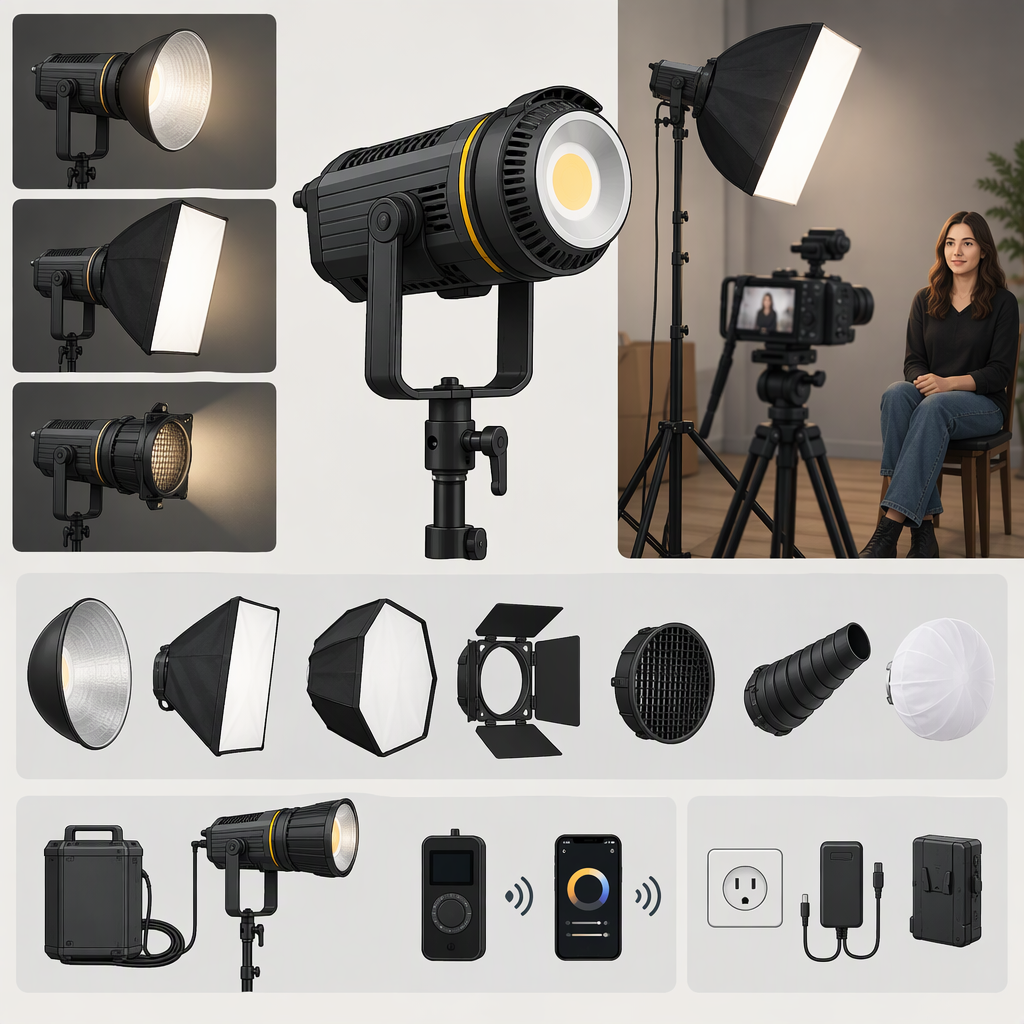
The Godox VL200 is a 200 W daylight LED video light. Godox’s manual for the original VL series lists a Bowens-style accessory mount, AC power or a separately purchased V-mount battery, brightness control from 0–100%, and wireless control options. Those details may suit a filming setup that needs a daylight-balanced source and Bowens-mount modifiers—but whether it is suitable depends on the light needed at your subject, the modifier and distance, and your rig’s power and mounting requirements. Check that your unit is the original VL200, not the distinct VL200 II, and verify kit contents and accessory fit for the exact items you plan to use. (godox.com)
What the Original Vl200’s Specifications Tell You
Godox’s original VL-series instruction manual lists these VL200 specifications:
- Rated power: 200 W.
- Color temperature: 5600 K ±200 K, a daylight-oriented setting rather than a bi-color range.
- Illuminance at 100%: 75,000 lux at 1 m with the supplied reflector; 7,800 lux at 1 m without it.
- Color rendering: CRI approximately 96 and TLCI approximately 95.
- Dimming: 0–100%.
- Operating ambient temperature: −10°C to 40°C.
- Power: AC 100–240 V, 50/60 Hz, or a V-mount battery sold separately.
The illuminance figures are not interchangeable: the manual gives different readings depending on whether the reflector is fitted. They are specified at 1 m and full output, so they do not promise the same light level at your subject after changing distance, adding diffusion, or using another modifier. Treat the figures as documented reference points, not as a substitute for checking your actual lighting arrangement. (godox.com)
The original VL200 uses a separate light head, controller and power adapter. The manual lists their respective weights as 2.23 kg, 1.19 kg and 0.96 kg; account for the parts you will need to place or carry, not just the light head. (godox.com)
Decide Whether It Fits Your Filming Setup
Work through these questions before choosing or rigging the light:
- How much light must reach the subject? Start with the exposure you need, the subject-to-light distance, and whether you plan to use the reflector, a softbox, diffusion or another modifier. The manual’s 75,000-lux figure applies at 1 m with the supplied reflector at full output; it does not describe every modifier or working distance. If the light will be farther away or softened, assess the resulting level at the subject rather than relying on the headline number.
- Does a daylight source suit the scene? The documented 5600 K ±200 K setting is daylight-oriented. If your scene requires a broad adjustable color-temperature range, the original VL200’s listed specification does not establish that capability.
- Can your location supply the required power? The manual documents AC input and separately purchased V-mount battery operation. It does not establish runtime or that every V-mount battery can deliver the required output. Check the battery’s output capability and the exact unit’s instructions before relying on battery power.
- Can your rig support the whole arrangement? Consider the head, modifier, mounting hardware and how the separate controller and adapter will be positioned. The manual describes a U-shaped bracket, but check the exact stand or receiver interface and the load limits of your complete rig rather than assuming a particular stand fitting.
- Do the documented conditions suit the shoot? Godox lists an operating ambient range of −10°C to 40°C and warns that the product is not waterproof. Plan for protection from moisture and do not treat it as a weatherproof fixture. (godox.com)
Illustrative distance check: if a light that gives a certain reading at 1 m is moved to 2 m, the inverse-square relationship predicts about one-quarter the illuminance, assuming the same source, orientation and modifier in an unobstructed setup. This is a general lighting estimate, not a VL200 test result. A modifier, bounce, spill or room surfaces can change the actual reading; measure at the subject when the exposure matters.
Compatibility Checks
Modifiers
The original VL-series manual identifies a Bowens mount and says the supplied reflector is included. That supports checking modifiers made for that mount, but it does not confirm every product marketed as Bowens-compatible will clear the fixture, fit your particular unit or work as intended. Verify the accessory’s mount and any required adapter against the exact VL200 and modifier documentation. The manual also cautions that illuminance varies with accessories. (godox.com)
Mounting and Stands
The manual describes a U-shaped bracket that allows the light to be angled. It does not, in the retrieved specification text, identify a specific stand receiver or provide a complete stand-and-modifier load rating. Confirm the mounting interface, locking method and load rating for the actual support and attachment you plan to use. Do not infer stand compatibility from the Bowens modifier mount: they are separate connections. (godox.com)
Power
The manual lists AC 100–240 V, 50/60 Hz and separately purchased V-mount battery operation. It does not name a universally compatible battery or establish runtime for a particular battery. Confirm the battery’s physical interface and electrical output against the manual and the battery maker’s specifications. Check the exact kit contents too: the manual’s listed accessories are not proof that every seller’s package includes the same items. (godox.com)
Controls
For the original VL series, the manual documents 433 MHz wireless control and Bluetooth control through the GodoxPhoto app; it identifies the RC-A5II remote as an additional purchase. It describes 16 channels and six groups. If you need remote operation, verify that your particular light, remote or phone setup uses the matching control system, and distinguish these original-VL details from the different VL II series documentation. (godox.com)
Decide: Fits, Does Not Fit, or Verify First
- Likely fits the stated need: Your planned light level is achievable at the intended distance with your chosen modifier; a daylight-oriented 5600 K source suits the scene; you have a documented AC or adequately specified V-mount power arrangement; and the modifier and support interfaces are confirmed.
- Does not fit the stated need: You require a documented bi-color range from the original model, the setup needs more light than you can obtain at your working distance and with your modifier, or your location cannot provide a verified power arrangement.
- Verify first: The listing says VL200 II or leaves the version unclear; the modifier or stand uses an adapter; battery output is uncertain; the seller’s kit contents differ from the manual; or the shoot depends on a control method, operating condition or compatibility detail not confirmed for your exact unit.
Before Connecting or Buying an Accessory
Record the exact light model and any version or kit suffix. Then check the manufacturer’s manual and the accessory’s documentation for the specific connection involved: Bowens mount for a modifier, separate mounting interface for the support, power requirements for AC or battery operation, and the stated system for remote or app control. Mark each planned combination as documented direct fit, adapter-dependent, or unverified. If you cannot find a model-specific confirmation, treat it as unverified rather than assuming that shared branding guarantees compatibility.
Sources: Godox, VL150/VL200/VL300 instruction manual; Godox, VL300/VL200/VL150 product and downloads page; Godox, VL II Series product page.