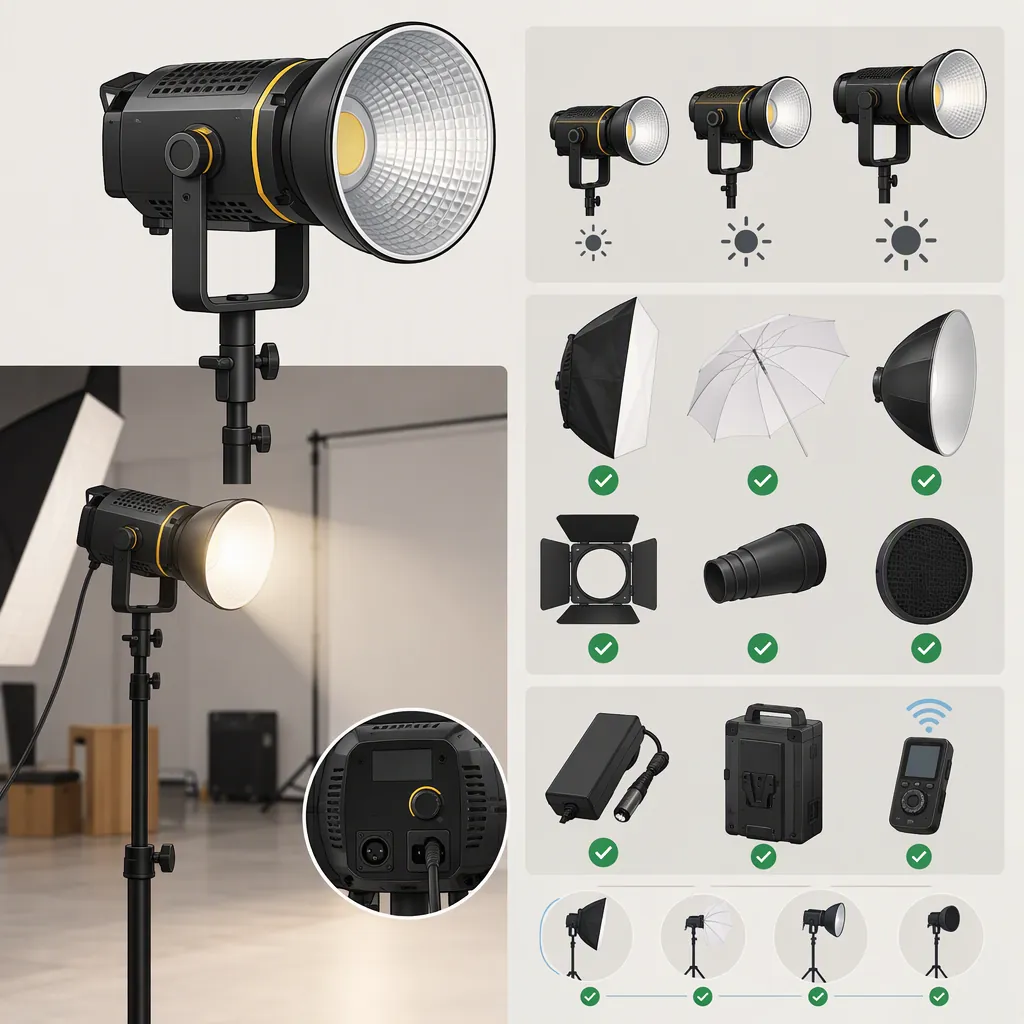
Godox Vl150 Led: Filming Selection and Compatibility Guide
To evaluate the Godox VL150 LED for filming, verify the complete modifier, support, power, and control chain first. Then test the documented configuration at your intended camera settings, working distance, and microphone position.
The available evidence supports a verification workflow, not a definitive compatibility or performance recommendation. Godox’s shared VL300/VL200/VL150 page lists manuals, safety instructions, and optional accessories, but the supplied page text does not establish the specifications needed to confirm suitability for a particular setup. [godox-vl]
What Is Confirmed—And What Remains Open
| Area | What the available evidence establishes | What still needs verification |
|---|---|---|
| Model documentation | Godox lists shared VL300/VL200/VL150 manuals, including a Chinese/English version. [godox-vl] | The instructions and specifications applicable to the VL150 and your unit |
| Safety documentation | “Important Safety Instructions for LED Lights” is listed in the download area. [godox-vl] | Assembly, operating, ventilation, and clearance requirements |
| Optional accessories | QR-P70/P90/P120 parabolic softboxes and CS-50D, CS-65D, and CS-85D appear under optional accessories. [godox-vl] | Exact connector, adapter, accessory variant, and configuration compatibility |
| Mechanical and electrical compatibility | The supplied manufacturer text does not establish mount, support, electrical, battery, or control specifications. [godox-vl] | Requirements for every component in the proposed setup |
| Filming performance | The supplied manufacturer text lacks measurements sufficient to assess exposure, color, brightness variation, or operating noise. [godox-vl] | Results under the intended filming conditions |
The manual contents were not included in the supplied evidence. The Cardinal Camera and Focal Point extracts contain specification headings but no populated technical specifications, so they do not resolve these gaps. [cardinal-listing] [focal-listing]
An optional-accessory listing is a useful lead, not a complete fit specification for every variant.
Find and Check the Applicable Documentation
Use this sequence to turn the available Godox documentation entry point into a compatibility check:
- Identify your equipment. Record the light’s exact model and any revision shown on its label, plus the model numbers of the modifier, adapter, stand, power equipment, and controller.
- Open the Godox VL300/VL200/VL150 product page. Locate Downloads → Product Manual and the listed Chinese/English manual. Also locate the LED-light safety instructions. These entries are present in the supplied page text. [godox-vl]
- Check the document’s applicability. Confirm that it explicitly covers the VL150. In a shared manual, distinguish VL150 entries from those for the VL200 or VL300.
- Locate the relevant fields. Use the document contents or text search to find mounting, power, controls, specifications, and safety information. These are search targets—not verified chapter titles.
- Compare both sides of each connection. Check the light documentation against the exact accessory documentation using the fields below.
- Record the evidence. Save the document title, applicable model, page or section, and any restrictions. If the documents do not resolve a question, mark it unconfirmed.
Do not substitute specifications for a related model when the VL150 entry is missing.
Fields to Compare
| Compatibility question | Fields to locate and compare |
|---|---|
| Will the modifier attach? | Light mount designation; modifier connector or speed-ring designation; required adapter model; explicit fit restrictions |
| Can the support carry the setup? | Light attachment interface; stand attachment; complete supported load, including accessories; documented load limits and setup restrictions |
| Is the power arrangement approved? | Light or controller input requirements; supply output requirements; connector specification; any documented polarity requirement; explicitly supported battery and intermediate equipment |
| Will the remote or app work? | Exact controller or app name; supported light models; protocol or pairing requirements; any firmware or version restrictions |
| Can it operate in this space? | Ventilation and clearance instructions; modifier restrictions; cable routing and operating conditions |
A matching connector or apparent mechanical fit is not enough to establish the full configuration. Resolve relevant electrical and mechanical questions before assembly or powered testing.
Define What Your Filming Light Must Do
Before testing, write down the shot, subject distance, modifier, framing, camera settings, and location constraints. Decide what would count as a failure rather than recording only “looks acceptable.”
The following are proposed evaluation criteria, not VL150 performance claims.
| Requirement | Record before testing | Observable failure to check |
|---|---|---|
| Exposure | Target exposure, ISO, aperture, shutter setting, and working distance | The intended subject exposure cannot be reached within your planned settings |
| Color | Fixed white balance, other scene lights, and the subject or reference used for comparison | A color appearance or mismatch that makes the intended shot unusable |
| Image behavior | Frame rate, shutter setting, and intended dimming settings | Visible bands, pulsing, or other unwanted brightness variation |
| Sound | Microphone position, recording gain, and intended dialogue conditions | Additional operating sound that interferes with the planned recording |
| Space | Light and stand placement, frame boundaries, movement paths, and required clearances | Equipment enters the frame, obstructs movement, or cannot maintain documented clearances |
Keep these criteria specific to the intended shot. A result suitable for one scene may not meet another scene’s requirements.
Compatibility and Suitability Worksheet
Keep documentation status separate from filming results.
| Field | Your record |
|---|---|
| VL150 model and revision, if identified | ______ |
| Modifier model and connector or speed ring | ______ |
| Required adapter and supporting documentation | ______ |
| Stand model, attachment, and documented load limit | ______ |
| Complete supported load | ______ |
| Power supply or battery and intermediate equipment | ______ |
| Documented electrical and connector requirements | ______ |
| Controller or app and supported version | ______ |
| Ventilation and clearance requirements | ______ |
| Document titles and page or section locations | ______ |
| Unresolved compatibility questions | ______ |
| Filming requirements and failure conditions | ______ |
| Camera settings, placement, and clip identifiers | ______ |
| Test observations and unresolved filming questions | ______ |
| Compatibility status | Confirmed / Unconfirmed / Incompatibility identified |
| Filming suitability | Meets requirements / Does not meet requirements / Not yet tested |
A documented compatible configuration may still fail the shot’s requirements. An unconfirmed configuration is not automatically proven incompatible.
Run a Repeatable Camera and Sound Test
Proceed only after relevant compatibility and safe-setup requirements are resolved. This procedure is not a report of VL150 test results.
- Assemble according to the manuals. Follow documented requirements for support, power, modifiers, ventilation, and clearance.
- Lock the camera settings. Use the intended frame rate, shutter setting, ISO, aperture, and white balance. Avoid automatic changes during comparison clips.
- Reproduce the planned placement. Record the modifier, light position, and light-to-subject distance. Keep the subject and framing consistent.
- Capture the intended dimming settings. Save a separate, labeled clip for each setting. Include the camera settings, distance, and dimming setting in the test log.
- Review the image against your criteria. Check exposure, color appearance, brightness variation, reflections, and shadows. Note the clip and time location of any problem rather than relying on memory.
- Record an audio comparison. Keep microphone position and recording gain unchanged. Record the environment with the light off and then with it operating. Note other changing room sounds that could affect the comparison.
- Check the working space. Confirm framing, movement paths, cable placement, and documented clearances.
- Save the outcome. Mark each requirement as met, not met, or unresolved, with the corresponding clip or recording.
When comparing alternative lights, keep settings, placement, and modifier configuration consistent where practical. Record any unavoidable differences.
A successful test supports a decision for the tested configuration; it does not establish performance at every frame rate, shutter setting, dimming level, or accessory combination.
Make the Selection Decision
Use the worksheet to distinguish three outcomes:
- Compatibility confirmed and filming requirements met: The documented, tested configuration meets your stated needs.
- Compatibility confirmed but filming requirements not met: The components may work together without being suitable for the intended shot.
- Compatibility or test results unresolved: Keep the selection provisional and identify the missing document entry or test.
This keeps “fits together” separate from “meets the shot’s needs.”
FAQ
Will My Existing Softbox Fit the Godox Vl150?
That cannot be confirmed from the available evidence alone. Godox lists optional softboxes and accessories, but the supplied text does not establish the mounting details for your exact softbox. Compare the VL150 mount designation with the modifier’s connector or speed ring, then verify any required adapter and restrictions. [godox-vl]
Can the Godox Vl150 Use My Battery or Power Supply?
Battery and power-supply compatibility remains unverified here because the supplied manufacturer text does not specify the relevant requirements. Locate the VL150’s applicable power instructions, then compare the approved arrangement, input and output requirements, connectors, and any intermediate equipment. Do not rely on connector fit alone. [godox-vl]
Does the Godox Vl150 Work with My Remote or App?
The available manufacturer text does not establish VL150 control protocols or supported remote and app combinations. Find documentation explicitly naming both the VL150 and your controller or app, and check any pairing, firmware, or version restrictions. [godox-vl]
Is the Godox Vl150 Suitable as My Main Filming Light?
The available performance evidence is insufficient for a definitive recommendation. [godox-vl] Confirm the complete setup’s compatibility, then test exposure, image behavior, sound, and placement at your intended settings. Treat the result as configuration-specific, not a general verdict on every VL150 filming setup.
Sources
-
[godox-vl] VL300/VL200/VL150-Product-GODOX Photo Equipment Co.,Ltd.
-
[cardinal-listing] Camera Products & Accessories | Cardinal Camera
-
[focal-listing] Shop Product | Focal Point