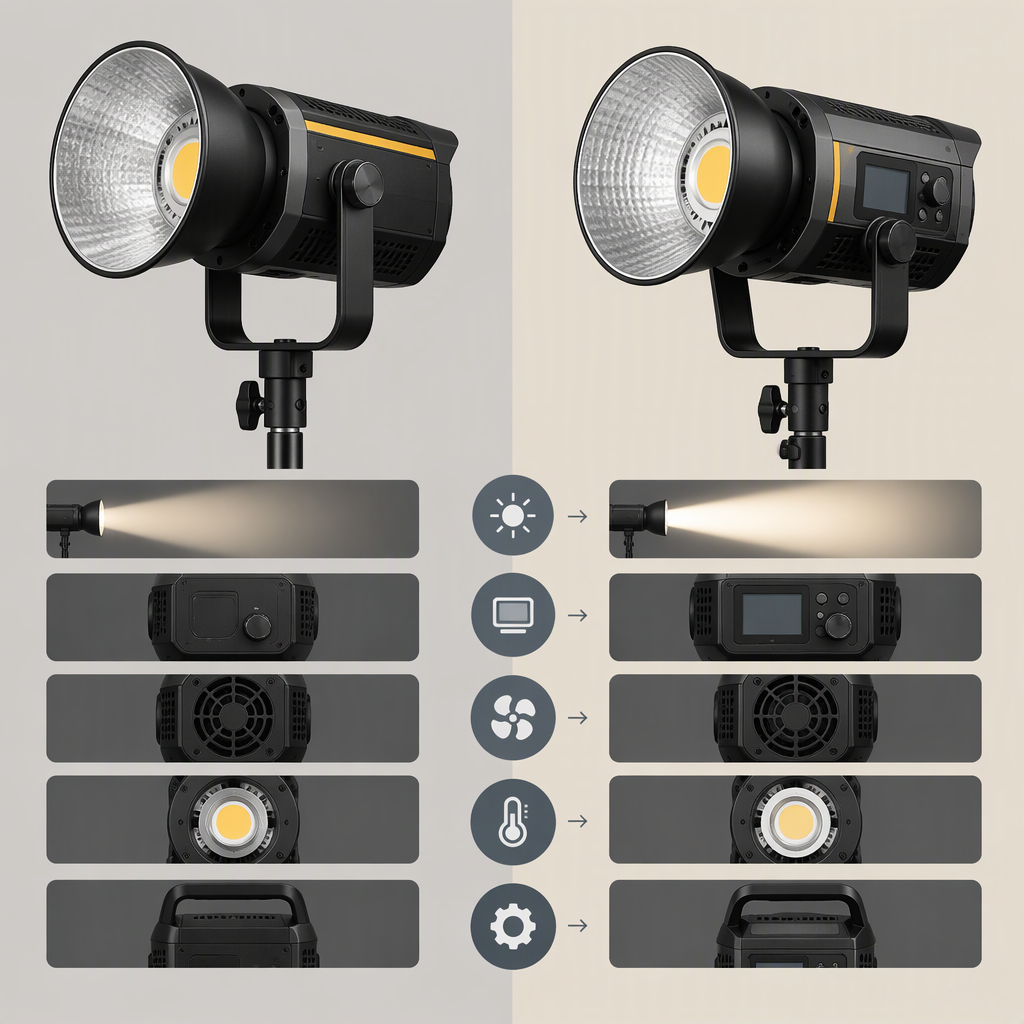
Godox Vl150 Ii vs Vl150: What Actually Changes?
Short Answer
The Godox VL150II is the officially named second-generation model; Godox’s manual identifies the VL150II and the earlier VL150 separately. Choose the VL150II if its built-in FX effects or newer 2.4 GHz wireless-control option matter to your workflow. The original VL150 may still suit a setup that needs its documented 150 W daylight output and whose control needs are already met by its 433 MHz remote system and Bluetooth app control. The available manufacturer documents do not establish that the II is brighter or universally better, so don’t choose on generation number alone. (godox.com)
Confirm the Model Names
“Godox VL150 II” is commonly written without a space as VL150II. Godox’s product materials call the generation the VLII Series and list the VL150II among its models; its earlier manual lists VL150 as a separate model. That makes the original VL150 the relevant comparison—not the UL150II, ML-150II, or another Godox light with a similar name. (godox.com)
What the Documents Confirm
| Decision point | VL150 | VL150II | Why it may matter |
|---|---|---|---|
| Power class | Godox lists 150 W. | The II manual identifies the model as VL150II, but the material retrieved here does not establish a directly comparable output advantage over the original. | Don’t assume the II is brighter based on “II” or on retailer wattage labels. Compare measurements taken with the same reflector, distance, and method if output is decisive. |
| Built-in effects | The original manual does not list the II’s eight built-in FX effects among its stated features. | Godox lists eight customizable light effects. | The II is the clearer fit if you expect to use its built-in flash, storm, broken-bulb, or TV-style effects; these are effects, not a substitute for a lighting cue or test in a specific scene. (godox.com) |
| Wireless control | The original manual documents 433 MHz wireless control and Bluetooth app control. | The II manual documents 2.4 GHz wireless control and Bluetooth app control. | If coordinating with an existing remote or lights, check the actual frequency and model compatibility. Similar wording such as “wireless” does not establish that remote-control accessories work across generations. (godox.com) |
| Basic setup | The original manual documents V-mount battery or DC power, a Bowens mount, and a separated light body, controller, and adapter. | Godox’s II manual also documents V-mount or DC power, a standard Bowens mount, and separate light body, controller, and adapter. | The basic mounting and power arrangement is not, by itself, a reason to assume you must move to the II. Confirm a specific battery, adapter, or modifier against its own compatibility information. (godox.com) |
These are documented feature differences, not a controlled performance comparison. The original VL150 manual gives 150 W and 5600 ± 200 K; the II manual’s general description confirms the series and functions but the retrieved text does not provide a like-for-like output test. Treat claims about greater brightness, color accuracy, cooling, or value as unconfirmed unless you have comparable evidence for the exact models. (godox.com)
Choose for Your Filming Setup
- Pick the VL150II if you will use its built-in FX effects, or if its documented 2.4 GHz wireless option better fits your control plan. Check the exact remote, app, and light compatibility before relying on a multi-light setup. (godox.com)
- Consider the original VL150 if its documented controls meet your needs and you do not need the II’s listed FX effects. The original manual already documents Bluetooth app control, so Bluetooth alone is not a verified reason to upgrade. (godox.com)
- If output is the deciding factor, compare test figures only when measurement conditions match. Godox’s original manual states that illuminance can vary with accessories; a figure measured with a reflector should not be compared directly with a bare-lamp figure. (godox.com)
- If you already own accessories, check the exact mount, battery, cable, and remote model. Both manuals identify Bowens mounting and V-mount/DC power, but that does not confirm every modifier, battery, or remote will work with every package or revision. (godox.com)
Before Settling on a Model
- Confirm the light body is marked VL150 or VL150II; don’t rely only on a shortened listing title.
- Match the wireless-control requirement to the exact remote or app setup you plan to use. The manuals document different radio systems for the two generations; cross-generation remote compatibility is not established here. (godox.com)
- Confirm whether your intended battery and power arrangement are included or optional in the specific package you are considering. Godox’s manuals describe V-mount use, but package contents should be checked against the exact listing and region.
- Check the modifier’s mount and any physical or load limits against its own documentation; a shared Bowens-mount label is not a guarantee that every accessory is suitable.
Bottom line: The defensible reason to select the VL150II is its documented FX effects and updated wireless-control system—not an assumed brightness or universal performance improvement. If those differences do not solve a real need in your setup, the original VL150’s documented core setup may be sufficient.