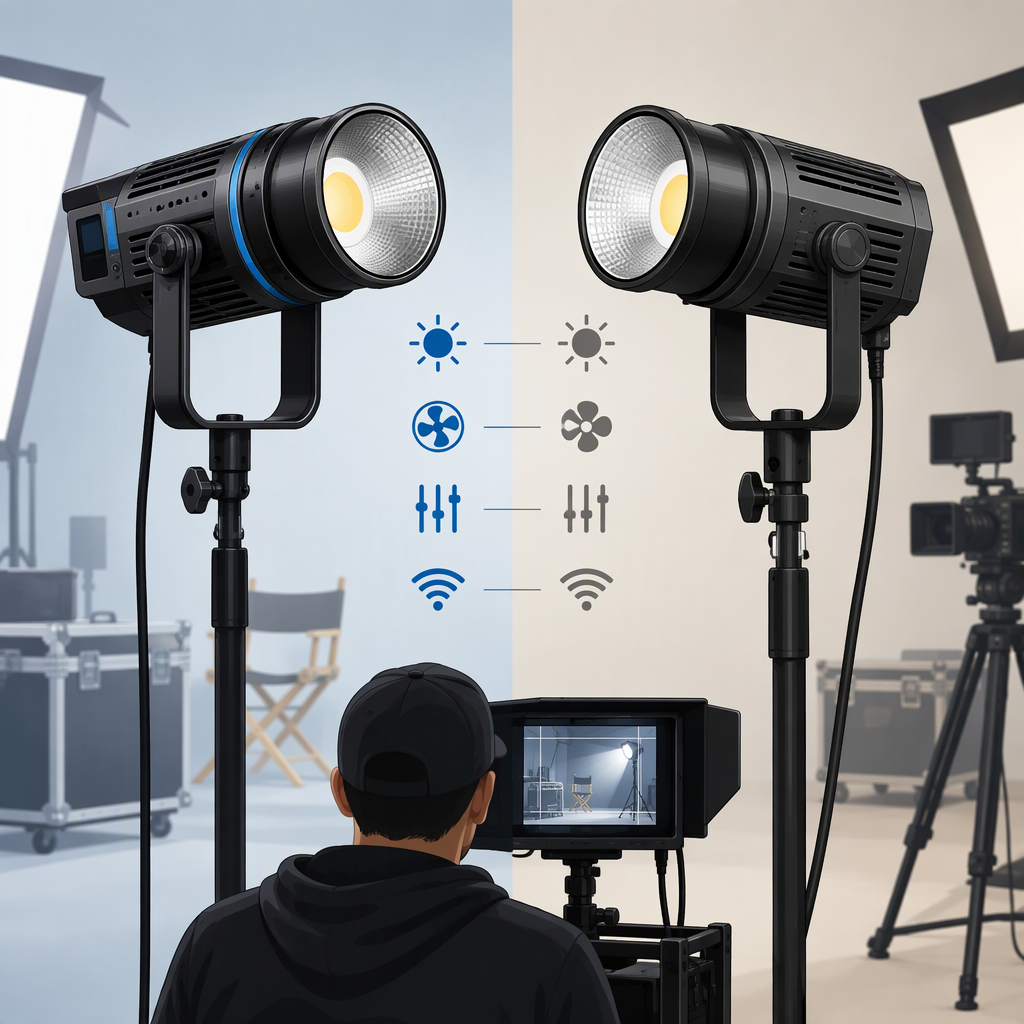
Godox Ul150 Ii Vs. Ul150: Which Generation Fits Your Filming Setup?
Short answer: Consider the Godox UL150 II if you want the newer control system, built-in lighting effects, DMX control, and a dual V-mount battery setup. The original UL150 may be enough if you need a fixed-daylight, fanless light and do not need those added controls. If you need adjustable white color temperature, compare the UL150IIBi too: it is a separate bi-color model, not another name for the daylight UL150II. Godox’s published specifications list the UL150II at 5600K and the UL150IIBi at 2800–6500K. (godox.com)
That is a feature-based choice, not a claim that the UL150II produces better-looking light or is brighter in real filming conditions. The product documents give specifications, but the evidence cited here does not provide a controlled, independent, like-for-like performance test of the two generations.
What Is the Godox Ul150 Ii?
The Godox UL150II is a fanless, daylight-balanced LED video light with a separate light head and controller. Godox specifies a fixed 5600K color temperature, CRI of at least 96, TLCI of at least 97, four dimming curves, 12 FX effects, and control through the unit, DMX512, 2.4G wireless, and Bluetooth. Its listed maximum power is 160W. It accepts AC power and can use optional V-mount batteries. (godox.com)
Check the model name carefully when shopping or comparing manuals:
- UL150II: daylight model, specified at 5600K.
- UL150IIBi: separate bi-color model, specified for 2800–6500K.
- UL150: original-generation daylight model.
The “II” identifies the later generation; “Bi” identifies the bi-color version. Do not assume a listing for “UL150 II” means the bi-color fixture. (godox.com)
What Changed from the Original Ul150?
Godox describes the UL150II generation as retaining the fanless design while adding an upgraded control box, DMX control, FX effects, and a bi-color option to the product family. The following comparison sticks to features specified in Godox’s product information and manuals. (godox.com)
| Decision point | Original UL150 | UL150II daylight | Why it may matter |
|---|---|---|---|
| Color temperature | Fixed 5600K, with ±200K tolerance listed in its manual | Fixed 5600K | Neither daylight model offers adjustable white color temperature. If you need to match different ambient sources without gels, consider whether the UL150IIBi’s 2800–6500K range is more relevant. (cn.godox.com) |
| Cooling | Fanless | Fanless | The original already addresses fan noise. Silence alone is not a documented reason to prefer the II over the original. Godox describes both generations as fanless. (cn.godox.com) |
| Control and effects | Manual brightness control and Bluetooth app control are listed; 0–100% dimming | DMX512, 2.4G wireless, Bluetooth, controller operation, four dimming curves, and 12 FX effects are listed | The II is more relevant if your workflow actually uses DMX, the additional control options, or built-in effects. (cn.godox.com) |
| Battery arrangement | Manual specifies an optional V-mount battery; the system includes a separate adapter and controller | Product specifications list V-mount battery support; Godox describes an upgraded control box and versatile power supply system | For battery shoots, confirm the exact controller, battery plates, batteries, cables, and included items in the specific package. A model name alone does not establish what a seller includes. (cn.godox.com) |
| Light shaping mount | Bowens mount, according to the manual | Bowens mount, according to Godox | Existing Bowens-mount modifiers are a promising compatibility match, but verify clearance and practical fit for a particular modifier rather than assuming every accessory will work equally well. (cn.godox.com) |
| Published power and color-rendering figures | 150W; CRI 96; TLCI 97 | Maximum power 160W; CRI ≥96; TLCI ≥97 | These are manufacturer specifications, not proof of a visible improvement. They do not establish a like-for-like brightness advantage under the same reflector, distance, and measurement method. (cn.godox.com) |
Do Not Infer a Brightness Upgrade from the Wattage Figures
The original manual lists 58,000 lux at one meter, while Godox’s UL150II product page lists the model’s electrical maximum power but does not give a directly comparable lux result in the cited specification text. The original manual also cautions that accessories can affect its listed light value. Without comparable test conditions—including reflector, distance, and measurement method—these documents do not establish that the II is brighter. (cn.godox.com)
Likewise, Godox’s CRI and TLCI figures are manufacturer ratings. They may help screen specifications, but they are not a substitute for an independent test or your own camera-and-workflow evaluation when color consistency is critical.
Which Model Fits a Filming Setup?
Choose the Ul150ii If Its Added Workflow Features Solve a Real Need
The UL150II is the more fitting choice between these two if you need DMX integration, built-in FX, the listed dimming-curve options, or the newer controller and dual-battery arrangement. These features are most relevant when the light must integrate with a larger lighting setup, be controlled remotely, or run from batteries. Check the precise package and power configuration before deciding; batteries are optional, not established as included. (godox.com)
Example: A small interview setup in a room with consistent daylight-balanced fixtures may not use FX or DMX. A multi-light set controlled through DMX, or a shoot that benefits from battery operation, may make the UL150II’s documented control and power features more useful. This is a workflow-based comparison, not a test result.
Choose the Original Ul150 If the Added Features Do Not Affect Your Work
If your setup calls for a fixed 5600K source, fanless operation, and basic dimming—and you do not need the II’s documented added control features—the original UL150 may meet the stated requirements. Whether it is the better purchase depends on the condition, package, and price of the actual unit; this guide does not establish current prices or availability.
Consider the Ul150iibi If Adjustable White Color Temperature Is the Deciding Factor
The daylight UL150II remains at 5600K. Godox lists the separate UL150IIBi as bi-color, with a 2800–6500K range. If you regularly need to move between warmer and cooler white light, compare that model rather than expecting the daylight UL150II—or original UL150—to adjust color temperature. (godox.com)
Consider Neither Until You Verify the Setup If a Critical Requirement Is Unresolved
Pause before choosing either daylight model if your decision depends on a specific output level, battery runtime, a particular modifier, or a required control connection that the available documentation does not settle for your exact configuration. Check the relevant manual and package contents, or seek a comparable test with stated conditions. The cited documents do not establish battery runtime or prove compatibility with every accessory.
Bottom Line
- UL150II: choose it when its documented control, effects, or power-system features matter to your workflow.
- Original UL150: consider it when fixed 5600K output, fanless operation, and basic dimming are sufficient and the individual unit’s price and condition make sense.
- UL150IIBi: compare this separate model if adjustable white color temperature is important.
- Neither yet: hold off if output, runtime, package contents, or a specific compatibility requirement is decisive but unverified.
The verified distinction is mainly about control and workflow options—not a demonstrated across-the-board improvement in brightness, color quality, or filming results.