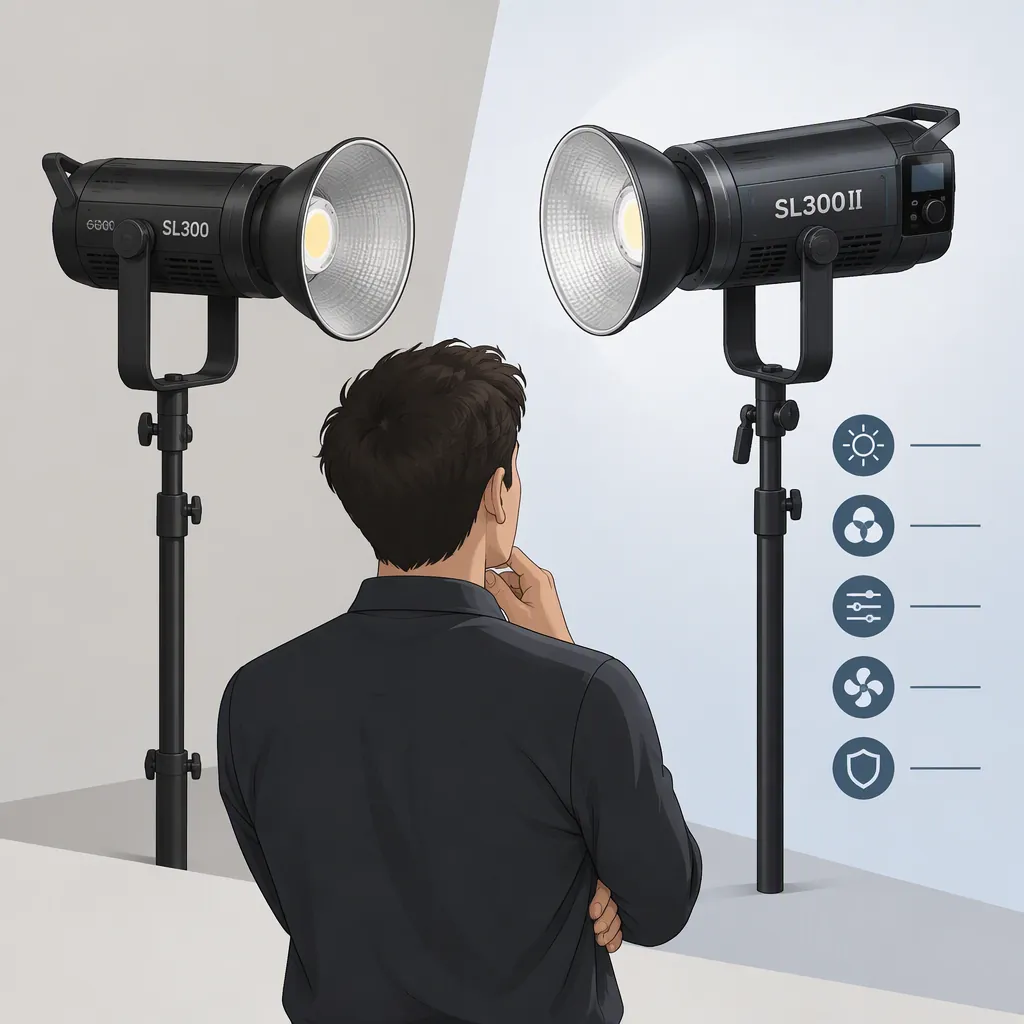
Godox Sl300ii: How to Choose Between Second-Generation Variants
For a search such as “godox sl 300 ii,” first distinguish the SL300II from the SL300II Bi. CineD’s June 2022 announcement describes the former as daylight-only and the latter as adjustable from 2800K to 6500K. Use that distinction to narrow the choice: evaluate the daylight model for a fixed-daylight workflow and the Bi model when adjustable color temperature is required. These are reported specifications, not independently verified performance results or proof of improvements over an earlier generation. [c1]
Identify the Variant Before Comparing Generations
The supplied sources distinguish SL300II and SL300II Bi as separate variants. CineD describes the Bi version as a later bi-color addition to the daylight-only SL300II, rather than as a replacement generation. EssentialPhoto also separates the daylight-balanced and bi-color versions in its comparison. [c1] [c2]
For model identification, record the complete designation, including II and Bi, wherever they appear. Treat a shortened listing title as something to verify, not as sufficient evidence of the exact fixture.
The references do not provide a documented first-generation-versus-second-generation comparison. Consequently, this guide does not establish that the second generation is brighter, quieter, more reliable, or otherwise better than an earlier model.
Model Identity Checklist
- Record the complete model name from the fixture label.
- Check whether the designation includes Bi.
- Match that designation to the accompanying manual.
- Keep specifications for different variants in separate notes.
- Mark any unresolved model identity as unverified.
Separate Color Flexibility from Reported Output
CineD reports a 2800K–6500K adjustment range for the SL300II Bi. EssentialPhoto lists the daylight SL300II at 5600K ±200K. These reported differences make color-temperature requirements a useful starting point for selection. [c1] [c2]
Output figures need more caution. CineD reports 44,900 lux at 3200K and 49,900 lux at 5600K for the Bi version, measured at one meter with the included reflector. It also reports a higher figure for the daylight model. These are figures presented in a release announcement, not results from a comparative test performed for this article. [c1]
Do not translate a headline lux value into a guaranteed exposure with a softbox, diffusion, or another modifier. For a practical comparison, use the same subject distance, modifier, camera settings, and measurement position. If adjustable color temperature is essential, evaluate the Bi variant first; if it is not, compare both against the actual exposure requirement rather than assuming either is automatically preferable.
Check Audio, Control, and Power Requirements
CineD reports shared features including a Bowens mount, 0–100% dimming, and control through an optional RC-A6 remote. It also reports that switching the fan off reduces output to 20%, and that neither variant supports DMX, smartphone-app control, or battery power. These statements describe the models covered by the 2022 announcement; confirm them against the documentation for the exact unit under consideration. [c1]
For dialogue recording, assess usable exposure and recorded noise together. A fan-off setting is not enough to establish that a fixture will meet both requirements in a particular setup.
For control and installation, list the requirements before evaluating the model: accessible onboard controls, remote adjustment, mains availability, modifier fit, and documented support requirements. Do not assume that features from another Godox light apply to the SL300II.
Setup Evaluation Worksheet
Exact model: record the full designation.
Color requirement: fixed daylight or adjustable temperature.
Exposure check: record distance, modifier, camera settings, and dimming level.
Audio check: record microphone position, fan setting, and the resulting sound sample.
Control requirement: record the required interface and documented support.
Power and support: verify the exact unit’s electrical and mounting requirements.
Unresolved items: retain each as unverified until documentation or a controlled test resolves it.
Keep the Evidence Limits Visible
The main evidence here is CineD’s June 27, 2022 release announcement, supplemented by EssentialPhoto’s August 8, 2022 comparison. Neither establishes current availability, current pricing, or performance of a particular unit. [c1] [c2]
The EssentialPhoto comparison switches between Nanlite FS300 and Forza 300 references, and some narrative details differ from its table. Its numerical comparisons should therefore not be treated as a clean, controlled comparison. [c2]
The defensible conclusion is narrower than a generational ranking: identify the exact variant, match its documented capabilities to the workflow, and leave unsupported upgrade claims unresolved.
FAQ
Is the Godox Sl300ii the Same as the Sl300ii Bi?
No. CineD distinguishes the daylight-only SL300II from the SL300II Bi, which it reports as adjustable from 2800K to 6500K. Verify the complete designation rather than relying on a shortened listing title. [c1]
Does Fan-Off Operation Preserve Full Output?
Not according to CineD’s 2022 announcement: it reports that turning the fan off reduces output to 20% on both variants. Confirm the exact unit’s documentation and evaluate exposure in the intended audio setup. [c1]
Do These Sources Prove That Generation Two Is a Better Upgrade?
No. The supplied articles address the SL300II variants and comparisons with other lights, not a documented comparison against an earlier Godox generation. They do not establish a generational performance advantage. [c1] [c2]