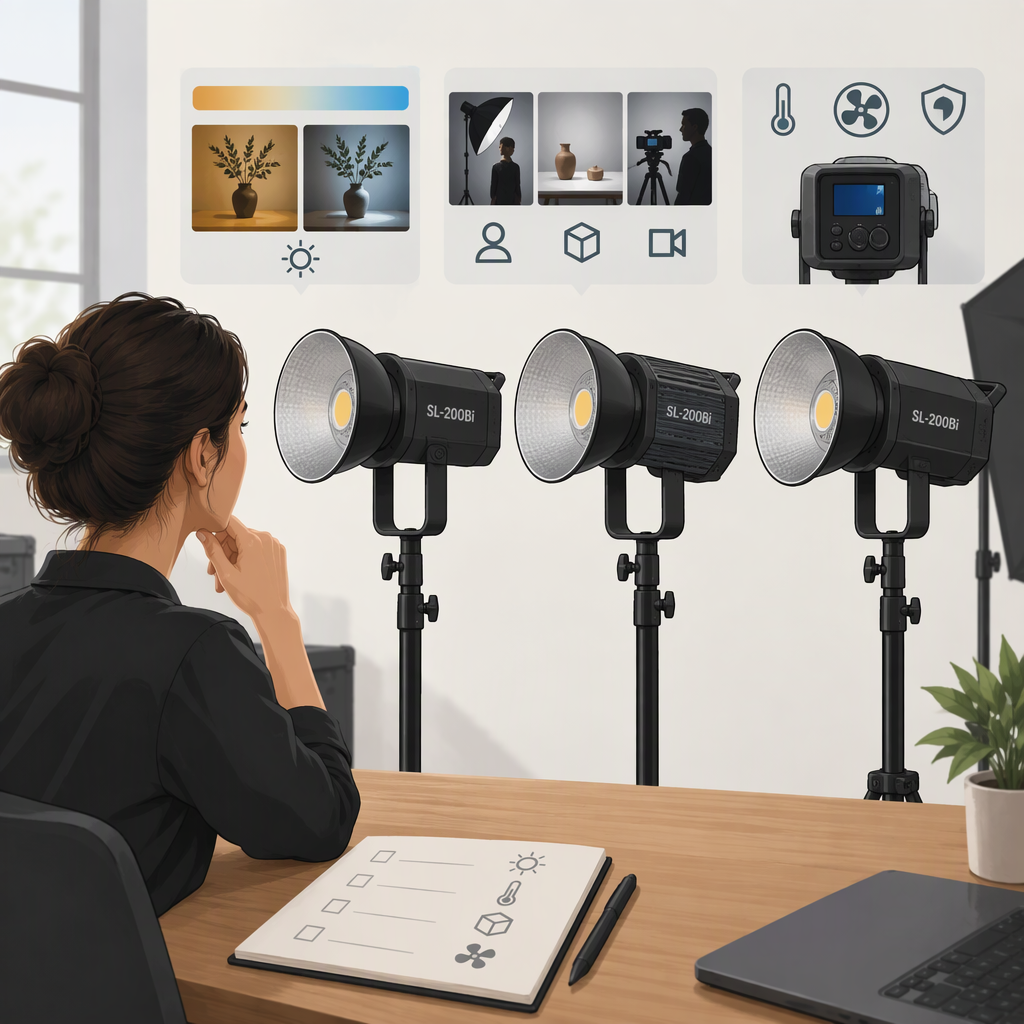
Godox Sl-200bi: How to Choose the Right Bicolor Model
Direct Answer: Choose Bicolor When Your Lighting Conditions Change
A bicolor light is useful if you expect to match different ambient color temperatures—for example, moving between a daylight-lit room and a warm-lit interior, or adapting one setup for different locations. If your shooting environment and color target stay consistent, a daylight-only light may be enough; adjustable color temperature may not justify a trade-off for your workflow.
For the model commonly meant by “Godox SL-200Bi,” Godox’s official SLIII page lists the SL200IIIBi. Its manual specifies an adjustable 2800K–6500K color-temperature range. Match the full model name and generation on the product label or listing before relying on that specification: “SL-200Bi” alone does not identify the exact version. (godox.com)
Identify the Exact Model Before Comparing
Godox’s official SLIII series page lists SL200III and SL200IIIBi as separate models. The bicolor manual names the product SL200IIIBi; it also describes 0%–100% brightness adjustment, nine FX effects, 2.4GHz and Bluetooth-app control, and a standard Bowens mount. These are manufacturer-stated specifications for the SL200IIIBi—not proof that a listing with a shortened or different model name has the same features. (godox.com)
When checking a listing, look for the entire model code, including the generation and the Bi suffix. Don’t transfer specifications from the SL200III, SL200II, or a similarly named model unless the documentation identifies that exact version.
Bicolor Versus Daylight-Only: A Practical Decision Rule
| Your situation | A sensible starting point |
|---|---|
| You often move between locations or mix the light with warm and cool ambient sources | Consider bicolor. Adjusting color temperature can make matching easier. The SL200IIIBi’s documented range is 2800K–6500K. (godox.com) |
| You work in a consistent setup with a known color target | A daylight-only light may be sufficient if its fixed output suits that setup. |
| You need a particular brightness after adding diffusion, increasing distance, or lighting a larger area | Compare measured output under relevant conditions. The specifications cited here do not establish a like-for-like output advantage for either SL200III version. |
Illustrative example: A creator filming in a room with warm practical lamps may want to shift a bicolor key light warmer to better match the scene. In a studio that always uses the same daylight-balanced setup, that adjustment may be less valuable. This is general selection guidance, not a claim about a tested setup.
Don’t treat a wattage label alone as a brightness comparison. If output is central to your decision, compare manufacturer figures for the exact models using the same unit, reflector or modifier, distance, and measurement conditions. If those conditions are not documented, treat the figures as non-comparable.
A Short Checklist Before Choosing
- Confirm the full model name. Make sure the product is the SL200IIIBi if you intend to use its documented bicolor range; don’t rely on a shortened search phrase.
- Check the color range against your use. The SL200IIIBi manual gives 2800K–6500K. Decide whether that range covers the ambient sources and looks you need. (godox.com)
- Check brightness for your actual setup. Look for output data for the exact model and note the measurement conditions. Consider the distance and light-shaping accessories you expect to use. A claimed output number without those details may not answer whether the light is bright enough for you.
- Verify setup requirements only if they matter to you. The SL200IIIBi manual specifies a standard Bowens mount and 2.4GHz/Bluetooth-app control. If your workflow depends on a specific modifier or control method, confirm that your exact accessory or device is compatible rather than assuming it. (godox.com)
- Check the exact listing for what is included. Package contents can depend on the particular listing; don’t assume a modifier, stand, remote, or other item is included unless that listing says so.
Bottom Line
Choose bicolor when adjusting color temperature would solve a recurring problem in your locations or mixed-light setups. Consider a daylight-only model when your lighting conditions are consistent and fixed output meets your needs. If you mean the Godox SL200IIIBi, its official manual specifies 2800K–6500K; confirm that full model name and compare output only when the measurement conditions are clear. (godox.com)