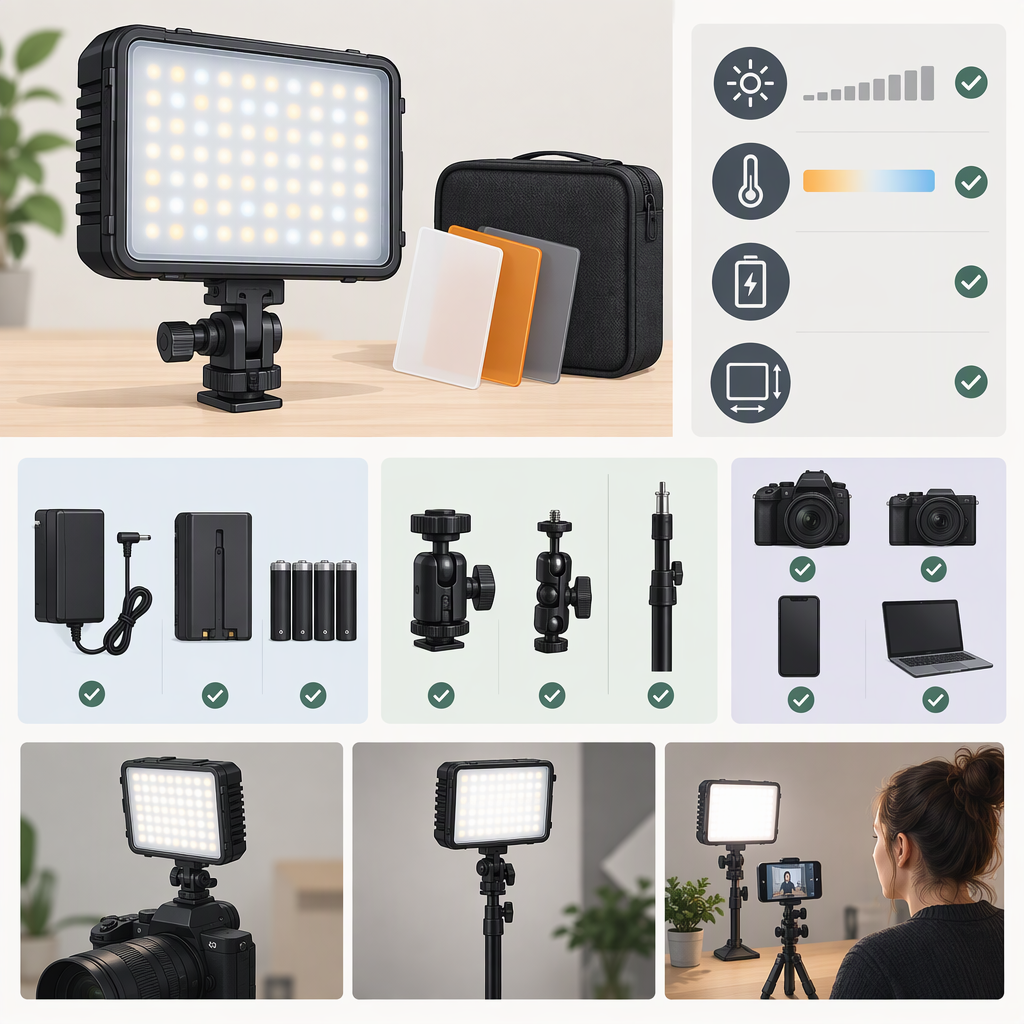
Godox Led64 Video Light: Selection and Compatibility Guide
Short Answer
The Godox LED64 is a small, continuous LED video light. Godox’s manual lists 64 LEDs, stepless brightness control, a color-temperature specification of 5500–6500K, and an illuminance rating of 1000 lux at 0.5 m. It can run on four AA batteries or a 5V DC supply. The manual describes a camera hotshoe connection and a 1/4-inch bracket-mounting hole. Those details can help you assess a close-positioned fill or product-lighting setup, but they do not establish that the light will be bright enough, cover your shot, or render color accurately enough for your particular work. Compare the exact unit and your setup against the checks below before relying on it. (godoxdl.oss-cn-shenzhen.aliyuncs.com)
Identify the Exact Unit First
Godox publishes an LED64 manual and lists it within a product family that also includes LED36, LED126, and LED170. Match the label on the light you are considering to LED64 and use the LED64 manual—not specifications for a similarly named light. The documentation retrieved here does not establish revision differences or confirm that every unit sold under this name has identical specifications. If the unit’s label, packaging, or controls differ from the manual, treat the difference as unresolved until you can match it to documentation for that unit. (godox.com)
The manual describes the LED64 for macro photography, product shooting, and video recording. That is the manufacturer’s stated positioning, not a guarantee of suitability for any particular distance, subject size, or lighting condition. (godox.com)
Check Mounting and Power Compatibility
Mounting
The manual describes sliding the light’s camera hotshoe connection into a camera or camcorder hotshoe and tightening its locking ring. It also identifies a 1/4-inch bracket-mounting hole and suggests using a connecting bracket when a camcorder has no hotshoe. (godox.com)
Before mounting it, check the actual support—not just the camera brand:
- Camera or cage: Does the light’s shoe physically slide into the available shoe and lock securely without interfering with other accessories?
- Stand or bracket: Does your support have the matching connection for the light’s 1/4-inch mounting hole? Check the screw and clearance on the actual parts.
- Load and placement: Can the support hold the light securely in the position you need, without blocking the lens, screen, microphone, or controls?
The manual describes a physical mounting connection; it does not establish electronic communication with a camera. Do not treat a matching shoe shape as proof of any electrical camera function. Likewise, do not assume compatibility based on Canon, Sony, Nikon, or another camera brand alone.
Power
The manual specifies four AA batteries or a 5V DC supply through the light’s DC power jack; it says a 5V charger is purchased separately. It does not identify the jack’s dimensions or polarity in the retrieved documentation. Before using an adapter, confirm that its plug and polarity match the exact unit, as well as the documented voltage. Do not assume that any 5V cable or charger will fit. (godox.com)
The manual’s technical data lists maximum power below 4.5W. It does not establish battery runtime, so plan around having spare batteries or a verified suitable supply if you need a long session. (godoxdl.oss-cn-shenzhen.aliyuncs.com)
The manual does not establish what accessories are included with a particular sale. Check the actual package contents separately; do not assume batteries, a charger, a bracket, or a stand are included. (godox.com)
Match the Documented Light Specifications to Your Shot
| Manual specification | What it helps you assess | What it does not tell you |
|---|---|---|
| 1000 lux at 0.5 m | A reference illuminance at the stated distance | Output at another distance or with a different measurement setup; whether it is enough for your exposure or subject |
| 5500–6500K | The stated color-temperature range | Color-rendering quality, a CRI/TLCI value, or whether the temperature is adjustable by the user |
| 64 LEDs and stepless brightness control | The light source and a way to adjust brightness | Beam angle, coverage, softness, flicker behavior, or output at each dimmer setting |
| Four AA batteries or 5V DC; maximum power below 4.5W | The documented power options and maximum-power figure | Runtime on a particular battery set or compatibility with an unspecified adapter |
These figures come from Godox’s LED64 instruction manual. Preserve the stated distance and units when comparing them; the manual excerpt does not provide enough measurement detail to establish how the result will translate to every scene. (godoxdl.oss-cn-shenzhen.aliyuncs.com)
Use your actual setup to make the decision:
- Distance and exposure: Compare the 1000-lux-at-0.5-m figure only with a need measured under comparable conditions. If your subject will be farther away, the manual’s one distance point does not establish the illuminance there. Measure the light at your working distance or test it in the camera exposure you plan to use.
- Coverage: Frame the shot and check whether the illuminated area covers the subject. The cited manual information does not specify beam angle or coverage, so do not infer those from the LED count or the light’s dimensions.
- Color: The manual lists 5500–6500K, but does not provide a CRI/TLCI figure in the retrieved technical data. If color-critical results matter, ask for a reliable measurement for the exact unit or test it against your workflow; the color-temperature range alone cannot answer that question. (godoxdl.oss-cn-shenzhen.aliyuncs.com)
- Placement and control: The manual identifies brightness adjustment and describes linking multiple lights. That does not establish how a particular arrangement will look, so check shadows, reflections, and available mounting positions in the intended shot. (godox.com)
- Environment: Godox’s manual says the light is not waterproof and lists an operating temperature range of −10°C to 40°C. Do not plan to use it in rain or damp conditions based on its portable form factor. (godox.com)
Example: Close Product Shot Versus a Wider Scene
Suppose you want a small tabletop subject lit from 0.5 m. The manual’s 1000-lux-at-0.5-m figure gives you a relevant reference point, but you still need to test whether the resulting exposure and coverage meet your requirements. For a wider scene or a subject farther away, the same figure does not establish adequate light: the documentation retrieved here gives neither output at that distance nor beam coverage. In that case, measure or test the exact unit in position before deciding, rather than extrapolating a result the manual does not provide. (godoxdl.oss-cn-shenzhen.aliyuncs.com)
Go/No-Go Checklist
Mark each item confirmed, incompatible, or unverified for your exact light and setup:
- Product identity: The unit is labeled LED64 and matches the manual you are using.
- Mount: The hotshoe or bracket connection fits physically and locks securely.
- Power: Four AA batteries are available, or the 5V supply’s plug and polarity are confirmed for the unit.
- Included items: You have checked the package contents rather than assuming accessories are included.
- Output: The light meets your requirement at your actual subject distance and camera settings.
- Coverage and color: You have checked the lit area and color quality; the published figures alone do not settle these questions.
- Environment: Your intended conditions stay within the documented limits, including keeping the light dry.
Decide only when the critical checks are confirmed. A physically compatible mount does not prove adequate light output, and the published color-temperature range does not prove color accuracy. If a decisive specification or connection remains unverified, measure it, test the exact unit, or obtain documentation that applies to that unit before relying on it.
Sources
- Godox, LED64 instruction manual (PDF)
- Godox, LED36/64/126/170 product and manuals page
- Godox-hosted LED64 manual, technical data and operating instructions (PDF)