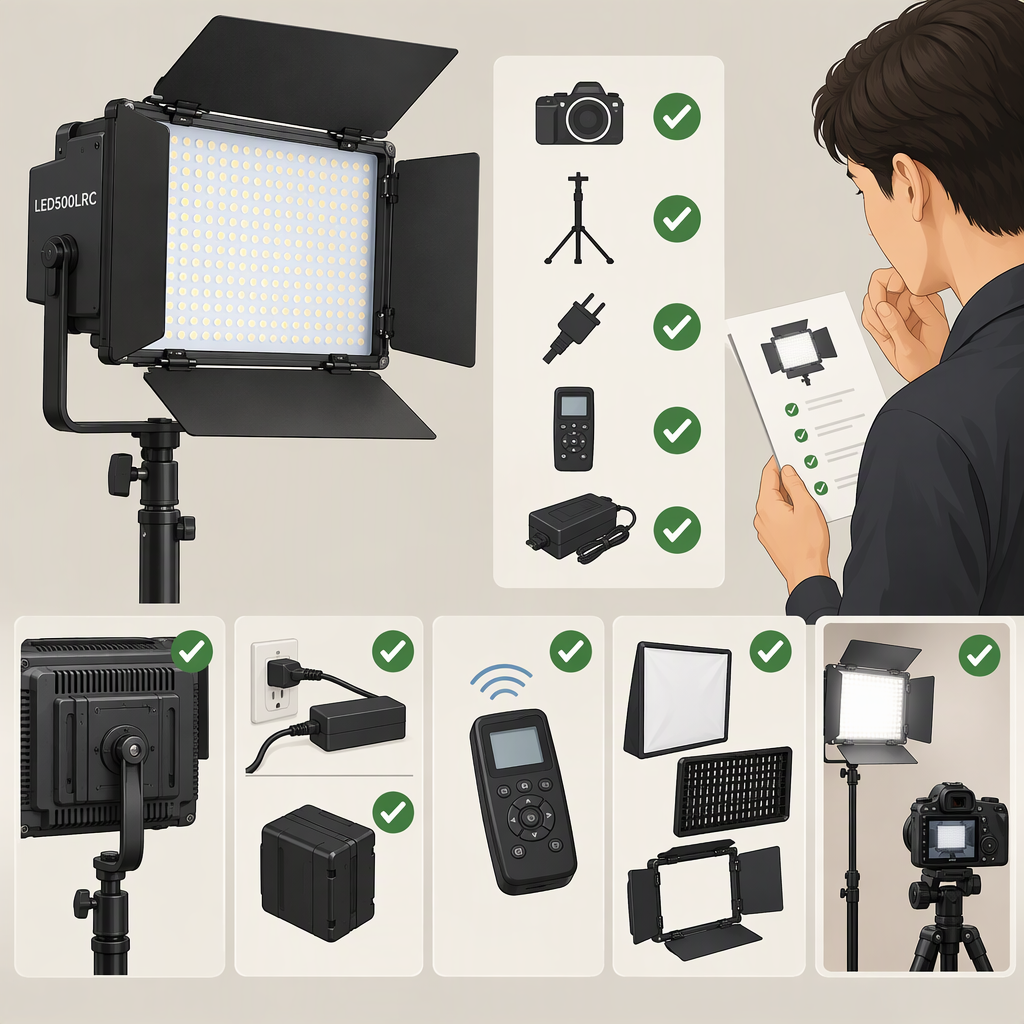
Godox Led500lrc: How to Check Suitability and Compatibility
Short answer: Don’t decide from the model name alone. First match the name on the unit or listing to the applicable Godox documentation. Then compare documented specifications with your filming needs and verify every connection you plan to use—especially power, mounting, controls, and accessories. The product-specific details needed to confirm the LED500LRC’s specifications and compatibility are not established here, so those checks remain unresolved until you consult documentation for the exact unit.
1. Confirm the Exact Model and Applicable Documentation
Before comparing specifications, make sure the documents you consult apply to the product you are considering.
- Read the complete model name on the product label, packaging, or listing. Record any suffix or other identifier shown; don’t assume a similarly named model is identical.
- Look for the corresponding product documentation from Godox. Compare its model name and any stated version or regional applicability with the identifier on the unit or listing.
- If the names do not match—or the documentation does not clearly cover the identifier—treat the match as unconfirmed. Ask Godox or the seller to clarify before relying on a specification or compatibility claim.
This guide does not establish which LED500LRC variants, if any, exist or which manual applies to a particular unit. Don’t infer those details from the keyword alone.
2. Match Documented Specifications to the Shot
Start with the filming situation, not a general claim that a light is “good for video.” Write down:
- Shot and coverage: What area or subject must be lit, and how much of the frame needs coverage?
- Distance: How far will the light be from the subject? A specification without its measurement conditions may not tell you what to expect at your planned distance.
- Ambient conditions: Will other room lights, windows, or outdoor conditions affect the scene?
- Desired appearance: What light quality and color characteristics does the shot require?
- Setup constraints: How much space, mounting support, and setup time do you have?
Next, compare those needs with specifications documented for the exact unit. Use a figure only if the source identifies what it measures and, where relevant, its test conditions. Manufacturer specifications describe what the manufacturer reports; they are not the same as an independent measurement or a guarantee of the result in your particular room.
Do not treat missing information as a pass. If a requirement depends on a specification you cannot confirm—for example, expected output in your setup—mark it unresolved instead of assuming the light will meet it.
Hypothetical Example
Suppose a creator needs to light a subject across a room while keeping the fixture on a particular stand and using a specific control method. The creator should first note the subject distance and coverage, then locate applicable documentation for the exact unit. If the documentation does not establish the needed performance or the planned connection, those points remain unverified. This example illustrates the process; it is not a test or a claim about LED500LRC performance.
3. Check Compatibility with the Planned Setup
Verify only the connections and accessories you actually intend to use. Check the product documentation and unit labels, and check the accessory’s own documentation as well. A physical resemblance or a seller’s broad compatibility statement is not enough to establish that a particular combination is supported.
| Check | What to compare | If it is unclear |
|---|---|---|
| Power | The exact unit’s documented power requirements and options against your available power source and planned cables or adapters. | Don’t assume a battery, adapter, or cable is suitable. Confirm the exact requirements before connecting or relying on it. |
| Mounting | The documented mounting interface against the stand, bracket, or support you plan to use. Consider whether the full setup can be secured as intended. | Treat the fit as unconfirmed; ask for confirmation for the exact unit and mounting accessory. |
| Controls | The control method named in the applicable product documentation against the controller or workflow you plan to use. | Don’t infer support from a connector, appearance, or another product’s features. Verify the specific control method. |
| Accessories | Each intended accessory against both the light’s documentation and the accessory’s documented compatibility. | Leave that accessory out of the plan until the combination is confirmed. |
This checklist does not confirm that any particular power source, mount, controller, or accessory works with the LED500LRC. It identifies what to verify before use or purchase.
4. Proceed-Or-Verify Checklist
Mark each item confirmed, not needed, or unresolved:
- The name on the unit or listing matches the documentation you are using.
- The documentation applies to the exact unit, including any version or region conditions it explicitly identifies.
- The documented specifications address your shot, subject distance, coverage, and lighting conditions.
- The planned power source and every power connection match the applicable requirements.
- The mounting interface matches the stand or support you intend to use.
- The planned control method is documented for the exact unit.
- Each accessory you plan to use is supported by documentation for the relevant products.
Proceed only when every critical requirement is confirmed. If one is unresolved, seek confirmation from Godox or the relevant accessory manufacturer before depending on it. If the exact model match or a critical performance or compatibility detail cannot be established, the responsible conclusion is that suitability has not yet been confirmed—not that the light is suitable or unsuitable.