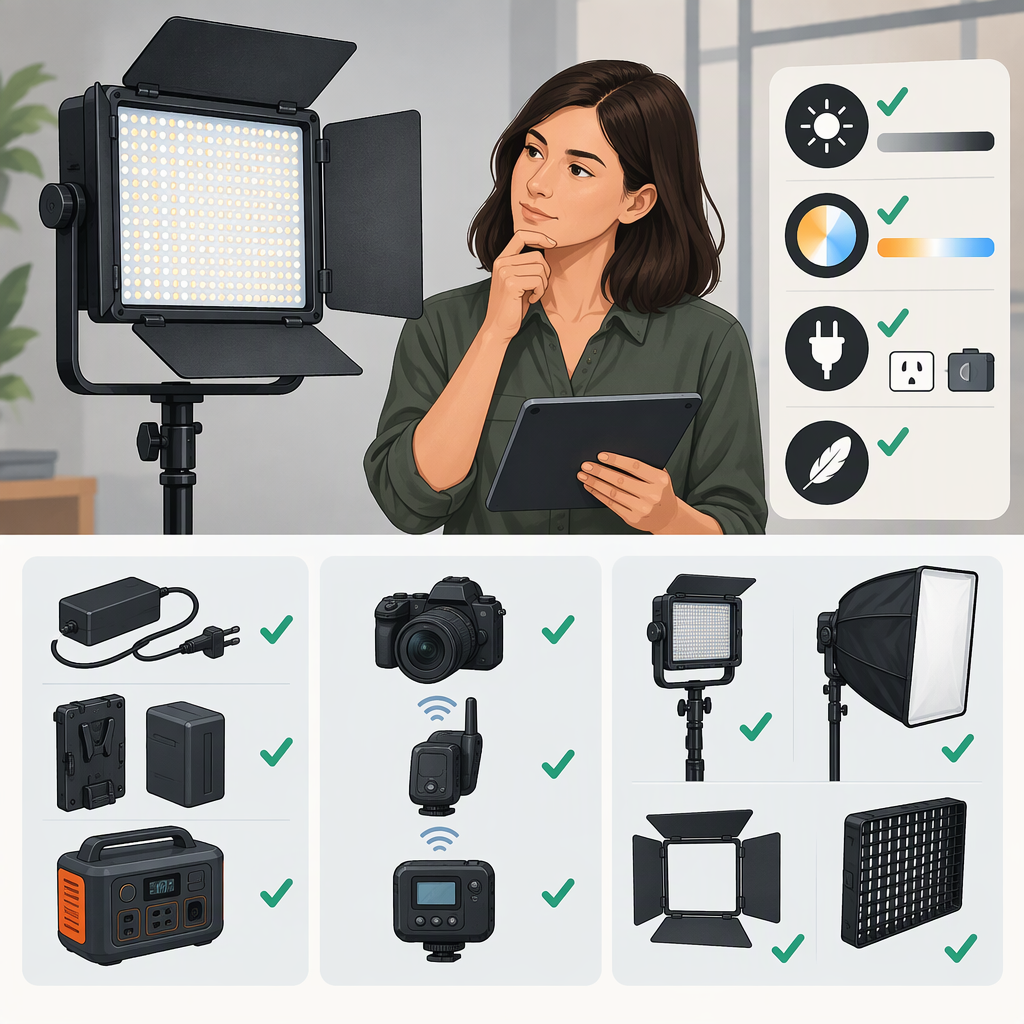
Godox Led500lr: How to Choose It and Check Compatibility
The Godox LED500LR can only be assessed reliably after you identify its full model suffix and compare its documented specifications with your filming needs. Godox’s manual lists daylight, tungsten, and changeable-color versions in the LED500L/LED500LR family; it also documents battery and DC power options. But a family name alone does not confirm the specifications or compatibility of your particular unit. Check the label and the manual for that exact version before choosing a power source, stand, or accessory. (godox.com)
Identify the Exact Led500lr Version
“LED500LR” is not enough to establish the color version. Godox’s manual lists these variants:
- LED500LRW: white version, 5600K.
- LED500LRY: yellow version, 3300K.
- LED500LRC: changeable version, 3300K–5600K.
The manual gives a brightness adjustment range of 10%–100% for the fixed-color versions and for the changeable version at 3300K or 5600K; it lists 25%–100% across 3400K–5500K for the changeable version. These are documented control ranges, not a measure of how much light will reach your subject. Confirm the full suffix on the unit and use the matching instructions rather than assuming all LED500LR versions behave alike. (godox.com)
Decide Whether It Fits Your Filming Setup
Work through this check before deciding that the light is suitable:
- Describe the shot. Note the subject, camera-to-subject distance, framing, ambient light, and whether the light will be fixed or moved between setups.
- Set the lighting requirement. Decide what illumination and color appearance the shot needs. A color-temperature range can help you assess color matching, but it does not by itself establish brightness at your subject.
- Compare against model-specific output data. Use output figures only if they apply to the exact version and state the measurement conditions, such as distance and settings. The Godox manual cited here identifies color and dimming ranges, but does not provide an output figure in the material cited here. Without suitable output data, you cannot conclude from those ranges alone that the light will be bright enough at a particular distance. (godox.com)
- Check practical constraints. Confirm that the required power option, physical support, and any intended accessories work for the location and way you plan to shoot.
Illustrative example—not a test of this product: For a fixed indoor interview, first establish the desired light level and color balance at the subject’s position. Then compare those needs with output data for the exact LED500LR variant, if you can obtain data under relevant conditions. If you cannot, treat brightness suitability as unresolved rather than inferring it from the model name or color-temperature range.
Check Compatibility One Pairing at a Time
Power: The Godox manual describes two power methods: two Sony NP-F970 lithium-ion batteries, or a 13–16.8 V DC power adapter connected to the light’s DC input. It describes the adapter as supplied, but package contents can depend on the particular unit or listing. Confirm the exact unit’s input requirements, connector, adapter, and included components before connecting power. If using batteries, check that the exact batteries and their condition meet the manual’s requirements. (godox.com)
Stand or support: The manual’s parts diagram identifies support-mounting holes. That alone does not establish the thread size, whether a particular stand fits, or whether a chosen support is suitable for the complete setup. Check the unit’s mounting interface and the stand or adapter documentation; ensure the assembled setup is stable for the way you intend to position the light. (godox.com)
Modifiers and controls: Do not assume that an accessory fits just because it is described as suitable for a Godox light. The manual describes a replaceable color filter and wireless remote operation; it says the remote is sold separately. For any modifier or remote, confirm that its documentation names the exact light or interface and supports the function you need. The manual describes 433 MHz wireless control, but that does not establish compatibility with every Godox remote or other control system. (godox.com)
Camera connection: Do not treat the LED500LR as camera-compatible or incompatible based on the name alone. Check for a documented connection or control feature only if your intended setup depends on one.
What to Verify Before Relying on a Conclusion
Use the label on the light to identify its full model suffix, then consult the matching Godox manual. Verify output under conditions relevant to your shoot before making a brightness decision, and check the specifications for the exact power supply, batteries, support, and accessories you plan to use. The documentation cited here supports identifying color variants, color and dimming ranges, power methods, and described wireless control; it does not confirm a specific stand, modifier, power accessory, or remote pairing. If a required detail is absent from the applicable documentation, leave that compatibility or suitability question open rather than guessing. (godox.com)