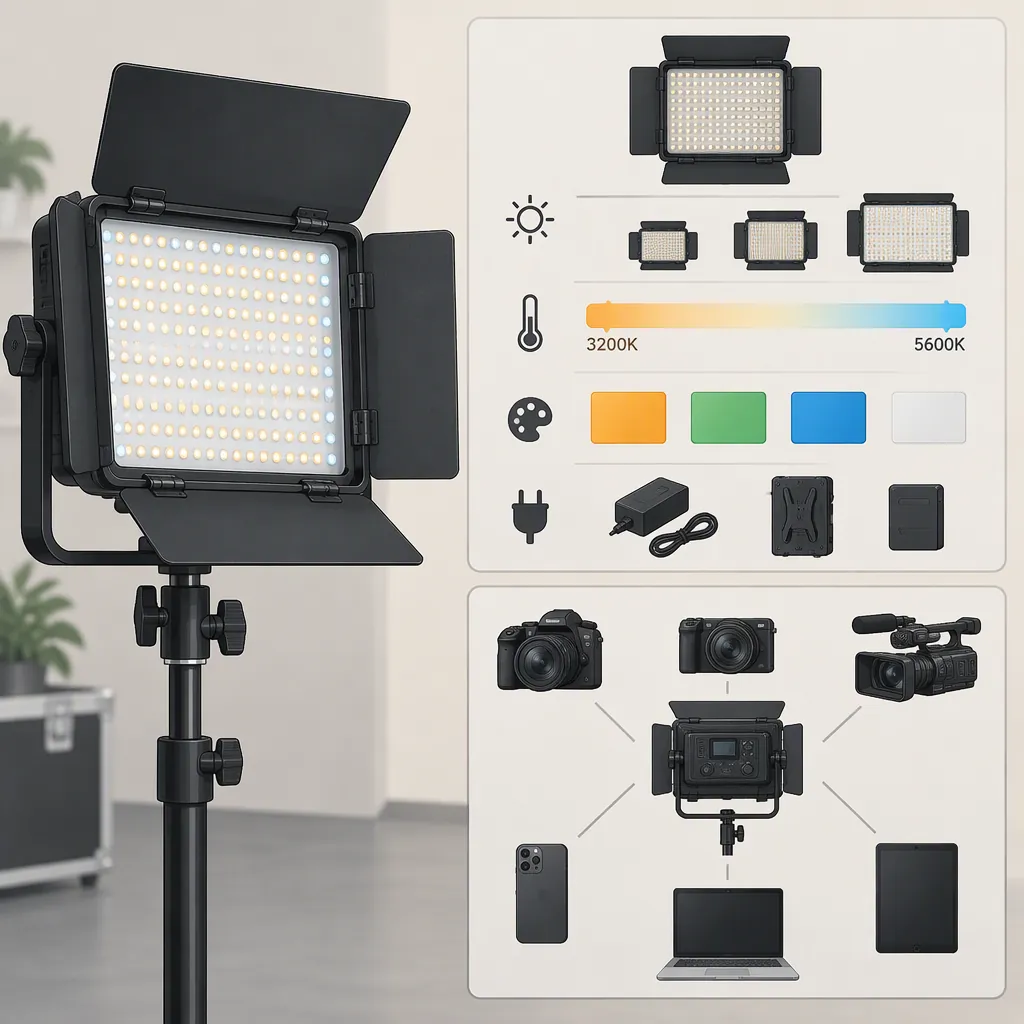
Godox Led500c: Filming Light Selection and Compatibility Checks
This page provides a verification process, not a confirmed LED500C compatibility list. The available GODOX LED Video Light storefront excerpt does not identify an LED500C listing or provide its specifications. It therefore cannot establish the model’s power requirements, battery support, mounting interface, accessory compatibility, controls, or filming performance. [source_1]
To decide whether a GODOX LED500C suits your shoot, first verify the exact unit and its hardware requirements. Then evaluate exposure, color, visible flicker or banding, and workflow with your intended camera settings. Keep undocumented or untested conditions marked unresolved rather than assuming compatibility.
Evidence Limits: What Is and Is Not Confirmed
The supplied Amazon GODOX LED Video Light storefront excerpt includes other models, such as the P120C, FV150, and SL-200W, but no LED500C entry. Those listings are not evidence of LED500C specifications or compatibility. [source_1]
This article does not verify the LED500C’s output, color-temperature range, color-rendering ratings, power sources, mounting hardware, controls, or included accessories. The missing entry also does not establish that the model is discontinued, unavailable, or unsuitable.
Use documentation that matches the exact fixture to resolve these gaps. The checks below are proposed procedures, not reports of tested LED500C performance.
Confirm the Exact Unit Before Comparing Lights
Start with the model label on the fixture, not a shortened listing title. Record the complete designation and any suffix, then compare it with the model named in the manual and the supplied components.
Separate your findings into three categories:
- Documented: A requirement or feature stated in documentation for the exact model.
- Observed: Something checked on the actual unit, such as connector markings or included mounting hardware.
- Unresolved: A feature supported only by a generic listing, another model’s description, or conflicting information.
An observed connector is not, by itself, proof that a power source is electrically suitable. Likewise, similar model names do not establish identical specifications. If the fixture label, manual, and supplied components do not agree, leave the affected question unresolved.
Model Verification Record
| Item | Record |
|---|---|
| Exact model on fixture | ______ |
| Model named in manual | ______ |
| Power-input markings | ______ |
| Supplied adapter markings | ______ |
| Included mounting hardware | ______ |
| Included accessories | ______ |
| Documentation source and date checked | ______ |
| Differences or missing information | ______ |
Check Power, Mounting, and Accessories Separately
Do not reduce compatibility to a camera-brand question. Treat power, physical support, accessories, controls, and recorded-image performance as separate decisions.
The table below identifies what to establish; it does not confirm any LED500C feature.
| Area | Requirement to Confirm | Corresponding Compatibility Check | Leave Unresolved If… |
|---|---|---|---|
| Power | The exact unit’s documented electrical input requirements | Match the power source’s ratings, polarity, and connector requirements to the documentation | The only evidence is that the plug fits |
| Battery use | Whether battery operation is supported and which batteries are specified | Check the exact battery designation and any required adapter or charger documentation | Support, battery type, or charging requirements are undocumented |
| Mounting | The fixture’s attachment interface and support requirements | Check the stand or bracket interface and documented limits for the complete assembled setup | Fit or load suitability is judged only by appearance |
| Modifiers | The supported attachment method and any restrictions | Match the exact modifier and attachment hardware to the fixture documentation | Compatibility is inferred from another GODOX light |
| Controls | The control methods and supported accessories | Verify the exact remote, app, or wireless accessory and any stated requirements | Compatibility is inferred from the brand name |
| Camera use | Whether physical attachment is intended and documented, if needed | Verify mounting separately, then test recorded footage at the intended settings | A camera-brand label is treated as proof of image performance |
Do not energize an undocumented power combination as a compatibility test. Resolve electrical requirements first. Similarly, do not proceed with a setup whose support requirements remain unresolved.
Compatibility Checklist
- Exact fixture model and matching documentation confirmed.
- Power source matches the documented requirements.
- Battery support and required components confirmed, if needed.
- Mounting interface and support limits checked for the assembled setup.
- Modifier attachment and restrictions checked.
- Required control methods and accessories confirmed.
- Conflicting or missing information recorded as unresolved.
Define Your Filming Requirements
Before testing, write down what the light must accomplish. This makes the selection decision specific to the shoot rather than dependent on an unverified specification or a broad “compatible” label.
Record:
- Shot and subject: Framing, subject size, and intended light position.
- Working distance: Where the fixture must sit without interfering with the shot.
- Camera settings: Camera, lens, frame rate, shutter setting, exposure settings, and white balance.
- Lighting conditions: Ambient light, other fixtures, and the intended modifier.
- Workflow needs: Available power, placement space, adjustment access, required controls, and audio-recording conditions.
- Acceptance criteria: The exposure, color appearance, illumination, and recorded-image quality your project requires.
Do not invent LED500C performance thresholds to fill documentation gaps. Use your project’s requirements as the test criteria.
Test the Intended Filming Setup
Proceed only after the electrical and support requirements have been resolved.
- Reproduce the planned shot. Use the intended camera settings, working distance, modifier, and ambient lighting.
- Check exposure. Record whether the setup achieves the required exposure at a practical light position and usable camera settings.
- Review color in context. Use a consistent white-balance setting. Inspect skin tones or representative product colors, including their appearance alongside other lights in the scene.
- Inspect recorded clips. Look for visible flicker, banding, or uneven illumination at the frame rate, shutter setting, and brightness levels the shoot requires. Do not rely solely on a live preview.
- Check workflow and audio. Assess stand placement, cable routing, adjustment access, and any audible noise in a quiet recording.
- Repeat for required variations. If the shoot needs multiple recording settings, light levels, or configurations, evaluate each one rather than extending a single result to all conditions.
Filming Test Log
| Test Item | Planned Requirement or Setting | Observation |
|---|---|---|
| Fixture model | ______ | ______ |
| Camera and lens | ______ | ______ |
| Frame rate and shutter setting | ______ | ______ |
| White balance and exposure settings | ______ | ______ |
| Light distance and brightness setting | ______ | ______ |
| Modifier and ambient lighting | ______ | ______ |
| Exposure | ______ | ______ |
| Color appearance | ______ | ______ |
| Visible flicker, banding, or uneven illumination | ______ | ______ |
| Noise, placement, and adjustment access | ______ | ______ |
| Untested conditions | ______ | ______ |
Turn the Results into a Selection Decision
Use these rules to connect the verification record and filming test to a practical conclusion:
| Finding | Decision |
|---|---|
| Electrical or support requirements are unresolved | Do not proceed to powered testing. Resolve these requirements first. |
| A required control method, power option, or accessory is confirmed unsupported | Does not meet the current requirements. Reassess only if the project requirements or configuration change. |
| A required feature remains undocumented | Unresolved. Do not count it as available when comparing lights. |
| Exposure, color, visible flicker or banding, or workflow fails your project’s criteria | Current configuration is unsuitable. If you change the configuration, test it again. |
| Hardware requirements are resolved and all required filming checks pass | Acceptable for the tested setup. Record the conditions that support this conclusion. |
| A required condition has not been tested | Unresolved for that condition. A passing result elsewhere does not answer it. |
Keep the conclusion narrow: “acceptable at this distance, with these camera settings and accessories” is more useful than “compatible with every camera.” It also makes clear what must be rechecked when the setup changes.
FAQ
Is the Godox Led500c Compatible with My Camera?
The available source does not establish compatibility with a specific camera. [source_1] If you intend to attach the fixture to the camera or rig, verify the mounting interface and support requirements first. Separately, record clips at your planned frame rate, shutter setting, and light levels, then inspect exposure, color, flicker, and banding. Physical fit and recorded-image suitability are different checks.
Which Batteries Work with the Led500c?
Battery support and battery types are not verified by the supplied excerpt. [source_1] Check documentation matching the fixture’s exact model for supported batteries and any required adapters or charging arrangements. Treat battery support as unresolved until that information is available; do not test an undocumented electrical combination.
Can I Use a Softbox, Diffuser, or Remote from Another Godox Light?
The supplied excerpt does not verify LED500C modifier or control-accessory compatibility. [source_1] Compare the exact accessory’s documentation with the fixture’s attachment or control requirements. For modifiers, also check restrictions and the assembled support setup. For remotes or wireless controls, look for explicit support for the exact model rather than relying on shared branding.
How Should I Decide Whether the Led500c Suits My Filming Needs?
Define the shot requirements, resolve power and mounting questions, and confirm any essential accessories or controls. Then test the exact setup against your exposure, color, recorded-image, and workflow criteria. Select “acceptable for this tested setup” only when those requirements are met; retain “unresolved” for missing documentation or untested conditions.
Does the Missing Storefront Entry Mean the Led500c Is Discontinued?
No. The supplied excerpt contains no LED500C entry, but that omission does not establish the model’s availability or discontinuation status. [source_1] It limits what this source can support, not what can be concluded about the product’s status.
Sources
- [source_1] Amazon.com: GODOX: LED Video Light