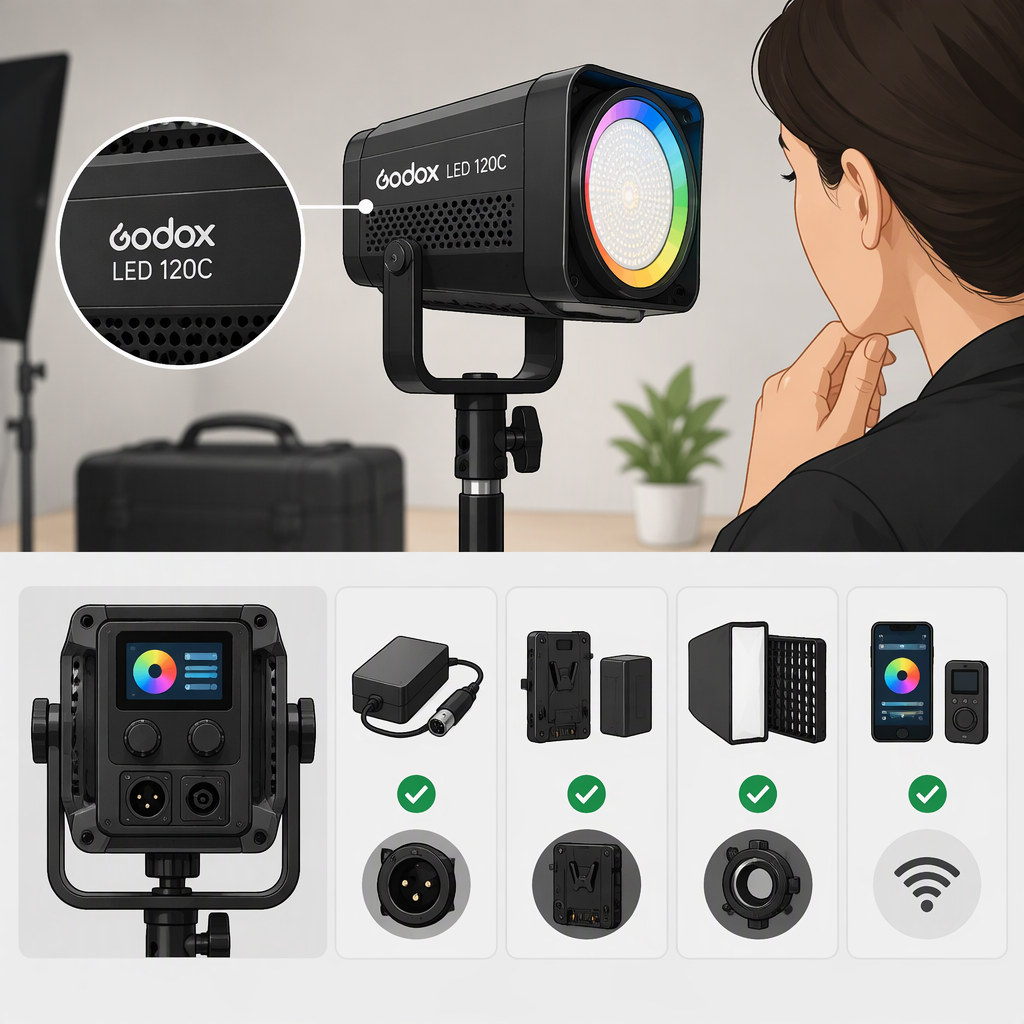
Godox Led 120C: Identify the Light and Check Compatibility
Short Answer
“Godox LED 120C” is not enough to confirm an exact model. One plausible match is the Godox LEDP120C, a video light described in a Godox instruction manual. But Godox also has an official product page for a model called LEDP120. Match the name on the light and its listing to the manual for that exact unit before relying on specifications. (godox.com)
If your light is specifically the LEDP120C covered by the available instruction manual, that manual describes battery and DC-power options and a 1/4-inch mounting hole. Those details do not, by themselves, establish that a particular battery, adapter, bracket, camera rig, or use case will work for you. Compare the exact manual’s requirements with your own equipment. (manualslib.com)
1. Identify the Exact Light First
Before buying, powering, or mounting a light found under the search phrase “Godox LED 120C,” check:
- The model printed on the light or its packaging. Look for the complete designation, including letters such as “P” and “C.”
- The listing’s exact model name and included items. A listing title or search phrase is not proof that the product or kit matches another listing.
- The manual that names that same model. Godox’s official site has a product page for LEDP120 and an official LEDP120C instruction-manual PDF. Since those names are not identical, don’t assume their specifications or included items are interchangeable. (godox.com)
The rest of this guide’s LEDP120C-specific details apply only if the unit you’re considering is identified as LEDP120C and its accompanying documentation matches. If the label says something else, use that model’s documentation instead.
2. Check Compatibility with Your Rig
Treat compatibility as three separate checks. A fit in one area does not prove a fit in the others.
Mounting
The LEDP120C instruction-manual text describes a 1/4-inch mounting hole and an L-type bracket. It also describes placing the bracket’s camera hot-shoe connection in a camera or camcorder hot shoe. Before relying on that setup, check that your exact light has the stated mount, that the bracket is included or available, and that your rig has a matching, usable connection. A camera-brand name alone does not establish mounting compatibility. (manualslib.com)
Example: If your camera has no hot shoe, the manual’s hot-shoe mounting method may not suit your rig as described. Check whether the exact light and bracket can instead attach to a support you already have; don’t assume the bracket or an alternative adapter is included.
Power
For the LEDP120C, the instruction manual describes use with a Sony NP-F970 lithium battery or a DC adapter rated 9.0 V, 1.5 A, with a specified DC-head inside diameter of 1.3 mm. These are model-specific manual details, not a general recommendation to use any battery or adapter advertised as compatible. Confirm the manual that matches your unit, the power source’s rating and connector, and whether the required item is included. (manualslib.com)
Example: If you plan to power the light from an adapter, compare its label with the manual’s voltage, current, and connector requirements. If any detail differs or is unclear, don’t treat the adapter as a match based only on a seller’s title.
Controls and Connections
The information available here does not establish a camera-control connection or remote-control compatibility for the LEDP120C. If you need the light to communicate with a camera, app, or other control system, look for that function in documentation for the exact model. Do not infer it from the Godox name or from camera compatibility claims about other products.
3. Decide Whether It Suits Your Filming
A model name and a mounting or power match do not tell you whether a light will give the result you need. Define the job first: what are you filming, how far away is the subject, what lighting result do you want, and will you work near a power outlet or need battery operation?
Then check the exact model’s documentation for the characteristics that matter to that job—such as light output, color adjustment, physical dimensions, and operating requirements. The available LEDP120C manual text describes adjustable brightness and color temperature, but the evidence here does not establish enough about output or coverage to promise a particular result at a particular distance. Treat suitability as unresolved until you can compare relevant specifications with your shooting conditions. (manualslib.com)
For example, a light may attach to your camera and accept a documented power source yet still fail to meet your needs at your subject distance. Conversely, a setup near an outlet may make a documented DC-power option more practical than carrying a battery—but that is a workflow trade-off, not a claim about runtime or lighting performance.
Before You Buy or Use It
- Confirm the complete model designation on the unit or listing.
- Find documentation that names that same model; don’t substitute LEDP120 details for LEDP120C, or vice versa, without confirmation.
- Compare the documented mount and bracket with your camera, stand, or rig.
- Compare the documented power requirements with the exact battery or adapter you intend to use.
- Confirm which accessories are actually included in the specific listing or kit.
- For your filming task, check relevant light specifications against your subject, distance, desired result, and portability or power constraints.
- If a model designation, requirement, or included item is unclear, resolve that before treating the light as compatible.
Bottom line: The search phrase alone does not identify a confirmed version. If the product is the LEDP120C, its manual provides concrete mounting and power details to compare with your setup; it does not establish that every camera rig, accessory, or filming scenario is a fit. Use the label and matching documentation as the basis for your decision.