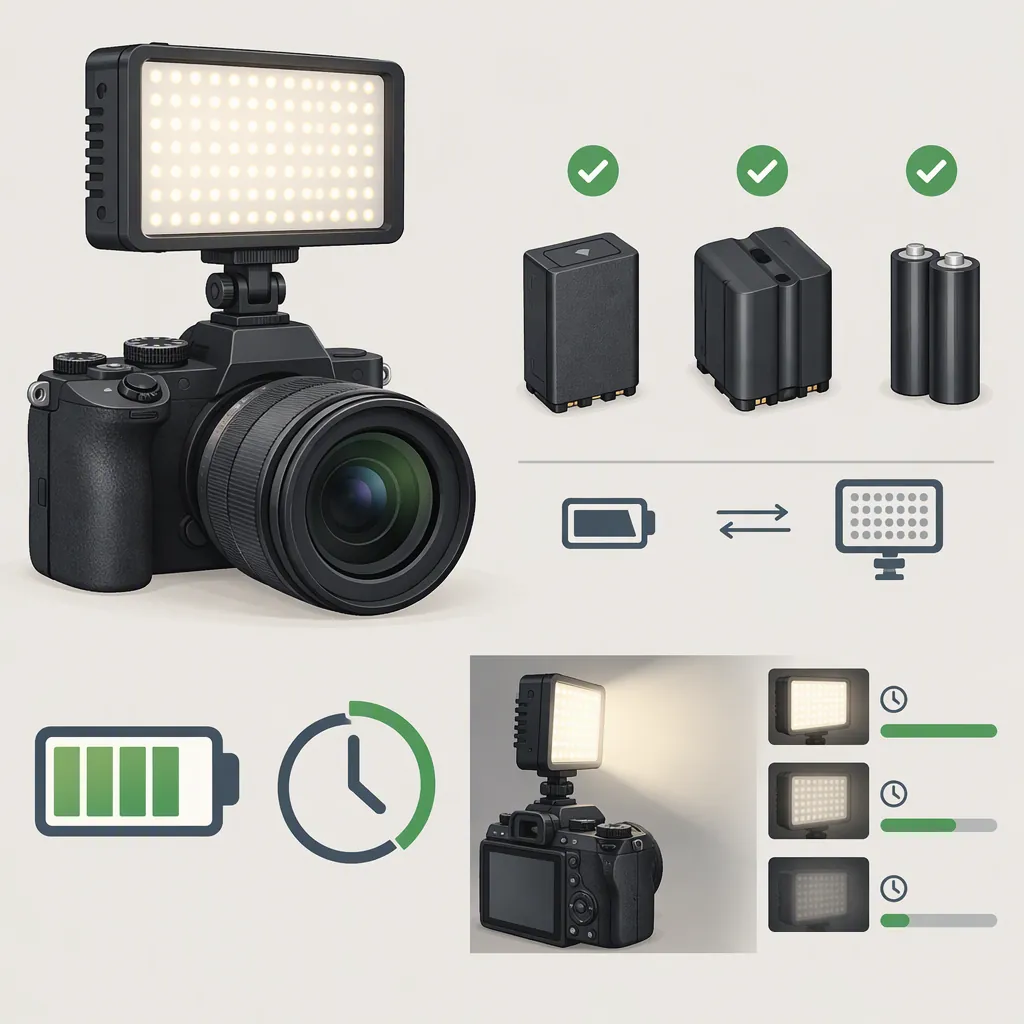
Camera Led Battery: Check Compatibility and Plan Runtime
For an on-camera LED light, choose a battery explicitly supported by the exact light model. Confirm the battery type, power specifications, connection, and charging method before use. Then plan runtime using information for that light-and-battery combination at your intended settings—not a generic “camera battery” rating.
Compatibility and capacity answer different questions: compatibility determines whether a battery is suitable for the light; capacity helps with runtime planning only after that match is confirmed.
Identify the Light Before Selecting a Battery
Record the LED light’s model separately from the camera’s model. Use the light’s manual or manufacturer’s power specification to complete this checklist.
| Item to check | What to record |
|---|---|
| Exact light model | Full model name and any version distinction |
| Supported battery | Explicitly listed battery model, series, or built-in battery arrangement |
| Power requirements | Permitted voltage and any stated current or power requirements |
| Connection | Required battery mount, tray, or connector |
| External power, if supported | Input specifications and required cable or adapter, including polarity where stated |
| AA cells, if specified | Cell count, size, and permitted chemistry |
| Charging | Specified charging method or compatible charger for the rechargeable battery |
Compare the candidate battery and every required accessory with those requirements. A similar name or apparent physical fit is not confirmation. If an important requirement is missing or conflicting, leave compatibility unresolved and seek model-specific clarification from the manufacturer.
Keep retail categories and other devices’ guidance in perspective. Camera Wholesalers’ Batteries collection contains camera batteries, chargers, grips, and battery door covers; inclusion in that collection does not establish LED-light compatibility. [c1] Trailcampro’s guide addresses trail cameras, including standby consumption, photo activity, and infrared illumination—not continuous filming-light operation. Neither reference establishes a matched LED battery recommendation or filming-light runtime. [c1] [c2]
Understand the Battery Label
Use the label alongside the equipment documentation, not as a substitute for it.
| Parameter | Meaning | What it helps you check |
|---|---|---|
| V — volts | Voltage | Whether the documented battery or supply voltage meets the light’s requirements |
| A — amps | Current | Whether a supported power source can provide the required current; this is not a capacity figure |
| W — watts | Power | The rate of energy use or a source’s power capability, depending on which specification you are reading |
| Ah / mAh — amp-hours / milliamp-hours | Charge capacity | Capacity comparisons when voltage and rating conditions are comparable |
| Wh — watt-hours | Energy capacity | A more useful starting point for comparing stored energy across different nominal voltages |
Read what each number describes. A light’s power requirement and a power source’s maximum output rating are not the same thing. Neither a high output rating nor a large capacity establishes compatibility.
Compare Capacity Without Confusing Units
One amp-hour equals 1,000 milliamp-hours. A nominal energy conversion is:
Wh ≈ nominal voltage × Ah
Or, when capacity is given in milliamp-hours:
Wh ≈ nominal voltage × mAh ÷ 1,000
Use the voltage associated with that capacity rating—not a charger’s voltage or an unrelated output specification. Where the manufacturer provides a Wh rating, record it directly.
Do not compare batteries by mAh alone when their nominal voltages differ. Even equal Wh ratings do not guarantee equal usable runtime: the light must support each battery, and the capacity rating does not establish how much energy that particular setup can use.
Verify Runtime for the Light-And-Battery Combination
Prefer a runtime statement that identifies:
- Light: exact model.
- Battery: exact pack or cell arrangement and stated capacity.
- Settings: brightness, mode, and other settings covered by the test.
- Conditions: starting charge, temperature, and any other disclosed conditions.
- Endpoint: whether runtime means operation until shutdown or until a specified output level.
Mark omitted details as unknown. A runtime figure without its settings and endpoint should not become a guaranteed filming duration.
Use Capacity Calculations Only as a Starting Point
For a constant electrical load, the ideal energy relationship is:
Ideal runtime in hours = battery energy in Wh ÷ load power in W
This requires the battery’s energy rating and the light’s electrical power consumption at the intended setting. Do not substitute an adapter’s maximum output rating or the light’s optical output for electrical consumption.
The calculation assumes all rated energy is available to the load. Conversion losses, battery condition, operating conditions, shutdown limits, and changing power demand can affect usable duration. Without those inputs, do not assign a numerical runtime to an unnamed LED light.
Rehearse Before the Shoot
After compatibility is confirmed:
- Prepare the battery using its documented charging instructions.
- Set the light to the brightness and mode planned for filming.
- Run a representative session within the equipment’s operating limits.
- Record elapsed light-on time, breaks, warnings, and any output changes.
- Compare usable duration with the full lighting schedule, including setup and rehearsals—not just recorded takes.
Treat the result as an observation for that setup, not a universal battery rating. A partial rehearsal does not establish full-session runtime. Plan battery changes and a reserve rather than placing an essential take at the observed limit.
Check Charging Separately
Confirm that the charger or built-in charging method supports the selected rechargeable battery. Check any documented input requirements and charging conditions.
Do not infer charging support from a connector’s appearance or from the presence of an external-power input. Verify whether the light’s documentation permits charging, operation while charging, or external-power operation; these are separate questions.
For a light that specifies AA cells, confirm the permitted chemistry as well as the size and number. Follow the documented cell and charging instructions rather than choosing a chemistry based on advice for another device.
FAQ
Can I Use My Camera Battery in My Led Light?
Only when the LED light’s documentation explicitly supports that battery model or series and the required connection arrangement. Check the camera and light separately. A camera-battery catalog listing alone does not confirm the match. [c1]
How Long Will a Camera Led Battery Last?
Use runtime information for the exact light, battery, and intended settings, then check it against a representative lighting session. Count setup and rehearsal time as well as takes. Capacity alone does not establish usable filming duration.
Does a Higher Mah Rating Mean Longer Runtime?
It can help compare capacity at the same nominal voltage under comparable rating conditions, but it does not prove compatibility or guarantee longer usable runtime. For different nominal voltages, compare Wh rather than mAh alone.
Can I Use Rechargeable Aa Batteries in My Led Light?
Check that the light specifies AA cells and permits the rechargeable chemistry you intend to use. If the permitted chemistry is not documented, resolve that uncertainty before use. Cell size alone is not approval.