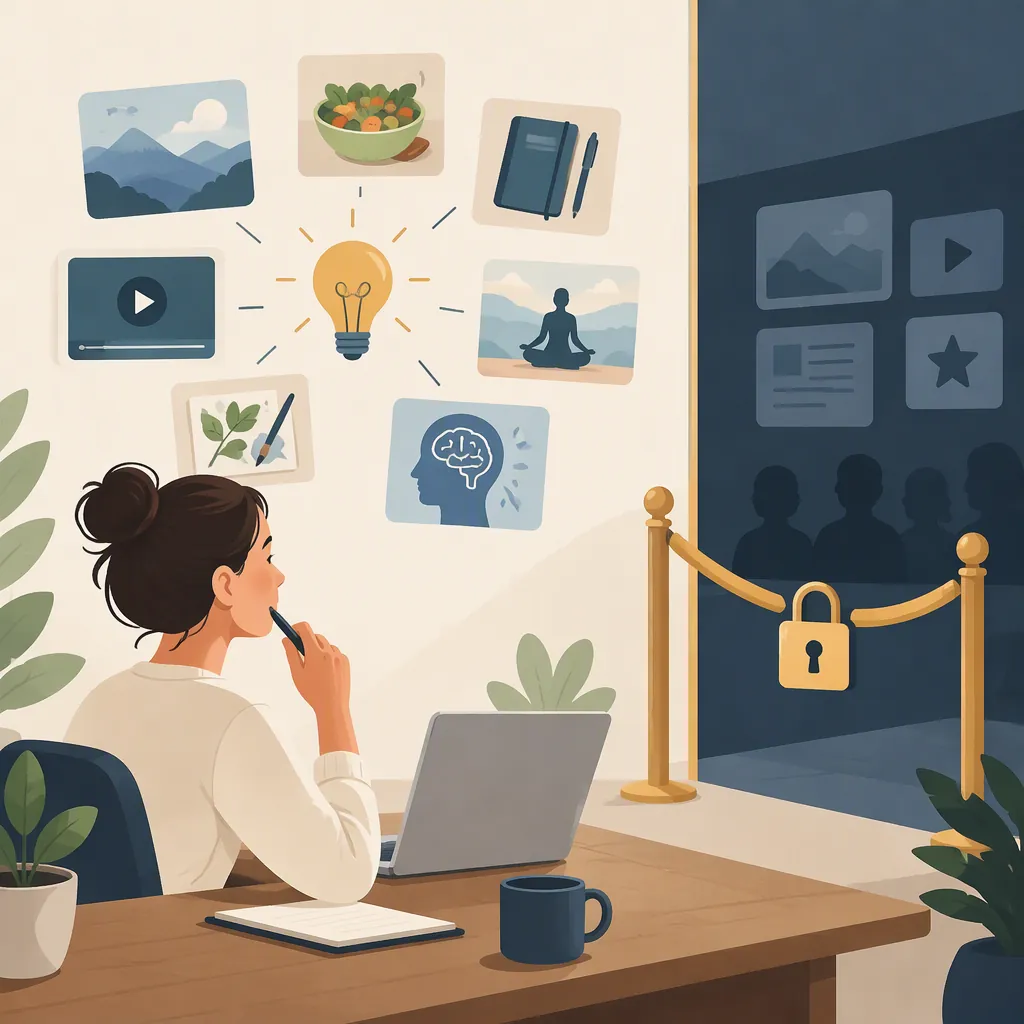
Exclusive Content Ideas with Clear Access and Rights Boundaries
Exclusive content ideas include annotated tutorials, process diaries, extended interviews, original worksheets, audience-selected deep dives, and early previews. Give each idea a specific audience benefit and define what is exclusive: access, timing, format, or distribution. The sources suggest tutorials, interviews, behind-the-scenes content, and repurposing as general formats; the exclusive variations here are editorial suggestions, not proven performance tactics or interpretations of a contract. [c3] [c4]
Define What Makes the Content Exclusive
For planning purposes, distinguish originality from restricted availability. An unusual topic can be publicly available; an ordinary topic can receive a version reserved for a particular audience.
Before choosing a format, finish this sentence:
This audience receives ___, which is unavailable elsewhere until ___ or under these conditions: ___.
Use one primary boundary:
- Access: A defined audience receives a separate piece or resource.
- Timing: An audience receives a preview before a stated public release.
- Depth: A public introduction has a separate, more detailed companion.
- Participation: A defined group helps select questions or receives a dedicated discussion.
- Distribution: A particular version is intended for one publication or channel.
These are proposed planning categories, not legal definitions. The supplied sources discuss content ideation, not the meaning or enforceability of exclusivity clauses. If a deal is involved, do not assume that calling something “bonus content” settles whether the agreement permits it.
Eight Exclusive Content Ideas to Adapt
NYTLicensing lists how-to content, interviews, live video, e-books, newsletters, and repurposing among its content suggestions. The neuroflash article also suggests behind-the-scenes material, tutorials, curated resources, and expert Q&A. The ideas below adapt those broad formats rather than reproduce a source's exclusivity strategy. [c3] [c4]
| Idea | What the Audience Receives | Suggested Boundary |
|---|---|---|
| Annotated tutorial | A walkthrough explaining why each step was chosen, plus alternatives | Keep the overview public; reserve the annotated companion |
| Process diary | Selected drafts with notes on revisions and discarded approaches | Reserve a specific diary installment, not all future process content |
| Extended interview | Additional questions organized around one narrow topic | Identify which segment is reserved and whether excerpts may appear elsewhere |
| Original worksheet | A blank planning sheet and a clearly labeled hypothetical example | Specify whether the worksheet, example, or both are reserved |
| Audience-selected deep dive | A detailed response to a question chosen by the intended audience | Define who can participate and who can access the finished response |
| Early preview | A draft chapter, demonstration, or project excerpt | State the preview period and planned public release |
| Resource notebook | Links to public resources with your own annotations and selection criteria | Make your commentary exclusive, without implying ownership of linked material |
| Follow-up edition | A companion addressing limitations or questions left open in a public piece | Identify the separate deliverable rather than relabeling the public original |
These are hypothetical concepts. They do not imply that any creator has used them successfully. For an interview, contribution, or third-party asset, confirm permission for the intended use before including it.
Choose an Idea with a Specific Audience Benefit
Rachel Pedersen's article recommends organizing brainstorming around content categories tied to expertise and audience, then developing one core idea into several formats. That is a useful starting point for ideation, but it does not establish that every adaptation is permitted under an exclusivity agreement. [c2]
For this exercise, choose one audience question and develop three possible responses: an explanation, a worked example, and a reusable resource. Compare them using these prompts:
- Benefit: What can the audience understand or do afterward?
- Difference: What does this add beyond the public version?
- Feasibility: Can it be made with available time and permitted materials?
- Boundary: Can its access and reuse conditions be described precisely?
Prefer a concrete promise such as “an annotated comparison of three approaches” over “special insights.” Avoid presenting fabricated outcomes, testimonials, or private audience information as evidence.
Exclusive Content Planning Brief
Working title: ___
Intended audience: ___
Audience question: ___
Concrete benefit: ___
Public companion, if any: ___
Exclusive deliverable: ___
What is reserved—access, timing, depth, participation, or distribution: ___
Release date and any public-release date: ___
Materials needed and their source: ___
Permissions to confirm: ___
Proposed excerpts, adaptations, and reuse: ___
Relevant agreement wording to review, if applicable: ___
Unresolved questions: ___
Review Access and Reuse Before Publication
Use the brief to identify questions, not to declare legal clearance. NYTLicensing advises obtaining permission before publishing someone else's content, including written consent or licensing. Its article does not resolve the scope of a creator's particular agreement. [c3]
When a contract or collaboration is involved, consider reviewing:
- Deliverables: Which files, editions, segments, or topics does the proposed restriction cover?
- Duration: When does the restriction start and end?
- Channels: Where may the full piece, excerpts, and adaptations appear?
- Reuse: Is later public release, portfolio display, or a revised edition contemplated?
- Contributions: Do permissions for images, interviews, music, and other materials cover the planned use?
- Audience wording: Does the description accurately explain what is reserved and for how long?
For example, an early preview could be described as “available to the designated audience before the planned public release,” rather than “available nowhere else forever.” That is a suggested wording distinction, not a contract clause.
If the agreement is unclear, flag the question for clarification or qualified legal review before relying on an assumed permission. The supplied references provide format inspiration, not evidence that a specific exclusivity arrangement is valid or suitable.
FAQ
Does Exclusive Content Have to Cover a New Topic?
Not for the planning approach used here. You can address a familiar topic through a reserved annotated version, worksheet, or follow-up. Describe the actual difference rather than claiming that the topic itself is unique.
Can I Turn a Public Post into Exclusive Content?
One suggested approach is to create a distinct companion, such as a worked example or expanded tutorial. The sources recommend repurposing content generally, but they do not establish permission under your agreement. Review any applicable restrictions before reusing the original or publishing an adaptation. [c2] [c3]
Which Exclusive Content Idea Should I Start With?
Choose a narrow audience question you can answer using materials you are permitted to publish. An annotated explanation or original worksheet is one possible starting point. Define the deliverable, its difference from public content, and its access period before expanding into a recurring series.