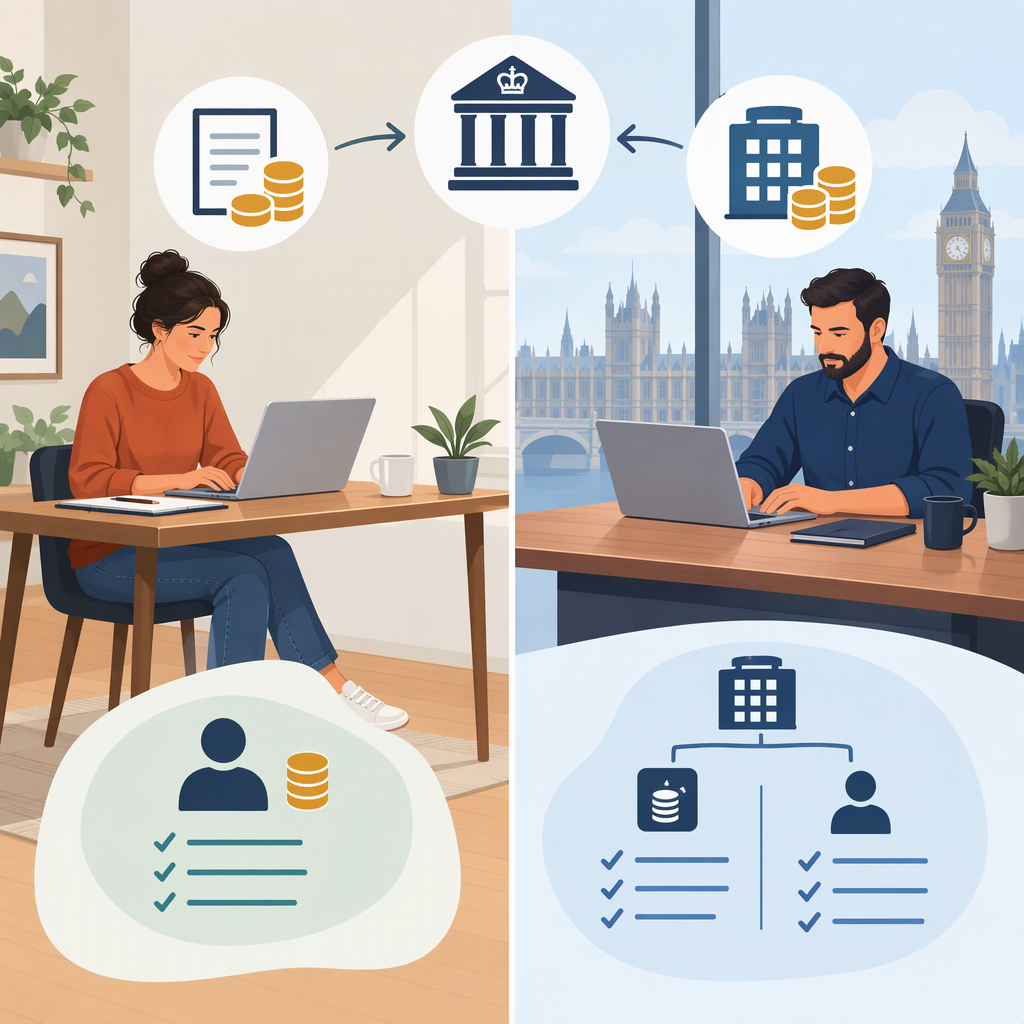
Freelance Limited Company Tax in the UK: Sole Trader vs Company
The Short Answer
This guide interprets “freelance limited company tax” as a UK comparison between freelancing as a sole trader and operating through a UK private limited company. The keyword and en-US locale alone do not establish a tax jurisdiction; if you meant a US LLC or another country’s company form, these UK rules do not apply.
For the UK tax year 6 April 2026 to 5 April 2027, a sole trader generally pays Income Tax and, above the relevant profit threshold, Class 4 National Insurance on business profits. A limited company is a separate taxpayer: it pays Corporation Tax on its taxable profits, while the owner may owe personal tax on salary or dividends taken from it. So a company’s Corporation Tax rate is not the owner’s final tax rate. How much the owner withdraws, their other income, and the company’s circumstances all matter. (gov.uk)
This is general UK information, not an individual tax calculation. Scottish Income Tax bands differ from those in England, Wales and Northern Ireland; the worked example below uses England, Wales or Northern Ireland. (gov.uk)
How the Tax Differs
| Question | Freelancing as a sole trader | Operating through a UK limited company |
|---|---|---|
| Who earns the business income? | You earn it personally; you keep the profits after tax. | The company earns the income. The company and its owner are separate for tax purposes. (business.gov.uk) |
| Main tax on business profit | Income Tax on taxable profit, plus Class 4 National Insurance when profits exceed the applicable threshold. | Corporation Tax on the company’s taxable profits. For financial years starting in 2026, the small-profits rate is 19% up to £50,000; the main rate is 25% above £250,000, with marginal relief between those limits. (gov.uk) |
| How the owner gets money | The profit belongs to you; personal tax is not postponed just because you leave cash in a business bank account. | You may take money as salary, dividends if you are a shareholder, or in other forms subject to rules. Salary goes through payroll; dividends are paid from available profits and are not a company expense for Corporation Tax. (gov.uk) |
| Main filing pattern | Register for Self Assessment when required and report business income on a personal tax return. | Prepare annual accounts and a Company Tax Return; file company accounts with Companies House. A director may also have a personal tax return to complete. (gov.uk) |
Sole Trader: Tax Follows Your Profits
A sole trader works out business profits by subtracting allowable expenses from business income. For 2026/27, the standard Personal Allowance is £12,570. In England, Wales and Northern Ireland, the main non-savings Income Tax rates are 20%, 40% and 45% across the published bands; Scotland has different Income Tax bands. Self-employed Class 4 National Insurance is 6% on profits above £12,570 up to £50,270, then 2% above £50,270. If profits are at least £7,105, Class 2 contributions are treated as paid for the National Insurance record; they are not normally an extra Class 2 bill at that profit level. (gov.uk)
A sole trader generally registers for Self Assessment if business income exceeds £1,000 in a tax year, subject to the rules and exceptions that apply to their circumstances. (gov.uk)
Limited Company: Tax Can Apply at Both Company and Owner Level
For a company accounting period beginning in 2026, Corporation Tax is 19% where profits are within the small-profits band and 25% above the main-rate threshold; marginal relief gradually increases the effective rate for profits between £50,000 and £250,000. Those thresholds can be affected by matters such as associated companies and short accounting periods, so do not assume every company gets the full thresholds. (gov.uk)
After Corporation Tax, the owner’s personal tax depends on how money is taken out:
- Salary: the company must operate payroll and account for Income Tax and National Insurance contributions, including employer contributions where due. Salary is not taxed like a dividend. (gov.uk)
- Dividends: these are payments to shareholders from company profits after Corporation Tax. Dividends cannot be treated as a company expense, and the company must have sufficient available profits and follow the required procedures. (gov.uk)
- Personal dividend tax: for 2026/27, the dividend allowance is £500. Above the allowance, rates are 10.75%, 35.75% and 39.35%, depending on the recipient’s Income Tax band and total income. (gov.uk)
A company’s profits left in the company have not yet become the owner’s spendable, after-personal-tax income. Conversely, taking all profits out can trigger personal taxes that a headline Corporation Tax rate leaves out.
Worked Illustration: Why One Headline Rate Can Mislead
This simplified illustration compares £40,000 of profit. It assumes the sole trader has no other income and is resident in England, Wales or Northern Ireland; the company has one owner, no associated companies, pays no salary, makes £40,000 profit before Corporation Tax, and distributes all post-tax profit lawfully as dividends. It ignores expenses beyond those already reflected in profit, accountancy costs, student loans, pension contributions, VAT, benefits and other reliefs.
Sole trader:
- Income Tax: (£40,000 − £12,570) × 20% = £5,486.
- Class 4 National Insurance: (£40,000 − £12,570) × 6% = £1,645.80.
- Approximate amount remaining: £32,868.20.
Limited company, all profit distributed as dividends:
- Corporation Tax: £40,000 × 19% = £7,600.
- Post-Corporation-Tax profit available: £32,400.
- Assuming the owner has no other income and can use the £12,570 Personal Allowance, the first £12,570 of dividends falls within that allowance. After the £500 dividend allowance, £19,330 is taxed at 10.75%: approximately £2,078 dividend tax.
- Approximate amount remaining after Corporation Tax and dividend tax: £30,322.
The example is a tax-mechanism illustration, not proof that one structure is always more expensive. A salary-and-dividend mix changes the calculation, as can other income, Scottish tax bands, employer National Insurance, associated companies and whether profits are kept in the company rather than withdrawn. Rates and thresholds are tied to the stated 2026/27 period. (gov.uk)
Other Obligations to Include in the Comparison
VAT is a separate question from business structure. The UK registration threshold is generally £90,000 of taxable turnover over the previous 12 months, or when you expect to exceed that amount in the next 30 days. It is taxable turnover—not profit—that matters, and exceptions can apply. The threshold is not a special limited-company tax. (gov.uk)
A limited company also has more formal filing duties: it must prepare annual accounts and a Company Tax Return. For a standard company, annual accounts are generally due to Companies House nine months after the financial year ends; Corporation Tax is usually due nine months and one day after the accounting period ends; and the Company Tax Return is due within 12 months. A first set of accounts has a different deadline. Check the dates against the company’s actual accounting period. (gov.uk)
A sole trader generally has simpler reporting and keeps the business profits personally. A company is a separate legal entity, but brings company records and filing responsibilities; company accounts and some company information are filed publicly. Government business guidance suggests weighing any potential tax savings against the added administration and accounting costs. No single structure is best for every freelancer. (business.gov.uk)
A Practical Way to Decide
Before comparing structures, write down:
- Your jurisdiction and tax year. Confirm where you are tax-resident, where the work and company are based, and which period you are estimating. UK rules above do not answer US or other-country questions.
- Expected figures. Estimate revenue, allowable expenses and profit—not just sales—and note any employment, investment or other income that affects personal tax bands.
- What you need to withdraw. Estimate how much you need for personal spending and how much you could leave in the company. A company-tax-only comparison is incomplete if you plan to withdraw most earnings.
- How money would be taken out. Compare salary, dividends and any other relevant payment method using the actual rules for your circumstances. Do not treat company funds as automatically personal money.
- The compliance and cost burden. List personal returns, company accounts, Corporation Tax returns, payroll if relevant, and professional or software fees. Get current local cost estimates rather than assuming incorporation saves money.
- VAT and record-keeping. Check whether your taxable turnover, customers, supplies or cross-border activity trigger obligations regardless of whether you trade personally or through a company.
For a real choice or a change of structure, ask a UK tax adviser to compare the same profit assumptions and withdrawal plan under both structures. Bring recent or forecast income, expenses, other personal income, desired withdrawals, and any VAT or payroll details. This helps turn the comparison into a like-for-like estimate without treating general guidance as individualized tax advice.