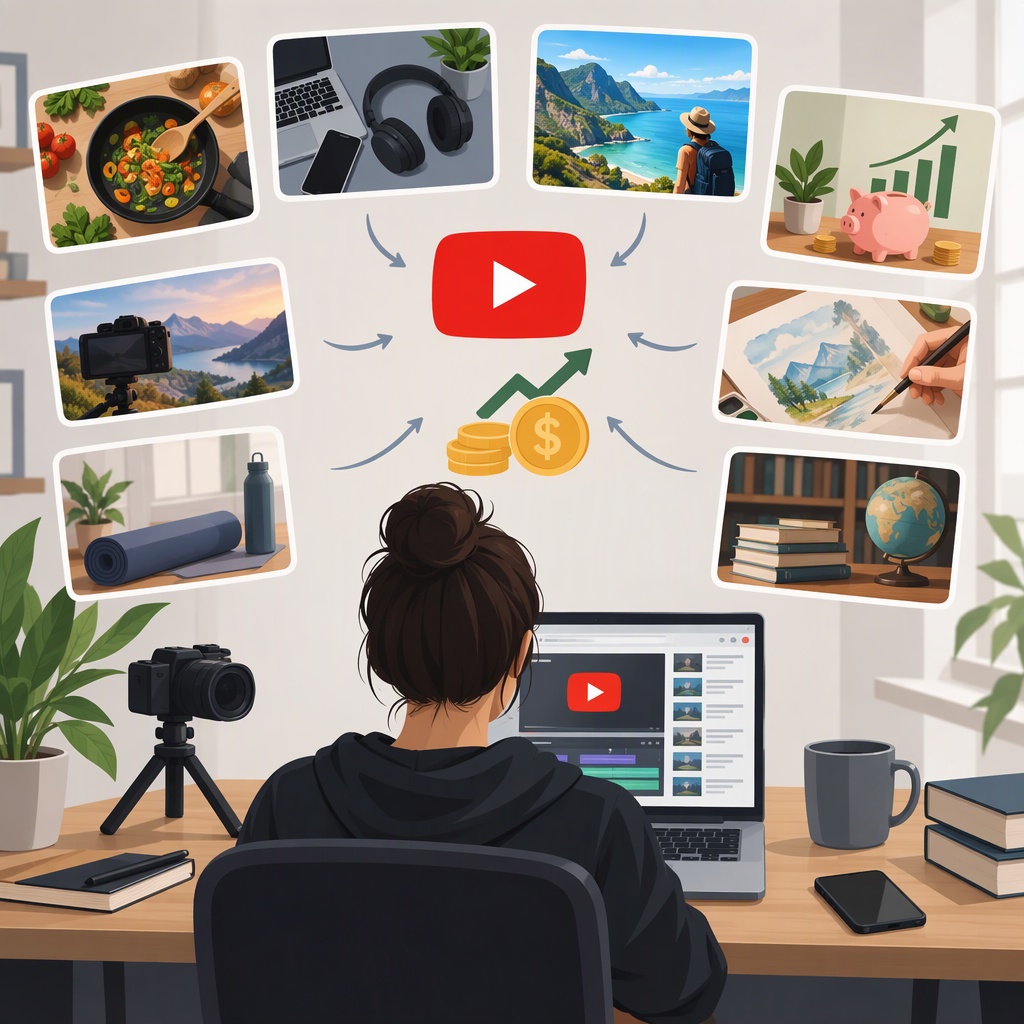
YouTube Niches to Make Money Without Showing Your Face
The best faceless YouTube niche is not automatically the one with the most commercial-sounding topic. Look for a real audience need, a revenue route worth investigating, a subject you can cover credibly, and a format you can produce with original work over time. Facelessness is a presentation choice—not evidence of audience demand, income, or monetization eligibility.
The ideas below are starting hypotheses, not a profitability ranking. No niche-specific earnings or demand estimates are established here. Check current public signals for the audience and location you want to reach, then assess the relevant YouTube rules before committing.
Faceless YouTube Niche Ideas to Investigate
| Niche idea | Possible faceless format | Audience need to investigate | Possible revenue routes to assess |
|---|---|---|---|
| Software or tool tutorials | Screen recordings with original narration and examples | Are people looking for help with a particular task, workflow, or tool problem? | YouTube monetization if eligible; relevant affiliate arrangements or sponsorships, if available and suitable |
| Product comparisons | Original demonstrations, screen comparisons, or hands-only tests | Do viewers need help choosing between products or understanding a specific feature? | YouTube monetization if eligible; affiliate links or sponsorships, if applicable |
| Practical educational explainers | Narration with original diagrams, slides, or demonstrations | Is there a clear question people want explained, and can you answer it accurately? | YouTube monetization if eligible; possibly a creator’s own educational materials or relevant sponsorships |
| Personal-finance education | Narrated lessons using original charts, examples, and calculations | Are viewers seeking clear explanations of a specific financial concept? | YouTube monetization if eligible; relevant sponsorships or creator offerings, subject to suitability and applicable rules |
| Hands-only cooking or crafts | Overhead demonstrations with your own footage and instructions | Are viewers looking for a recipe, technique, repair, or project they can follow? | YouTube monetization if eligible; relevant product affiliations, sponsorships, or creator offerings |
These are formats and monetization routes to investigate—not proof that a niche has demand or that a route will earn money. An affiliate program or sponsor may not exist for your specific topic; platform monetization also has eligibility and policy requirements. For comparisons or reviews, do not imply firsthand testing you did not perform. For finance education, plan how you will keep explanations accurate and distinguish general education from individual advice.
How to Choose a Niche That Fits
Compare a few candidate topics using the same questions. A promising option should have more going for it than an easy production setup or an apparent commercial angle.
- Audience need: What specific problem or question would a video answer? Look for recurring, specific queries—not just broad interest in a topic.
- Discoverability and competition: Search YouTube for those queries. Are existing videos answering them well, or do you see a possible gap in clarity, freshness, depth, or format? A crowded results page is a reason to examine the competition, not automatic proof that a niche is impossible.
- Credibility and original value: Can you explain the topic accurately and add something useful of your own—such as a demonstration, comparison method, clear explanation, or carefully sourced example?
- Repeatable production: Can you keep making videos in this format with the time, skills, access, and budget you actually have? A format that looks simple may still demand regular testing, research, filming, or updates.
- Monetization fit: Identify a plausible route, then verify that it is available and appropriate for your topic. Audience interest, advertiser interest, and a creator’s actual revenue are different things.
- Rights and policy risks: Can you make the videos with visuals, music, footage, and other materials you have the right to use? Could the proposed format rely too heavily on other people’s work or repetitive, mass-produced videos?
A Quick Validation Exercise
Pick three video questions for each niche you are considering. Search those questions on YouTube, compare the quality and recency of relevant results, and note what a useful video could add. If available to you, YouTube Studio’s Trends tab can show search-related insights, audience interest, and content-gap ideas. YouTube says some insights are limited by country, language, or device, and that a content gap can indicate a search for which viewers may not find enough relevant or high-quality Shorts. Treat these as idea signals—not proof of total market size, future views, income, or low competition. (support.google.com)
For a second signal, compare related search terms in Google Trends for the geography and time period that matter to you. Trends reports search interest, not an absolute count of potential viewers or evidence that a topic will earn money. Check whether a signal is steady or seasonal, and use wording viewers might actually search. (trends.google.com)
Example, using assumptions rather than market findings: Suppose you are comfortable explaining spreadsheet workflows but have limited time for filming. A screen-recorded tutorial series might fit your skills and production constraints better than hands-only cooking videos. That makes it a reasonable candidate to validate; it does not show that spreadsheet tutorials have greater demand or earning potential. Search for real workflow questions, assess current competing videos, and check whether any potential affiliate route is relevant before choosing.
If you want a simple comparison aid, rate each candidate from 1 to 5 on audience need, your credibility, repeatable production, monetization options, and rights risk. Write down the evidence or assumptions behind each rating. This is only a planning checklist—not a validated formula or earnings predictor. A weak score should prompt more research, not be treated as a market verdict.
Monetization Routes—And YouTube Rules to Check
Possible revenue routes include YouTube monetization, affiliate links, sponsorships, and a creator’s own offerings. They are not interchangeable: each depends on its own eligibility, availability, audience fit, and terms. A niche can attract interest without producing meaningful revenue for a particular creator. No income or RPM figure is included here because there is no comparable, appropriately scoped evidence for these niche ideas.
Faceless channels still have to meet YouTube’s monetization requirements. As listed on YouTube’s Partner Program eligibility page on November 13, 2026, the standard thresholds for applying for ad revenue sharing are 1,000 subscribers plus either 4,000 qualified public watch hours in the previous 12 months or 10 million qualified public Shorts views in the previous 90 days. The page also lists other requirements, including following channel monetization policies, being in a country or region where YPP is available, and having no active Community Guidelines strikes. YouTube notes that meeting the thresholds does not replace a channel review. (support.google.com)
Some eligible countries and regions have an expanded YPP tier that can provide earlier access to certain fan-funding and Shopping features at lower thresholds; that is distinct from the listed thresholds for ad revenue sharing. Features and regional availability differ, so confirm what applies to your location and channel in YouTube Studio. The eligibility page also announces YPP updates starting February 1, 2027; check the current official page before relying on thresholds or terms after that date. (support.google.com)
YouTube’s monetization rules also make originality relevant. Its policy describes repetitive or mass-produced content as inauthentic, and says reused material without significant original commentary, substantive modification, or educational or entertainment value can create monetization problems. A voiceover or a faceless format alone does not establish that a channel’s content is original or eligible. (support.google.com)
Check rights before using third-party video, images, music, or other creative work. YouTube describes options such as getting permission or using material under an applicable license, but says those options do not guarantee avoiding copyright issues. In the United States, fair use depends on the circumstances; crediting an owner or adding a disclaimer does not automatically make a use fair. Rules may differ by country or region. (support.google.com)
Practical Next Step
Choose two or three niche candidates, write down the audience question each would serve, and draft three video ideas for each. Check current search results and any available Trends signals, then assess your ability to make useful, original videos repeatedly and identify a plausible revenue route. Pick the candidate with the strongest combination of evidence and personal fit—not the one that merely sounds most profitable. Recheck current YouTube eligibility, monetization, and rights rules before you build a plan around them.