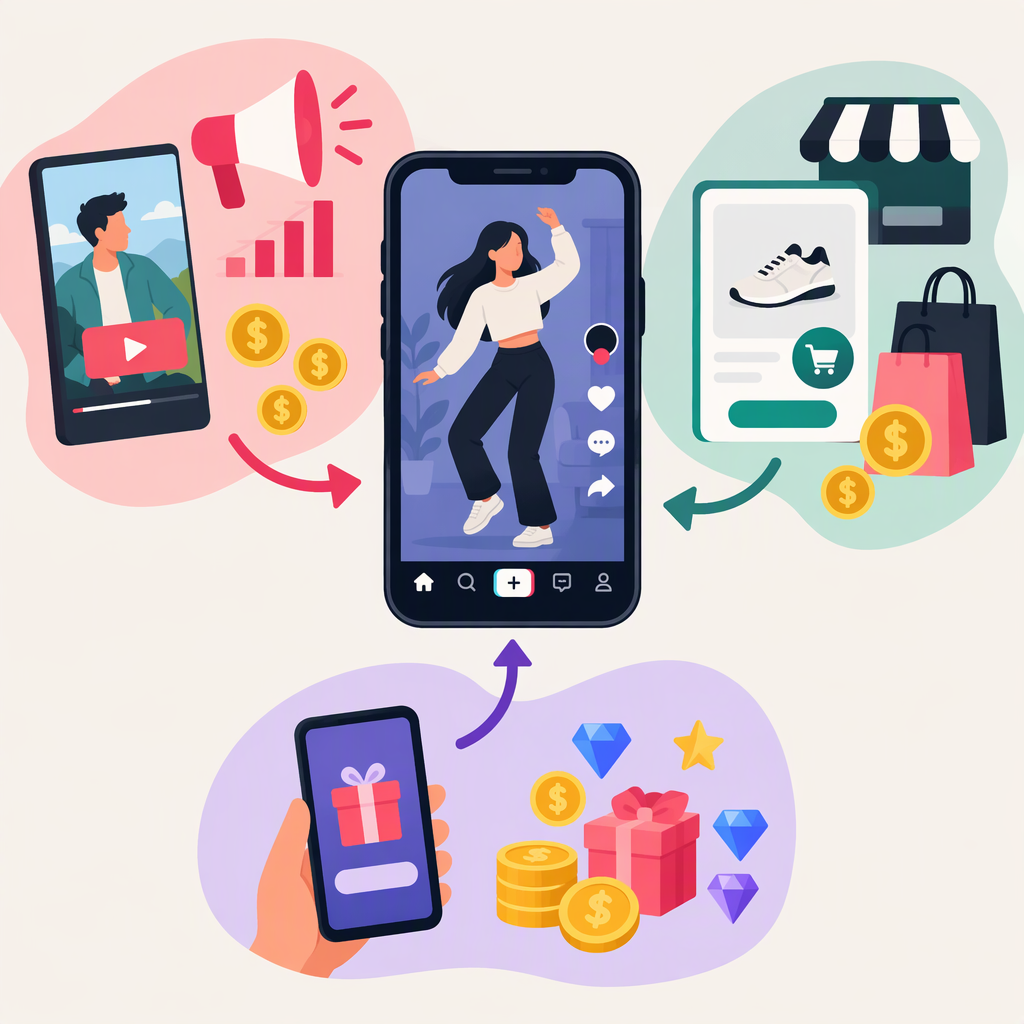
How Does TikTok Make Money? Ads, Shop Fees, and In-App Purchases
How TikTok Makes Money
TikTok earns revenue when businesses pay to advertise, when sellers pay fees on qualifying TikTok Shop sales, and when users buy paid digital items or services on the platform. Advertising appears to be the largest stream, but public estimates are not the same as TikTok’s audited, official revenue breakdown. Creator payouts are a separate payment flow: they are not automatically TikTok revenue, and public terms do not support a single universal creator revenue share.
1. Advertising: Businesses Pay to Reach Audiences
Businesses buy ad delivery on TikTok. Depending on the account, TikTok’s documented billing options include advance payment, automatic billing, and monthly invoicing for eligible businesses. That makes the basic flow straightforward: an advertiser pays TikTok for advertising services, and TikTok earns revenue from those charges. The specific ad options and billing arrangements can depend on the advertiser’s account and market. (ads.tiktok.com)
Advertising’s relative importance is best described with a qualification. Business of Apps estimated TikTok’s 2024 revenue at $23 billion, including $17 billion from advertising, with in-app purchases and commerce each above $2 billion. Those are third-party estimates, not an official TikTok financial statement; they suggest ads were the biggest of those streams in that estimate, but they should not be treated as a definitive or current breakdown. (businessofapps.com)
2. TikTok Shop: Sellers Pay Transaction-Related Fees
TikTok Shop gives sellers a way to list, promote, and sell products through TikTok’s commerce features. TikTok’s US seller materials describe a referral fee collected on qualified completed orders. In other words, the seller is the payer, and the fee is associated with a sale made through the marketplace—not simply with a creator mentioning a product. (seller-us.tiktok.com)
The precise fee depends on the applicable seller terms and fee schedule, which can change. TikTok’s US fee article describes a 6% rate introduced in 2024, but that dated rate should not be assumed to be the current charge for every seller or category. Check the terms applying to a particular seller, market, and transaction before relying on a fee amount. Shop availability and terms also vary by market; US examples are not universal. (seller-us.tiktok.com)
3. In-App Purchases: Users Buy Coins and Other Virtual Items
TikTok also sells virtual items. In the US, its support materials explain that users can buy Coins and use them to send Gifts during LIVE streams or on posts; Coins can also be used for services such as Promote. A user’s purchase is a payment to TikTok or an authorized payment channel for a digital item or service used on the platform. The item itself is not cash or a direct payment from the viewer to the creator. (support.tiktok.com)
For Gifts, TikTok says creators may collect Diamonds and may be eligible for rewards. The policy and help materials describe the relationship between Coins, Gifts, Diamonds, and rewards, but they do not establish one universal public percentage that TikTok keeps from every purchase. Don’t infer a standard creator share from the price of Coins or the displayed value of a Gift. Availability and eligibility can vary. (support.tiktok.com)
TikTok Revenue Is Not the Same as Creator Earnings
A creator can earn through TikTok programs, viewer Gifts, brand deals, affiliate sales, or other arrangements, but those payments are not all the same kind of money—and some do not come from TikTok at all.
For example, TikTok’s US Creator Rewards Program says eligible creators can receive rewards based on qualified video views and other program rules. That is a payment TikTok makes to eligible creators. It is distinct from TikTok’s revenue from advertisers, Shop seller fees, or paid virtual items. The program is limited by eligibility requirements and country availability, so it is not a guaranteed payment to every creator. (support.tiktok.com)
In short: TikTok’s business model turns audience attention into advertising sales, supports commerce through seller fees, and sells certain digital items and services. Creators may receive payments through specific programs or features, but those payments are not a universal share of TikTok’s revenue.