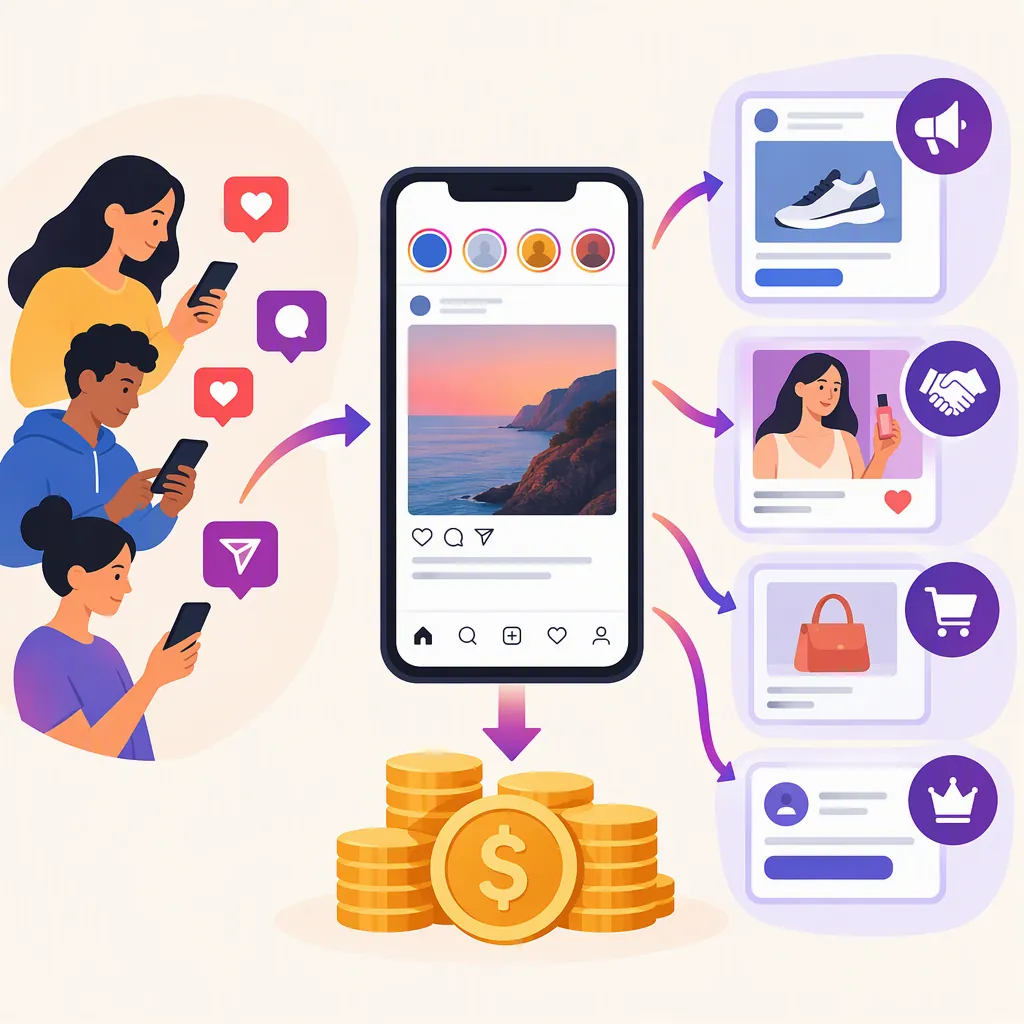
How Does Instagram Profit from Monetization?
Instagram’s platform monetization and a creator’s earnings are different money flows. Advertising represents a platform-revenue channel, while sponsorships, affiliate sales, and fan payments can generate creator income. The supplied sources discuss Instagram ads and creator monetization, but do not establish Instagram’s revenue breakdown, current platform fees, or standalone profit. It would therefore be misleading to say Instagram takes a fixed share of everything creators earn. [citation-1] [citation-2]
Advertising and the Platform Business Model
The advertising model separates the audience from the paying customer: people view content, while advertisers pay for promotional distribution. In that model, an advertising payment is platform revenue; it is not automatically a payment to the creator whose content attracts attention.
A supplied public discussion mentions Instagram feed and Story ads. That supports only a limited, third-party description of advertising on Instagram—not a conclusion about advertising’s share of revenue, ad pricing, or profitability. [citation-1]
The useful distinction is selling advertising distribution versus paying creators. Those transactions can coexist without having identical amounts or a fixed relationship.
Creator Monetization Is Not Automatically Instagram Revenue
The LearnWorlds article describes several ways creators can earn through an Instagram presence, including sponsored content, affiliate marketing, selling products or courses, subscriptions, badges, and gifts. These are descriptions from a third-party guide, not confirmation of current availability or terms for every account. [citation-2]
The money flows should be kept separate:
| Monetization Route | Money Flow to Distinguish | What Not to Assume |
|---|---|---|
| Sponsored content | A brand compensates a creator for a collaboration. | The sponsorship payment is necessarily Instagram revenue. |
| Affiliate marketing | A merchant or affiliate program pays a commission for a qualifying sale. | Instagram receives the same commission. |
| Product or course sales | A buyer pays the seller, potentially through an external checkout. | Every sale creates an Instagram transaction fee. |
| Subscriptions, badges, or gifts | Fans pay for access or support through the relevant payment arrangement. | One platform-fee percentage applies to every feature. |
The third-party guide supports these broad creator-income categories, but it does not provide a verified, comprehensive account of Instagram’s current deductions or fee allocation. [citation-2]
Revenue Is Not the Same as Profit
To answer how Instagram profits, rather than merely how money enters the system, costs also matter.
A simplified accounting distinction is:
Profit = revenue − expenses.
An advertiser’s payment can contribute to revenue. A creator payout, where applicable, is a different transaction. Neither an advertising payment nor a reported creator payout reveals platform profit on its own.
The supplied Facebook post compares one person’s reported Facebook and Instagram earnings. It is an anecdote, not a platform-wide payout schedule or a measure of Instagram’s profitability. Its figures should not be converted into a universal per-view rate. [citation-1]
What Video Monetization Does—And Does Not—Mean
A monetized video can involve different arrangements. A brand may pay for sponsored video content; viewers may support a creator through a feature described as gifts or badges; or the video may promote something sold elsewhere. The LearnWorlds guide discusses these distinct routes. [citation-2]
That does not establish a universal rule that Instagram pays for every video view, or that enabling a creator monetization feature determines how much Instagram earns from that video.
The clearest answer is to identify the transaction first: who pays, who receives the payment, and what is being purchased? Advertising distribution, a sponsorship, a product, and fan support are different purchases. Current platform terms would be needed to establish any Instagram-specific fee or revenue-sharing arrangement.
FAQ
Does Instagram Take a Percentage of Every Creator’s Income?
That is not established by the supplied sources. The third-party guide describes sponsorships, affiliate income, external sales, and in-app monetization features, but does not verify a single fee rule covering all of them. Do not treat every dollar earned through an Instagram presence as platform revenue. [citation-2]
Can Creator Payouts Reveal How Much Instagram Profits per View?
No. A creator payout is not a calculation of platform revenue minus expenses. The supplied public post reports an individual payout comparison, which cannot establish a universal payout rate or Instagram’s profit per view. [citation-1]
Do the Supplied Sources Show Instagram’s Largest Revenue Source?
No. The public discussion mentions ads, and the LearnWorlds guide focuses on creator income methods. Neither supplies a verified Instagram revenue breakdown, so these references cannot establish the largest revenue source or its percentage contribution. [citation-1] [citation-2]
Sources
-
[citation-1] Josh Miller - The difference in monetization between...
-
[citation-2] How to Monetize Instagram in 2026