How to Start a YouTube Career with a Practical First-Month Plan
Start a YouTube career by choosing a clear audience and topic, setting up your channel, and building a repeatable process for planning, recording, editing, and publishing. These are core steps in the supplied channel-starting guide. [source-1] Treat your early videos as a test of both audience interest and your ability to sustain the work. Keep spending limited, review feedback, and evaluate income separately from views before considering YouTube your primary job.
Choose an Audience and a Repeatable Topic
Begin with a specific viewer need rather than a broad ambition to become a YouTuber. For example, “practical cooking for people with limited kitchen space” gives you a clearer planning target than “lifestyle videos.” This is an illustrative positioning choice, not a proven niche recommendation.
The supplied guide recommends defining a niche, studying other channels, and creating a concise channel description. [source-1] Use that research to identify questions you can answer in your own way—not to copy another creator’s scripts, thumbnails, or identity.
Before committing, draft several distinct video ideas. If each idea requires more time, access, or expertise than you can realistically provide, narrow the topic or change the format. A useful starting focus should fit both the viewer’s needs and your available resources.
Channel Focus Worksheet
Complete these prompts before filming:
- Intended viewer: ___
- Question or problem I will address: ___
- Experience, research, or demonstrations I can contribute: ___
- Repeatable format: ___
- Topics outside my scope: ___
- Three distinct first-video ideas: ___

Draft description: “This channel helps [viewer] understand or do [subject] through [format].”
Build a Small, Repeatable Production Process
Set up a recognizable channel name, profile image, and description, then prioritize making a complete first video. The reference covers channel setup, scripting, equipment, and editing, and says expensive equipment is not necessary at the beginning. [source-1]
A practical starting approach is to test the equipment you already have. Record a short sample and check whether speech is understandable, the subject is visible, and the recording can be edited with your available setup. Buy additional equipment only after identifying a specific problem it would solve.
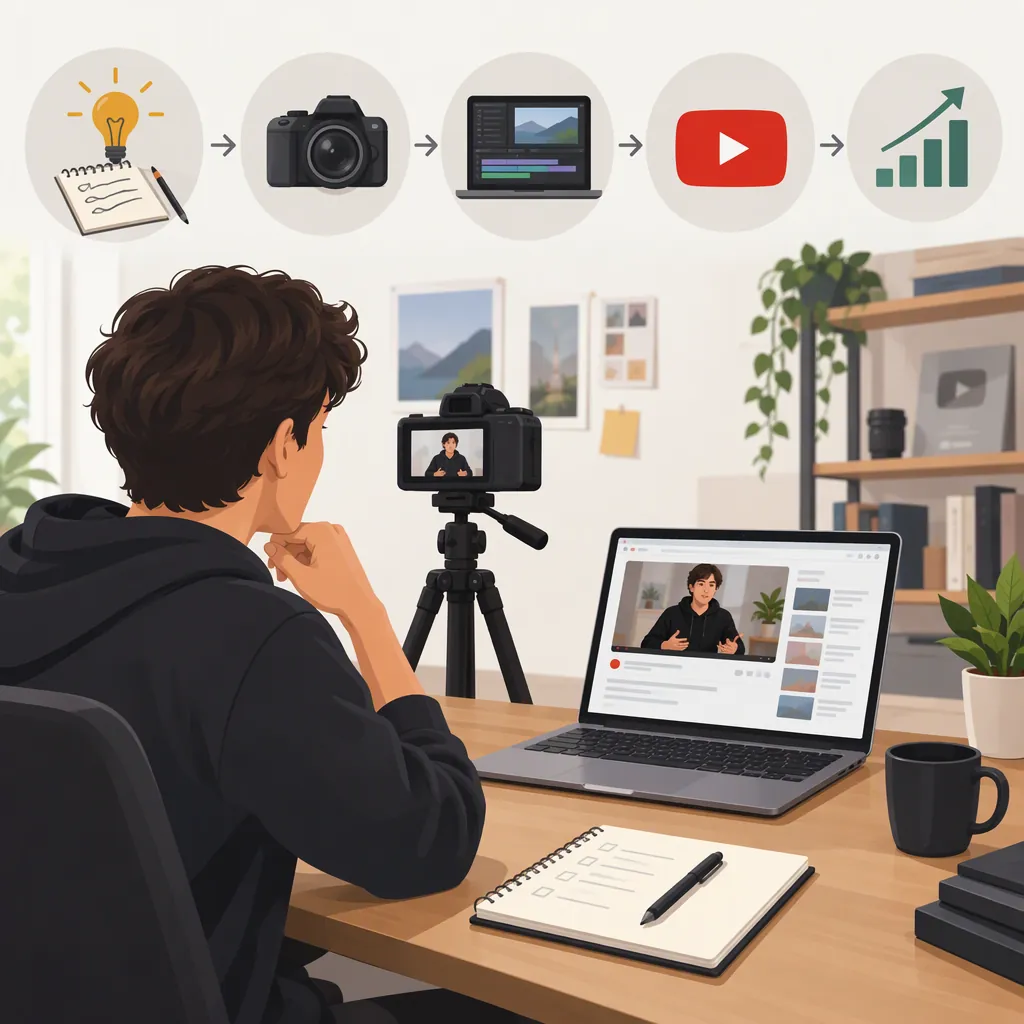
Use a simple workflow: define the video’s promise, outline the explanation, record, edit, and review. Remove material that does not help deliver the promise. Before publishing, check that the title and thumbnail accurately represent the finished video.
For any material you did not create, check whether you have permission or an applicable basis to use it. Do not assume that adding a credit or source link settles usage rights; the supplied reference is not sufficient to determine permissions for a particular asset.
First-Video Brief
- Viewer question: ___
- Accurate working title: ___
- Opening: State what this video will explain or demonstrate.
- Main points: List the essential steps or ideas in order.
- Evidence or demonstration needed: ___
- Materials requiring a rights check: ___
- Ending: Summarize the answer and its limitations.
- Final review: Check audio, clarity, accuracy, and alignment with the title.
Use the First Month as a Manageable Trial
The reference recommends a content plan that includes ideas, formats, and publishing frequency. It also acknowledges that there is no universal publishing schedule. [source-1]
The following four-week plan is an illustrative workload, not a growth formula. Reduce the number of videos if research, accessibility, filming, or editing requires more time. The goal is to complete the whole production cycle and learn what it costs you in effort and money.
Track preparation, recording, editing, and administrative time separately. This makes the career question more concrete: can you sustain the work alongside your current obligations, and what would need to change before you could do more?
Four-Week Starter Plan
| Week | Work | Deliverable |
| --- | --- | --- |
| 1 | Define your audience, set up the channel, and test recording quality. | Channel description, three ideas, and a test clip. |
| 2 | Outline, record, edit, and review one video. | One finished video with an accurate title and thumbnail. |
| 3 | Publish when ready, review available feedback, and prepare a second video. | A short review note and a second-video outline. |
| 4 | Complete the second video if feasible and assess the workload. | A decision to continue, simplify, or change the approach. |

For each video, record: hours spent, direct costs, what worked, what was difficult, and one change to test next.
Review Results Without Promising Growth
The supplied guide recommends reviewing comments and YouTube Analytics, including where viewers stop watching. [source-1] Use those observations to choose a focused improvement rather than treating every result as a verdict on your career prospects.
For each published video, ask:
- Did the finished video answer the question promised by its title?
- Did comments reveal confusion or a useful follow-up topic?
- Where did viewers stop watching, if that information is available?
- Which production step took longer than expected?
- What single change will I test in the next video?
Avoid changing the topic, presentation, length, and packaging all at once if you want to understand what helped. Early results should inform your next experiment, not be treated as proof of guaranteed future earnings.
The reference is a commercial, third-party guide rather than YouTube policy documentation. Its claims about guaranteed search placement or recommendation exposure should not be treated as assurances. This plan makes no promise of rankings, subscribers, or income.
Separate Channel Progress from Financial Readiness
A channel launch and a career transition are different decisions. For planning purposes, assess creative progress, audience response, and financial readiness separately.
The reference discusses the YouTube Partner Program, affiliate arrangements, and sponsorships as possible monetization routes. [source-1] It does not provide enough evidence here to establish current eligibility thresholds, your likely earnings, or the terms of a particular commercial agreement. Verify applicable requirements before relying on any revenue route.
Keep a record of actual income received, direct expenses, and production time. Do not count an anticipated sponsorship or a projected payout as money already available. Before reducing other paid work, consider whether your observed net income, savings, and workload support that decision.
A useful first-month outcome is a clearer decision—not necessarily revenue. You might continue at the same pace, simplify your format, revise the audience focus, or keep the channel as a part-time project.
Career Readiness Review
- Production: Can I repeat this workflow without exceeding my time budget?
- Audience: What questions or responses suggest a useful direction?
- Finances: What income have I actually received, and what did production cost?
- Risk: What expenses would continue if channel income stopped?
- Next decision: Continue, simplify, change focus, or pause?
- Next review date: ___
FAQ
Do I Need Expensive Equipment to Start?
No. The supplied guide says expensive equipment is not necessary at the beginning. [source-1] Test your existing setup first and identify specific recording or editing problems before spending money.
How Often Should I Publish?
Choose a schedule you can sustain through research, recording, editing, and review. The reference says there is no universal publishing frequency. [source-1] A weekly upload is a possible planning choice, not a guarantee of recommendations or growth.
How Soon Can YouTube Become My Full-Time Career?
The supplied evidence does not establish a reliable timeline or income forecast. It describes monetization routes but does not show what you will earn. [source-1] Base a career transition on your actual income, expenses, savings, and sustainable workload rather than an expected subscriber milestone.