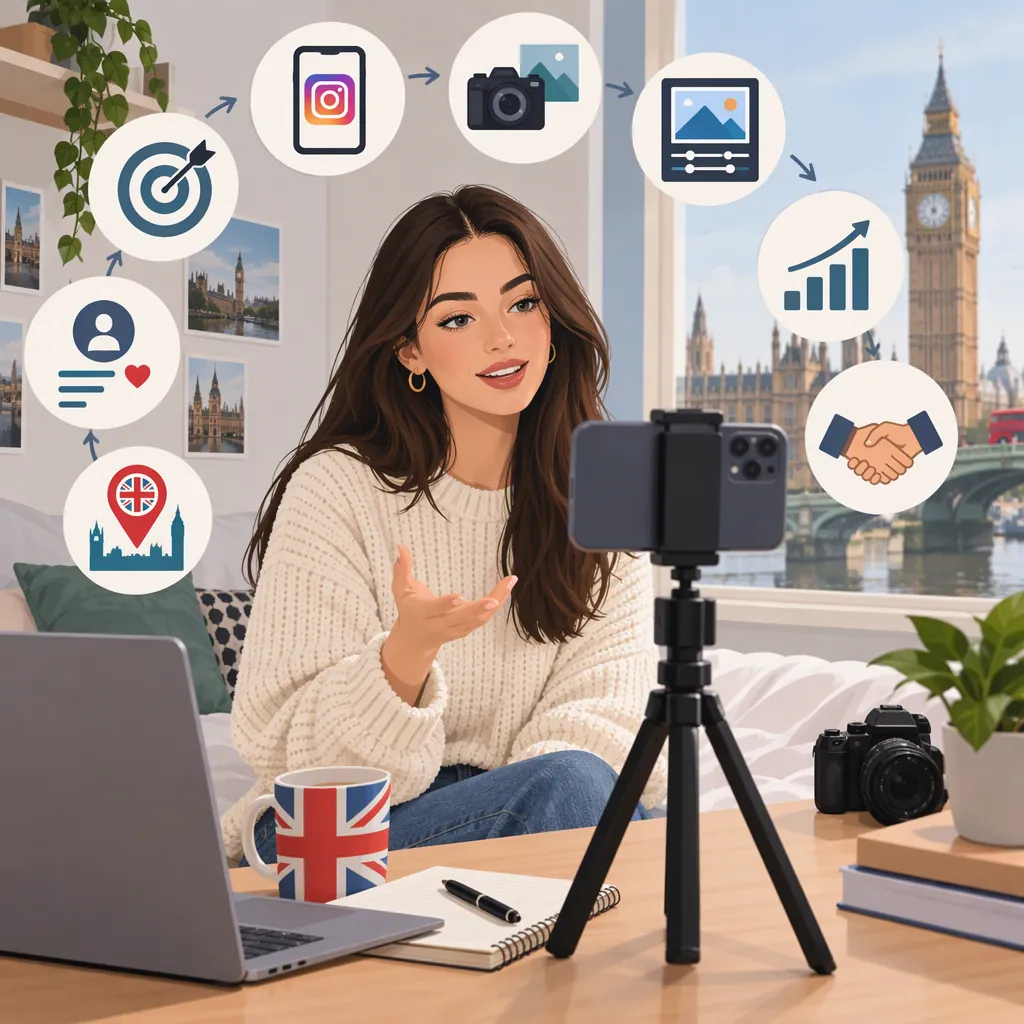
How to Become an Instagram Influencer in the UK
To become an Instagram influencer in the UK, choose a specific audience, create useful content consistently, engage with your community, and use your results to improve. Build a portfolio and an honest media kit, then approach brands whose work fits your audience. These are foundations for developing a creator career—not a guaranteed route to followers or paid partnerships. [c1] [c2]
Start with a workload you can sustain alongside your existing responsibilities. Your first goal is to demonstrate what you can create, who it helps, and whether you want to keep doing it.
Choose a Niche and a UK Audience
Start with the intersection of what you know, what you enjoy making, and what a particular audience needs. Both Sked Social and Acadium recommend choosing a clear niche rather than posting without a focus. [c1] [c2]
For a UK-focused account, make the local relevance concrete. Possible concepts include walks in one region, secondhand fashion on a pound-denominated budget, or practical meals using locally available ingredients. These are illustrative ideas, not proven growth opportunities.
Being based in the UK does not mean every post must be about the UK. Decide whether location is central to your content, relevant to potential partnerships, or simply background information.
Before committing:
- Draft ten post ideas that serve the same audience.
- Look at related accounts to identify questions they address or leave unanswered, without copying their work.
- Narrow the concept if your ideas target unrelated audiences.
- Broaden it slightly if you cannot imagine making the content repeatedly.
Define your account’s promise in one sentence: who it serves, what it helps them do, and what makes your approach distinctive.
Niche Planning Worksheet
- Audience: ___
- UK location or context, if relevant: ___
- Recurring question I can help answer: ___
- Experience or knowledge I can accurately demonstrate: ___
- Three repeatable content themes: ___
- Topics outside my expertise: ___
- Account promise: I make ___ for ___ so they can ___.
Make Your Profile and Portfolio Clear
Write a concise bio that explains your topic and audience. Choose a recognizable profile image and a presentation style you can maintain. Clear profile information and consistent personal branding are recommendations in both Instagram guides. [c1] [c2]
Include a broad location when it supports the account’s purpose, but avoid publishing a home address or private routine. Decide which parts of your life will remain off-camera.
Build a small portfolio that demonstrates actual skills, such as:
- Explaining an idea clearly.
- Filming a process.
- Editing a short video.
- Presenting a useful carousel.
- Researching and checking information.
Acadium identifies content research and multimedia skills as foundations for influencer work. Treat your early posts as practice in those skills, not just attempts to accumulate followers. [c2]
Label self-directed examples clearly. A post featuring a product you bought yourself is not evidence of a commissioned collaboration. Do not invent clients, testimonials, or campaign results.
Build a Sustainable Content Routine
Test a manageable mix of Reels, carousels, photos, and Stories rather than assuming one format will always win. The guides recommend content planning, varied formats, and community engagement, but their posting-frequency advice differs. Neither schedule should be treated as a universal requirement. [c1] [c2]
For an initial experiment, you might plan two substantial posts and one short question or update each week. This is a suggested workload, not an Instagram rule. Reduce it if filming, editing, or responding becomes difficult to manage.
Give each post one purpose: answer a question, demonstrate a technique, compare options, or explain an experience accurately. Batch similar filming tasks when convenient, leaving time to edit and check details.
Set defined windows for responding to comments and messages. Ask questions that invite useful discussion without promising constant availability. Ask permission before reusing someone else’s content or sharing a private message.
Measure Progress Beyond Follower Count
Review the analytics available to your account and connect each metric to a purpose. Sked Social recommends monitoring reach, saves, shares, and follower growth; Acadium recommends examining content performance and audience demographics. [c1] [c2]
The following examples are planning aids, not performance benchmarks. Use only the information your account actually provides.
| Goal | Evidence to review | What it cannot prove | One next test |
|---|---|---|---|
| Reach more people | Reach across several comparable posts | Reach alone does not show that viewers found the content useful or became followers | Make the opening explanation clearer while keeping the topic similar |
| Make practical content useful | Saves, shares, and comments describing questions or intended use | A save or share does not establish that someone followed the advice successfully | Add a clearer checklist or demonstration |
| Serve the intended UK audience | Audience location, where available, and relevant local questions | UK-themed content does not necessarily reach UK residents; commenters are not the whole audience | Make the location or local context more explicit |
| Keep production manageable | Time spent researching, filming, editing, and responding | A quick post is not necessarily effective, and a slow one is not necessarily valuable | Simplify one production step without removing useful information |
Compare several posts with similar goals rather than making a major decision after one unusually strong or weak result. Record the topic, format, response, and production time, then change one element at a time.
Weekly Content Review
- Post and date: ___
- Audience question addressed: ___
- Purpose and format: ___
- Production time: ___
- Available metrics and measurement date: ___
- Useful comments or questions: ___
- Evidence of audience fit, if available: ___
- What these results do not establish: ___
- One change to test next: ___
- Decision: repeat / revise / pause.
Prepare for Your First Relevant Brand Collaboration
Create a short media kit containing your niche, representative content, dated account metrics, and audience information you can substantiate. Sked Social recommends a media kit and relevant brand pitches; Acadium recommends partnerships that fit the account and written contracts for paid work. [c1] [c2]
If you have no previous clients, use your own portfolio. Keep observed results separate from predictions, and identify the period covered by each metric.
Choose an Appropriate Brand to Approach
Start with a small research list rather than sending the same message indiscriminately. For each potential partner, write down:
- Why its products or services are relevant to your audience.
- Which existing post demonstrates that fit.
- One content idea you could deliver accurately.
- Any concerns about claims, audience suitability, or your ability to assess the product.
- The publicly listed route for partnership inquiries.
If you cannot explain the audience fit without referring only to payment, reconsider the approach.
First-Contact Framework
This is a teaching template, not a promise of replies or paid work. Replace every placeholder with truthful information; portfolio placeholders are not actual links.
Subject: Instagram content proposal: [specific idea]
I create [type of content] for [specific audience], with a focus on [relevant UK context, if applicable].
Your [specific product, service, or project] appears relevant because [concrete audience connection].
My portfolio includes [self-directed or commissioned example, accurately labeled]. Representative work: [insert an actual portfolio address when using this template].
One possible collaboration is [specific content idea and proposed format]. My media kit includes dated metrics and the audience information currently available to me.
Could you share the campaign objective, intended deliverables, timing, budget, and proposed content usage? If the idea fits, we could discuss the scope.
Do not offer guaranteed sales, reach, or engagement. Before agreeing, clarify deliverables, deadlines, revisions, payment, content usage, exclusivity, cancellation terms, and disclosure expectations in writing. Estimate production time and costs before deciding whether the offer is workable.
Check UK Responsibilities Before Commercial Work
Transparent partnership disclosure is recommended by Sked Social, but its guide is not UK regulatory guidance. The references here do not establish current UK advertising rules, tax thresholds, or the treatment of gifts and affiliate income. [c1]
Use the checklist below to organize your research before accepting or publishing a collaboration. It is preparation guidance, not a statement of legal requirements.
UK Collaboration Research Checklist
| Area | Where to begin checking | Questions to confirm | Information to keep |
|---|---|---|---|
| Advertising disclosure | Official ASA/CAP resources on influencer advertising and CMA guidance on endorsements | Does this arrangement require disclosure? What wording, placement, and visibility apply to the planned format? | The brief, payment or benefits, brand approval rights, planned disclosure, and guidance checked |
| Gifts, loans, and affiliate arrangements | Official ASA/CAP and CMA guidance relevant to the arrangement | How do a gift, loaned item, discount, commission, or other relationship affect the disclosure assessment? | What was received, any posting expectations, affiliate terms, and messages agreeing the arrangement |
| Income and tax records | HMRC guidance accessed through GOV.UK | What must you record or report for your circumstances? How should payments, non-cash benefits, affiliate receipts, and costs be treated? | Payment dates, invoices, receipts, commissions, benefits received, and relevant agreements |
| Contract and content rights | The proposed agreement; qualified legal advice where necessary | Where may the brand use the content, for how long, and on what terms? Are revisions, exclusivity, and cancellation clearly defined? | The agreed contract, amendments, approvals, and payment terms |
Search for these topics within the organizations’ official resources rather than relying on a brand’s summary or an undated social post. Record the guidance title, its publication or update date if shown, the date you checked it, and the arrangement you assessed. Recheck before publishing if the brief changes.
Do not treat a platform partnership label as a complete compliance assessment. Seek qualified advice when you cannot resolve a disclosure or tax question, or when contract terms—such as broad usage rights or exclusivity—are unclear.
Protect Your Time and Evaluate the Career
Do not use a follower milestone alone to decide whether to leave other work. Set a review point and examine your workload, creative interest, actual revenue, costs, and dependence on individual clients. Avoid budgeting around partnerships that have not been agreed.
BBC reporting on three beginners describes emotional strain, difficult comments, and substantial time demands. That experiment involved TikTok and YouTube, not Instagram, so it illustrates possible pressures rather than Instagram-specific outcomes. [c3]
Set boundaries for private information, comments, and how often you check metrics. If the workload becomes unmanageable, reduce the schedule or pause.
At your review point, continuing part-time, changing the niche, or using the portfolio for other creative work are reasonable options. Treat the project as a career experiment, not a test of your personal worth.
Evidence and Timeliness
The Instagram strategy guides used here were published in 2022 by Acadium and 2025 by Sked Social. They support general planning advice, not confirmation of today’s Instagram interface, feature eligibility, algorithm behavior, or current UK legal requirements. [c1] [c2] The examples and worksheets in this article are suggested exercises, not documented creator outcomes.
FAQ
How Many Followers Do I Need to Become an Instagram Influencer?
There is no single follower threshold in Sked Social’s guide, which discusses brands working with smaller, targeted audiences. That does not guarantee a deal at any particular account size. Focus on useful content, audience fit, and results you can document. [c1]
Can I Start with No Followers?
Yes—you can begin building a profile and portfolio without an existing audience. Niche selection, content planning, engagement, and analytics provide a starting framework, but they do not establish how quickly a new UK account will grow or earn money. [c1] [c2]
Do I Have to Post Every Day?
No universal daily-posting requirement is established by these guides. Acadium gives mixed frequency advice and explicitly says beginners need not post every day; Sked Social suggests several posts per week. Choose a sustainable test schedule and review your own results. [c1] [c2]
How Do I Approach Brands Without Previous Clients?
Show clearly labeled self-directed work, explain why the brand fits your audience, and propose one specific content idea. Include dated, verifiable metrics rather than invented campaign results. Relevant pitches, media kits, and aligned partnerships are recommendations in the Instagram guides; they do not guarantee a response. [c1] [c2]
How Much Can a UK Instagram Influencer Earn?
The references do not establish a dependable UK earnings range. Acadium describes payment per post and affiliate commissions, but those options do not demonstrate likely income for an individual creator. Plan around agreed payments and actual costs rather than headline earning estimates. [c2]
Does Instagram’s Partnership Label Cover All UK Disclosure Responsibilities?
Do not assume it does. Sked Social recommends transparent partnership disclosure, but it does not establish current UK requirements. Check official ASA/CAP and CMA guidance for the specific arrangement and format before publishing. [c1]