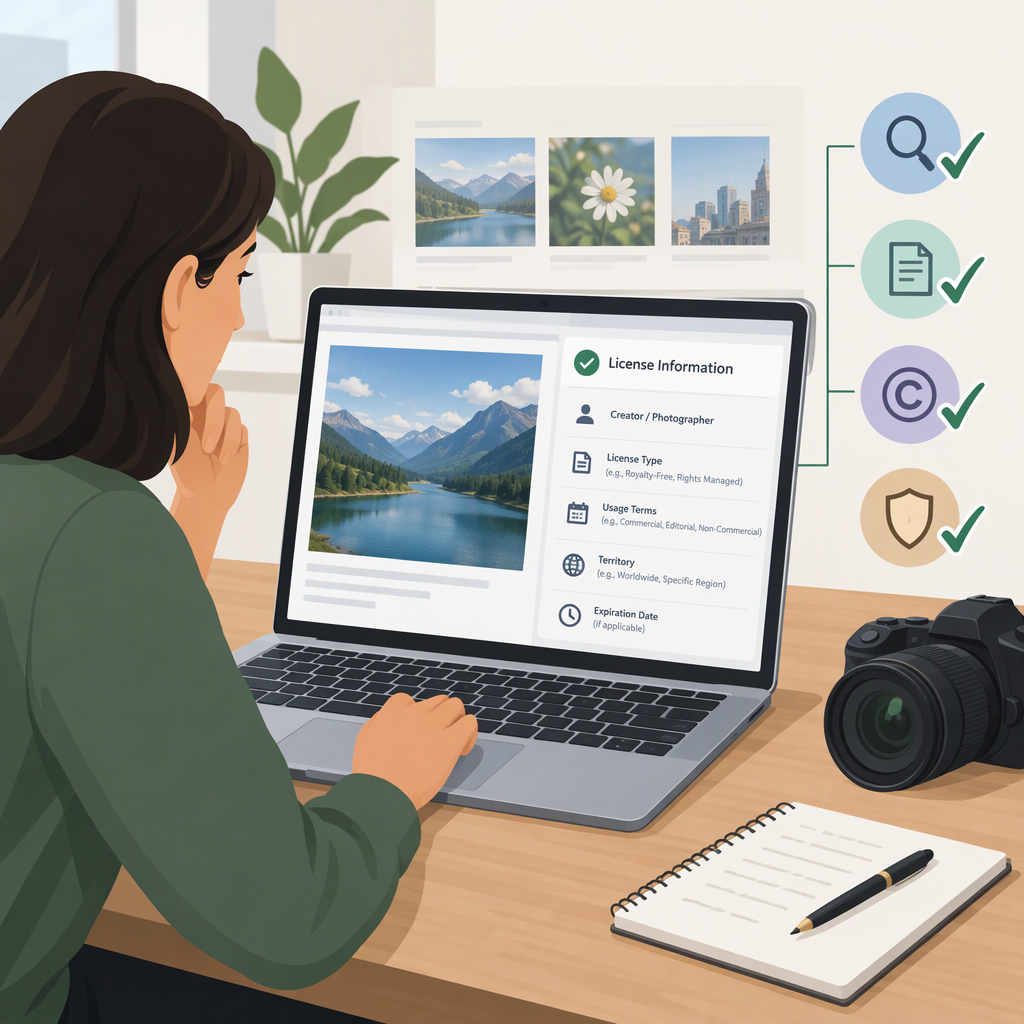
Photography Usage Rights: How to Check Before You Use an Image
Photography Usage Rights, in Brief
Photography usage rights are the permissions and conditions that determine how someone may use a photograph. They are separate from owning a copy of the image—and usually from owning its copyright. In the United States, the photographer generally owns copyright, subject to exceptions such as certain works made for hire. Buying, downloading, or receiving a photograph does not by itself transfer copyright or establish permission for every use. A license or other permission may allow specific uses while limiting others. (copyright.gov)
Before using an image, identify its source and rights holder, find the permission terms, and compare those terms with what you plan to do. If permission is unclear, ask the rights holder or choose an image with clear, suitable terms.
A Practical Permission Check
Use this checklist for each photograph:
- Identify the exact image and its source. Save the page or record where you found it, the creator or rights holder named there, and any image identifier. An image appearing online does not, by itself, show that it is free to reuse; the Copyright Office advises determining a work’s copyright status regardless of where it was found. (copyright.gov)
- Find the permission evidence. Look for a license attached to that image, a written agreement, or direct permission from someone authorized to grant it. A general site statement may not cover every image on the site. For stock images, read the terms for the specific image and license; terms differ among providers and plans.
- Match the terms to your actual use. Check the conditions that apply to that permission. Depending on the license or agreement, these may include commercial or editorial purpose, attribution, modifications, where or how the image may appear, and whether use is limited by time or audience. Do not assume every license addresses every item—or that a term from one provider applies to another.
- Check for separate concerns. If identifiable people, private settings, prominent brands, or other third-party material appear, copyright permission may not answer every question about the planned use. See the section below.
- Keep a record. Save the image page, applicable license or agreement, attribution wording, and relevant correspondence. If you cannot establish that the permission covers your use, ask for clarification or select another image.
A useful outcome is one of three decisions: allowed under the terms you found, not allowed under those terms, or not established—clarify before using. The last is not the same as permission.
Common Routes to Permission—And What to Check
| Route | What it generally means | What to check |
|---|---|---|
| Direct permission | The rights holder grants permission, often through a written agreement or license. | Confirm who is granting it, which image it covers, the permitted uses, any restrictions, and the permission’s duration. A photographer may not control every relevant right. |
| Stock-image license | A provider offers use under its own license terms. | Read the terms that apply to the exact image and intended use. Do not generalize from another provider’s license or assume that paying for access grants unrestricted use. |
| Creative Commons (CC) license | The rights holder allows reuse subject to the specific license conditions. | Check the exact license version and its requirements. For example, BY requires attribution; NC limits use to noncommercial purposes; ND restricts sharing adaptations; and SA requires adaptations that are shared to use the same or a compatible license. Some licenses combine conditions. (creativecommons.org) |
| Public-domain claim or dedication | Copyright restrictions may not apply to the work, or a rights holder may have dedicated it to the public domain. | Check the basis for the claim and the relevant jurisdiction. The Copyright Office describes public-domain works as works no longer protected by copyright or that did not meet its requirements. A label on an image page is a claim to assess, not proof that all possible rights or restrictions have been cleared. (copyright.gov) |
| Fair use | A U.S. copyright-law limitation may permit some uses without permission; it is not a license granted by the image source. | Fair use is assessed case by case under four factors: purpose and character, nature of the work, amount used, and effect on the potential market. There is no simple rule that attribution, educational purpose, or using only a small portion automatically makes a use fair. If the decision matters, get qualified legal advice. (copyright.gov) |
Illustrative example: Suppose a photograph carries a CC BY-NC license and you plan to place it in a promotional post for a paid service. The “NC” condition makes the planned commercial purpose a point to resolve; attribution alone would not remove that condition. Find a different license, obtain separate permission, or choose another image. The license terms—not merely the presence of a CC label—determine what is allowed. (creativecommons.org)
Copyright Permission May Not Settle Every Issue
A copyright license addresses rights in the photograph; it does not necessarily resolve concerns tied to a person or other material shown in it. In the United States, publicity rights are largely governed by state law, so rules can vary. A photograph intended to promote a product or service may therefore call for additional review of rights involving an identifiable person. A model release can document permission for specified uses, but do not assume a release is always required, covers every use, or guarantees that all legal issues are resolved. (law.cornell.edu)
Depending on the image and context, also consider whether recognizable property, trademarks, or private settings raise separate questions. If those issues could materially affect the use and you cannot resolve them from reliable permission records, pause and seek permission or qualified legal advice.
Bottom Line
Treat usage rights as permission with terms, not as a conclusion based on where an image appeared, who possesses a copy, or whether the creator is credited. Verify the permission for the specific photograph and intended use, follow its conditions, keep the record, and clarify uncertainty before publishing.