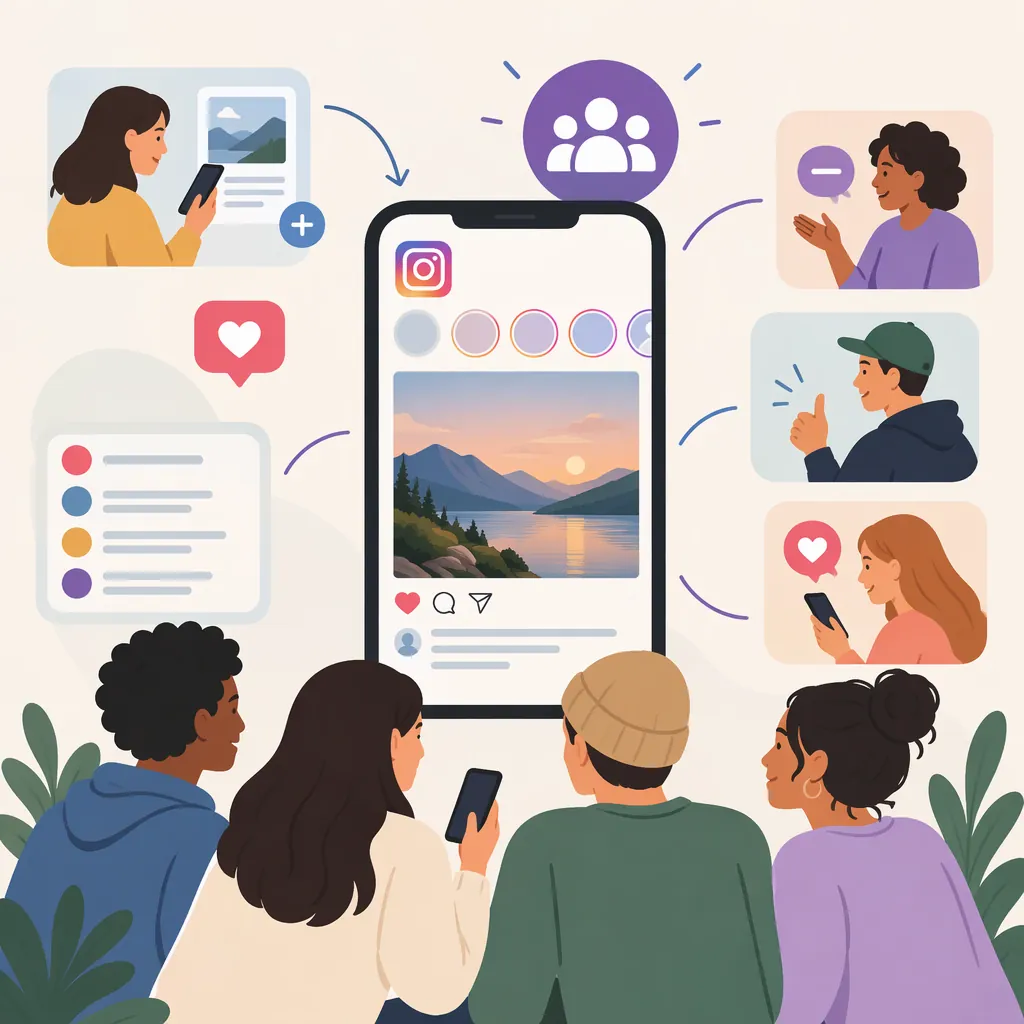
How to Make a Community on Instagram
To make a community on Instagram, choose a shared purpose, explain it in your profile and an introductory post, invite low-pressure conversations, and make time to respond. Publish clear participation rules, plan how to handle violations, and review whether the discussions remain useful and manageable.
This guide focuses on building a community around an Instagram account and its posts—not creating a separate group or setting up a specific Instagram feature. The examples below follow a beginner sketching community from its first invitation through ongoing conversations and moderation.
1. Define What People Will Gather Around
Start with a shared interest or activity rather than a follower target. For this plan, a community means an ongoing conversation people can voluntarily participate in—not simply an audience that sees your content.
Write down three things before you publish:
- Who the space is for: Choose a specific group, such as beginners learning to sketch.
- What people can do together: Ask questions, discuss practice techniques, or reflect on progress.
- What is outside the scope: Decide which topics, promotional contributions, and personal disclosures you will not invite.
Choose a purpose narrow enough to support several relevant discussions without asking people to share sensitive information. Avoid promising outcomes you cannot control, such as professional success or guaranteed visibility.
Community Purpose Template
This space is for [specific audience] who want to [shared activity]. We discuss [two or three topics] and welcome [types of participation]. We do not host [out-of-scope topics or behavior]. You are welcome to read without contributing.
For the sketching example:
This space is for beginners practicing everyday sketching. We discuss simple exercises, materials, and questions that come up while drawing. Respectful questions and reflections are welcome. Unsolicited promotions and personal attacks are outside the scope. Reading along is welcome too.
Use this purpose to decide what belongs in your posts. A discussion about drawing household objects fits; an unrelated promotional thread does not.
2. Make Participation Clear in Your Profile and First Post
Use your Instagram profile description to give visitors a concise explanation of the account. Then use an introductory post to explain how to participate and where the boundaries are.
Give people one straightforward starting action, such as answering a question in the comments. Keep the invitation specific and easy to answer.
Example Profile Description
Beginner sketching practice. Simple exercises and conversations about learning to draw. Join the questions in our posts—or read along.
Example Introductory Post
Welcome to this beginner sketching space. Each week, we’ll discuss a small drawing exercise and what we learned from it.
To start: which would you rather practice—lines, shapes, or shading?
Reading along is welcome. Please keep replies respectful, avoid unsolicited promotions, and don’t post private information about yourself or anyone else.
This connects the profile’s promise to a concrete conversation. Visitors do not have to invent a topic or provide a personal introduction to take part.
Avoid requesting identifying details, precise locations, private contact information, or personal histories that are unnecessary for the discussion. Do not make belonging conditional on commenting, tagging friends, or sharing your posts.
If you want to feature someone’s comment or contribution in a later post, ask permission for that specific use. Participation is not blanket consent to reuse their words or work.
3. Connect Posts, Comments, and Follow-Ups
Choose a publishing rhythm you can support with actual attention. One discussion prompt and one follow-up each week is a possible starting plan—not a requirement, proven optimum, or growth formula.
For each conversation:
- Publish one topic connected to the community’s purpose.
- Ask one specific question.
- Reserve time to read and respond to comments.
- Ask a relevant follow-up when someone invites further discussion.
- Use a later post to address an unresolved question or summarize useful themes.
Example: A Sketching Conversation Cycle
| Stage | Suggested Instagram action | Example |
|---|---|---|
| Discussion post | Share an example connected to the purpose and ask one question. | “This week’s exercise is drawing a cup using simple shapes. Which part would you like to practice: the oval rim, the handle, or the proportions?” |
| Comment reply | Acknowledge the person’s answer before asking anything else. | “The handle is a useful focus. Is its shape or its placement the harder part for you?” |
| Follow-up post | Address a theme from the discussion without exposing contributors’ details. | “This week we discussed cup handles. Here’s the next practice question: what would you change on a second attempt?” |
| Private review | Note what to keep or adjust. | “The choice-based prompt was clear. Next time, keep the follow-up focused on one drawing challenge.” |
Do not turn every reply into another demand for engagement. A thoughtful acknowledgment can be enough.
If nobody responds, first check whether the question is understandable, relevant, and comfortable to answer. Try a narrower prompt before increasing your posting frequency. For example, replace “How is your art journey going?” with “Which shape was hardest to draw in this exercise?”
When summarizing, avoid identifying or quoting contributors unless they have agreed. A general theme can often be discussed without reproducing an individual’s comment.
Two-Post Weekly Plan
- Discussion post: Share one example and one answerable question.
- Response window: Reserve a manageable block of time to read comments and reply.
- Follow-up post: Address one theme or unresolved question and invite optional reflection.
- Private review: Record what you learned and one possible adjustment.
4. Set Boundaries and Plan Moderation
Write participation rules before a difficult exchange happens. Keep them specific: no harassment, no sharing another person’s private information, and no unsolicited promotion. Explain that disagreement is welcome when it addresses ideas rather than attacking people.
Instagram describes safety tools that give users control over who can see or comment on their content and help filter negative words, alongside its work against bullying. [citation-1] This guide does not cover specific settings steps, and those tools should not be treated as a guarantee against harmful interactions.
Participation Rules Template
Discuss ideas respectfully. Do not harass people, share private information, or post unsolicited promotions. When a discussion crosses these boundaries, we may remind participants of the rules or stop engaging. Ask before reusing another person’s contribution. This account is not monitored continuously and is not an emergency support service.
Use a consistent response process rather than treating every difficult comment alike. The following is a suggested moderation approach, not an Instagram-mandated procedure.
| Situation | Suggested response | What to avoid |
|---|---|---|
| Good-faith disagreement | Respond to the idea, clarify your reasoning, and allow a respectful difference of opinion. | Treating disagreement itself as misconduct. |
| First off-topic comment or unsolicited promotion | Give a brief reminder and redirect to the discussion. | A lengthy public argument about the person’s motives. |
| Repeated boundary violations | State that the boundary has already been explained and stop the exchange. Review the account’s available safety controls if needed. | Repeated warnings that invite an endless debate. |
| Harassment or personal attacks | Refer briefly to the rule, disengage, and assess available safety controls. | Encouraging other participants to confront the account. |
| Someone posts another person’s private information | Do not quote or reproduce it. Prioritize addressing the exposure using available safety controls before giving any general explanation. | Repeating the information in a reply or asking others to investigate. |
A short reminder for the sketching community might be:
Please keep this thread about the drawing exercise. Unsolicited promotions are outside our participation rules.
For a repeated violation:
We’ve already explained this boundary, so we won’t continue this exchange.
Keep explanations brief and focused on behavior, not personal judgments. Do not ask participants to pile on, investigate an account, or enforce the rules for you.
Set realistic expectations about your availability. If you cannot keep up with replies and moderation, reduce the posting rhythm rather than implying that the account is monitored continuously.
5. Review Participation, Not Just Audience Size
After several conversation cycles, review whether the space is serving its stated purpose. Use observations from your own posts rather than assuming a larger audience means a stronger community.
Ask:
- Are people discussing the intended topic?
- Are any participants returning voluntarily?
- Do conversations include thoughtful exchanges rather than only brief reactions?
- Can newcomers understand how to join in?
- Can you keep up with replies and moderation without overcommitting?
Do not turn these questions into a rigid score for individual members. Record only what you need to improve the space, and avoid collecting sensitive personal details.
For the sketching example, you might notice that broad questions receive little discussion while prompts about one drawing challenge are easier to answer. Treat that as a reason to test a more focused question—not as proof that a format will produce growth.
Change one part of the plan at a time, such as the question format or posting rhythm. Continue what is relevant and manageable. Stop formats that repeatedly create confusion or require more moderation than you can provide.
Community Review Worksheet
- Review period: [dates]
- Purpose we intended to serve: [purpose]
- Conversation that stayed on topic: [example]
- Question that was unclear or difficult to answer: [example]
- Boundary issue to address: [issue, without private details]
- Workload we can sustain: [time commitment]
- One change for the next cycle: [change]
FAQ
Is an Instagram Community the Same as Having Followers?
Not in the sense used in this guide. A follower count describes an audience size; this plan focuses on shared purpose, voluntary participation, ongoing conversation, and clear boundaries. You can work on those practices without setting a minimum follower target.
Do I Need to Create a Separate Group to Build an Instagram Community?
Not for the approach described here. Start by explaining your account’s purpose, inviting discussion through posts and comments, and following up consistently. This guide is about that participation routine, not a setup tutorial for a separate Instagram feature.
How Often Should I Post for an Instagram Community?
Start with a schedule that leaves enough time to read replies and moderate discussions. One prompt and one follow-up per week is a possible starting plan, not a proven optimum. Adjust the rhythm to your capacity and the conversations people choose to have.
What Should I Do If Nobody Replies?
Review the invitation before posting more often. Ask one focused question connected to the account’s purpose, make it comfortable to answer, and leave room for people to read without contributing. Use the next conversation cycle to test one adjustment.
How Can I Prepare for Harmful Comments?
Publish clear rules, distinguish disagreement from violations, and decide when to remind someone of a boundary or stop engaging. Review Instagram’s available safety controls for content visibility, comments, and negative-word filtering. [citation-1] Keep your availability realistic, and avoid repeating private information or encouraging participants to confront an offending account.