How to Become a Full-Time Content Creator
To become a full-time content creator, define the income you need, choose an audience and content format, build a repeatable publishing process, and test how your work will earn money. Full-time work can mean a content job, freelance services, an audience-supported business, or a combination—not just becoming an influencer. Base your transition on actual earnings, expenses, and workload rather than a follower milestone or a promised timeline. These steps draw on creator guides that discuss income goals, production skills, and monetization; they do not establish a guaranteed route to financial stability. [c2] [c3]
Choose the Kind of Creator Career You Want
Start by separating three possible paths:
- Employment: Produce content for an organization.
- Freelancing: Sell content-production skills to clients, with payment structured by project or time.
- An audience-supported business: Publish your own work and earn through offers such as products, sponsorships, or affiliate commissions.
Rued Riis distinguishes employed creators from independent creators and describes combining freelance work with an audience-based business. Nakisha Wynn also discusses affiliate marketing, digital products, and brand collaborations. These are possible business models, not evidence that each will work for your niche. [c3] [c2]
For your transition, choose one primary path and one optional supporting path. If you prefer making content without documenting your personal life, consider client work, educational material, or an employed role rather than assuming lifestyle content is required.
Creator Career Brief
Complete these statements:
- My primary path is: employment / freelancing / audience-supported business.
- I create this type of content: ____.
- My audience or client is: ____.
- The need my work addresses is: ____.
- The person or organization paying me is: ____.
- My supporting income path, if any, is: ____.
Define What Full-Time Income Means for You
Before setting a quitting date, write down what the business needs to support. Wynn's guide recommends defining a personal full-time income goal rather than using someone else's earnings as the target. [c2]
For planning, separate money received from money available for personal spending. List essential household expenses, recurring business costs, and amounts you intend to reserve for taxes, benefits, and savings. Use your own figures; this article does not prescribe a tax rate or universal savings requirement.
Keep unpaid invoices and hoped-for sponsorships separate from cash already received. Decide in advance how much variability you can tolerate and what you would do if a major income source disappeared. The worksheet below is a proposed planning method, not a financial benchmark from the references.
Monthly Transition Worksheet
Essential personal expenses: ____
Business operating costs: ____
Planned tax and benefits reserves: ____
Planned savings contribution: ____
Monthly cash target: sum of the four lines above.

For each month, record:
- Cash received: ____
- Business costs paid: ____
- Amount reserved: ____
- Amount available for personal expenses: ____
- Unpaid invoices, tracked separately: ____

If the available amount falls short, my response will be: ____.
Choose an Audience and a Sustainable Format
Describe your audience by the questions, interests, or problems your content will address. Wynn recommends getting specific about the intended audience, while The Wanderlover emphasizes creating for audience needs rather than only for the creator's own interests. [c2] [c1]
Next, select a primary format you can realistically produce: articles, audio, photography, graphics, or video. Riis identifies text, graphics, sound, photos, and video as core content formats and recommends learning through making, sharing, gathering feedback, and repeating. [c3]
A practical starting choice is one main publishing channel and a manageable schedule. Add another channel only when you can explain its purpose and fit its production into your available time. That is a workload recommendation, not a claim about which platform currently grows fastest.
Write a small set of recurring topics. For each, identify an audience question and the specific takeaway a finished piece will provide.
Audience-To-Content Planner
| Audience Question | Content Topic | Format | Intended Takeaway | Feedback to Review |
| --- | --- | --- | --- | --- |
| Fill in a real question | Define a focused topic | Choose a format | State what the reader or viewer gains | Record relevant questions or responses |
Build a Repeatable Production Process
Use a content calendar to connect topics with production and publication dates. Wynn recommends content pillars, a calendar, and consistency in timing and quality. Riis highlights research, storytelling, production skills, and a portfolio in his discussion of content work. [c2] [c3]
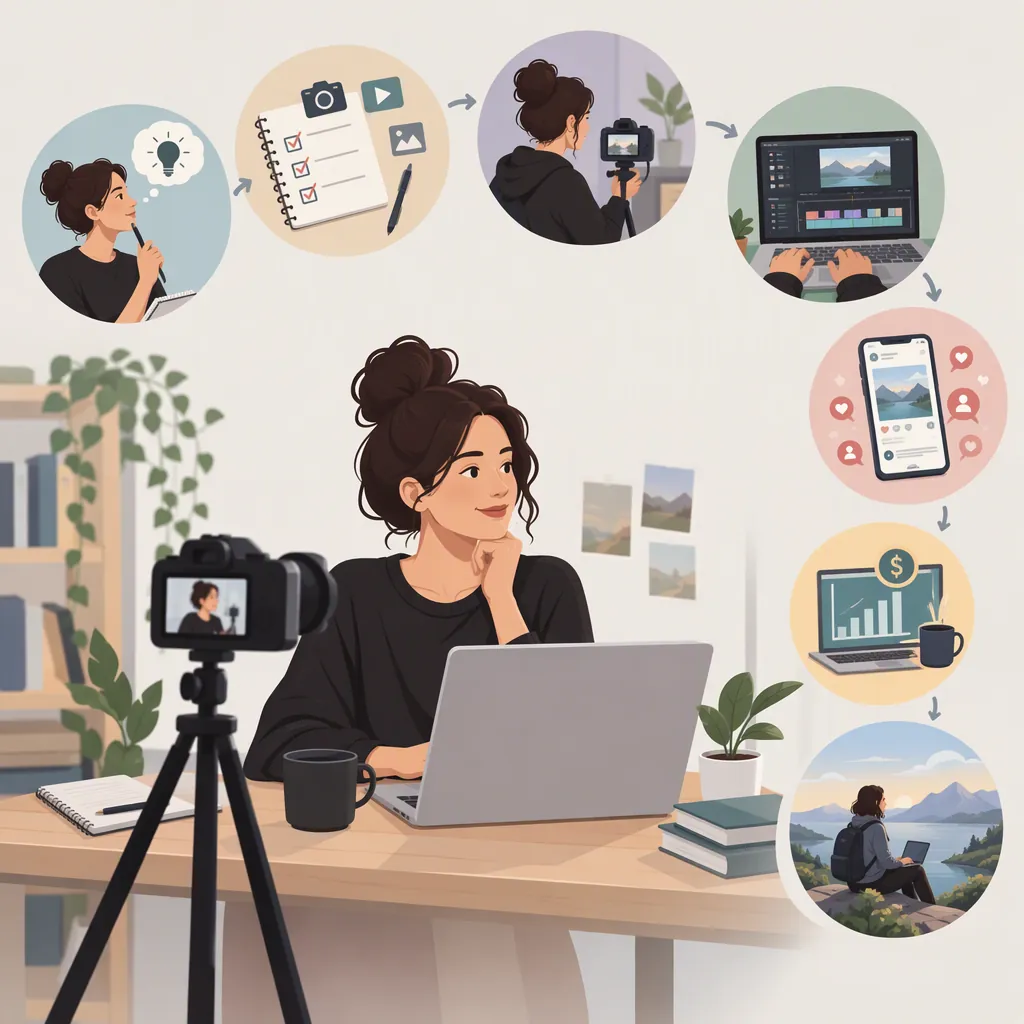
Try a simple workflow: research, outline, produce, edit, publish, and review. Record how long each stage takes. Include client communication and revisions when testing a freelance workflow, rather than measuring only the time spent writing or filming.
Choose a schedule that leaves room for administrative work and time away from publishing. The Wanderlover discusses burnout associated with continuous production and documenting personal life. That discussion supports considering boundaries, but it does not establish a universal safe posting frequency. [c1]
Keep selected examples of your work in a portfolio. Explain the purpose of each piece and your contribution without inventing performance results.
Weekly Production Review
Planned pieces: ____
Published or delivered pieces: ____
Hours spent researching: ____
Hours spent producing and editing: ____
Hours spent on administration and revisions: ____
Audience or client feedback: ____
One production improvement for next week: ____
Time reserved away from content work: ____.
Test How the Work Will Earn Money
Match the income model to the work you want to do. The references describe freelance production, products and services, affiliate commissions, brand collaborations, and platform-based earnings. They do not provide current, comprehensive platform eligibility or payout rules. [c1] [c2] [c3]
For a freelance path, define a limited service with clear deliverables, revision boundaries, and a price. For an audience-based path, test one relevant offer rather than building several products before you know what people need. For employment, organize work samples around the responsibilities of the role you are pursuing.
Track payment alongside the time and costs required to deliver the work. An offer that attracts interest but produces no paid work is not yet proof of an income source. Treat early results as information for the next test, not a forecast of full-time earnings.
Wynn recommends diversifying income streams. Use that as a reason to examine dependence on one source—not as a guarantee that more revenue streams will make the business stable. [c2]
Income Test Log
| Income Path | Offer or Deliverable | Price | Cash Received | Direct Costs | Hours Required | Next Decision |
| --- | --- | --- | --- | --- | --- | --- |
| Name the path | Describe the scope | Enter the price | Record actual payment | Record related costs | Include administration | Continue, revise, or stop |
Make the Transition a Decision, Not a Deadline
Use your publishing and income records to decide whether to stay part-time, reduce other work if feasible, pursue a content job, or move into independent creation full-time.
There is no verified one-year guarantee in these references. Wynn presents a one-year roadmap, while The Wanderlover cautions that traction and earnings may take years. Neither establishes a typical timeline for all creators. [c2] [c1]
The checklist below is a proposed decision aid, not a validated test. Set your own review period and minimum conditions before you are under pressure to leave other income. If the conditions are not met, identify the specific gap: insufficient earnings, excessive workload, weak demand, or inadequate reserves.
Source limitation: These references are individual creator guides, including articles dated 2021 and 2024. Their personal experiences and platform observations should not be treated as current payout rules, representative earnings, or promises of success. [c2] [c3]
Full-Time Readiness Checklist
- [ ] I have a written monthly cash target.
- [ ] I have reviewed actual income and expenses over my chosen review period.
- [ ] I can explain who pays me and what they receive.
- [ ] I have tested a production schedule that includes administration and rest.
- [ ] I understand my dependence on individual clients, platforms, or offers.
- [ ] I have planned for taxes, benefits, and business costs using my circumstances.
- [ ] I have chosen reserves appropriate to my obligations and risk tolerance.
- [ ] I have a fallback plan if earnings decline.

Decision: remain part-time / seek employment / reduce other work if feasible / transition full-time.
Next review date: ____.
FAQ
How Many Followers Do I Need to Become a Full-Time Creator?
These references do not establish a universal follower threshold. Riis describes both client-based work and an audience-based business, so the relevant readiness measures depend on your path. For this transition plan, use actual paid demand, costs, and workload rather than follower count alone. [c3]
Can I Become a Full-Time Content Creator in One Year?
A year can be a planning horizon, but these sources do not prove that it is a typical or guaranteed outcome. Wynn offers a one-year roadmap; The Wanderlover warns that traction and earnings may take years. Review your progress against your own income and production requirements. [c2] [c1]
Do I Have to Become an Influencer?
No. Rued Riis describes content creators working as employees, freelancers, and independent business owners. Producing articles, videos, graphics, or other material for clients is distinct from earning through a personal social media audience. [c3]