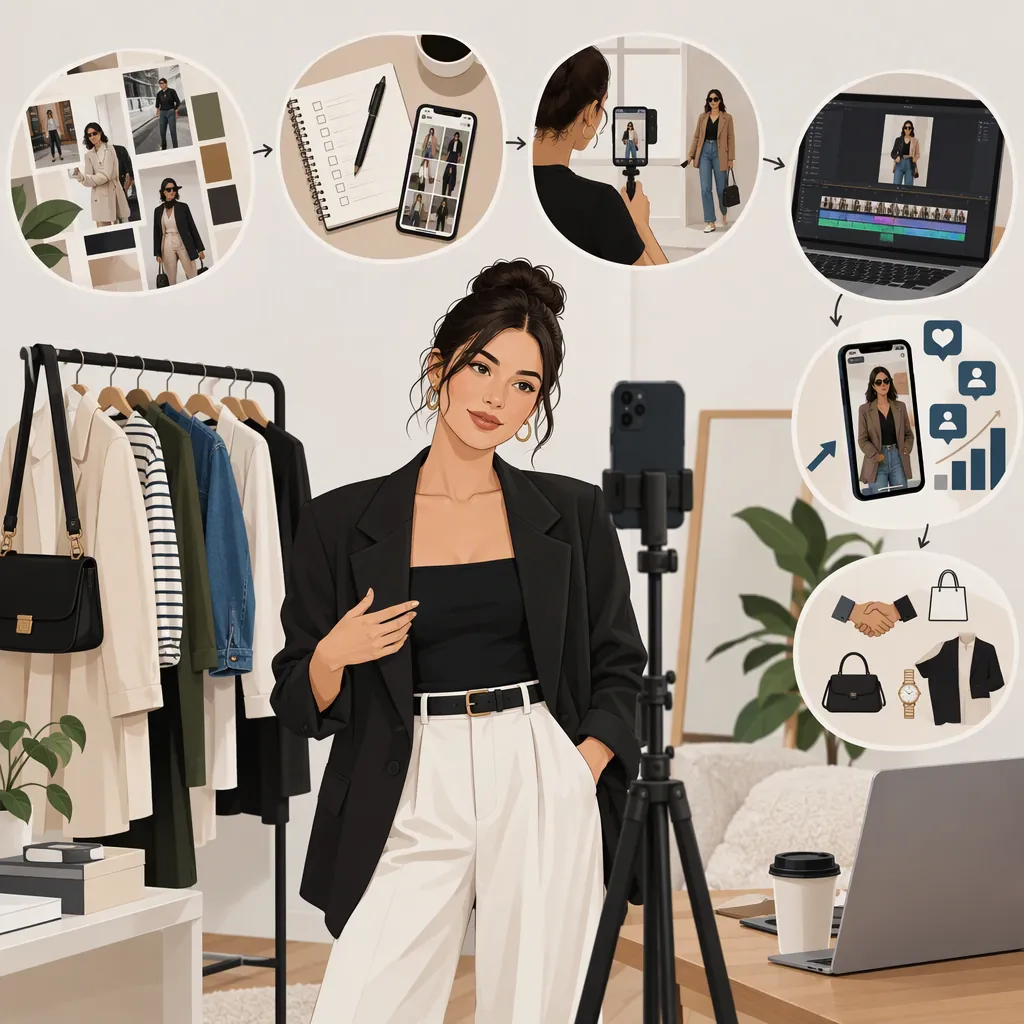
How to Become a Fashion Content Creator
To become a fashion content creator, choose a specific audience and style focus, make useful outfit or fashion content, publish on a manageable schedule, and build a portfolio of your strongest work. Use audience feedback to refine your approach before exploring paid collaborations. The supplied guides recommend niche selection, clear storytelling, community engagement, and consistency; none establishes a guaranteed timeline or income. [c1] [c2]
Choose a Fashion Focus and an Audience
Start with a question you can answer repeatedly, not just a broad interest in fashion. The John Casablancas guide recommends defining both a niche and a target audience; Afluencer similarly emphasizes a recognizable fashion identity. [c1] [c2]
Possible starting points include:
- Styling a small wardrobe for different occasions.
- Explaining vintage outfit combinations.
- Comparing different ways to wear one garment.
- Documenting your personal style experiments.
Treat these as editorial options, not proven growth strategies. Choose a focus you can demonstrate with clothing and knowledge you already have.
Write down who the content is for, what problem it addresses, and what you can realistically show. Avoid positioning yourself as an expert in garment construction, sustainability, or fashion history unless you can support the explanations you publish.
Fashion Focus Worksheet
Complete these sentences:
- My content is for people who want to ____.
- My main fashion focus is ____.
- I can demonstrate this using ____.
- Three recurring questions I can answer are ____, ____, and ____.
- Topics I need to research before discussing are ____.
Create Useful Posts with a Simple Setup
You do not need to begin with an expensive production setup. Afluencer recommends a phone, clear framing, steady shots, and good lighting; The Bureau also describes a smartphone as sufficient for starting fashion-week content. These are practical recommendations, not guarantees of professional results in every setting. [c1] [c3]
For an initial test, use a stable camera position and a background that makes the clothing easy to see. Check whether viewers can distinguish the details your explanation depends on.
Build each post around one idea:
- Question: What styling problem are you addressing?
- Demonstration: Show the outfit or comparison clearly.
- Explanation: Describe why you made those choices.
- Limitation: Explain when the suggestion might not suit someone else.
For example, compare two ways to style the same jacket and explain the different occasions you would choose them for. This gives the viewer more context than an unexplained outfit montage. Add readable captions and review them for accuracy before publishing.
Outfit Explanation Script
Opening: “Here are two ways I would style this ____ for ____.”
Look one: Show the full outfit, then explain one choice.
Look two: Show the alternative and explain what changed.
Comparison: Describe the trade-off in comfort, formality, or practicality.
Closing: State which option you would choose and why.
Review: Check that the garments, captions, and explanation match.
Choose a Platform and a Sustainable Schedule
The supplied guides identify Instagram, TikTok, and YouTube as options for fashion content; John Casablancas also lists Pinterest. They do not establish one universally best platform for beginners. [c1] [c2]
As a starting experiment, choose one primary platform based on the format you want to make and where your intended audience participates. Avoid committing to several channels before you know how much time production takes.
Set a schedule you can maintain alongside your other responsibilities. Afluencer explicitly recommends regular posting that fits your life rather than posting every day. [c1]
After each small batch of posts, review:
- Which questions appeared in comments?
- Which explanations were unclear?
- Which formats were manageable to produce?
- What do available platform metrics suggest about viewer response?
Use metrics as feedback, not as a verdict on your career prospects. Try changing one element at a time—such as the opening, framing, or explanation—so you can make a more useful comparison. Reply to relevant comments without feeling obliged to answer every message.
Build a Portfolio Before Chasing Access
Create a small collection that demonstrates what you can actually produce: an outfit explanation, a detail-focused video, a comparison, and a coherent series. These are suggested samples, not universal hiring requirements.
For each sample, record your role, the intended audience, and the creative objective. Include performance figures only when they are accurate, dated, and clearly labeled. Do not present unpaid practice work as a commissioned brand campaign.
Fashion-week coverage is one possible specialization, not a prerequisite for becoming a fashion content creator. The Bureau's guide recommends building short-form samples through local events, outfit content, and event previews before seeking program opportunities. Its portfolio advice reflects its own event-focused context, not an industry-wide admission standard. [c3]
Before covering an event, confirm filming permissions and the access included with your attendance. Do not assume that a ticket, creator title, or invitation gives you backstage access.
Portfolio Entry Template
Sample title: ____
Link or file location: ____
Status: Independent practice / commissioned work
Intended audience: ____
Creative objective: ____
My responsibilities: ____
Production date: ____
Verified results, if available: ____
What I would improve next time: ____
Explore Paid Work Without Assuming Stable Income
John Casablancas describes sponsorships, affiliate marketing, products, and advertising revenue as possible monetization routes. The Bureau discusses event compensation models including flat fees, gifted access, and revenue share. These examples do not establish what you will earn or whether you will qualify. [c2] [c3]
Keep two possible work arrangements distinct: publishing sponsored content to your audience and producing content for a client's use. Before accepting either, clarify the actual deliverables and rights rather than relying on the label “collaboration.”
A practical agreement checklist includes:
- Deliverables, formats, and deadlines.
- Payment amount or calculation method and payment date.
- Revision expectations.
- Where the content may be used and for how long.
- Whether paid advertising or exclusivity is included.
- Who covers clothing, travel, and other expenses.
Treat gifted clothing or admission separately from cash compensation. For revenue-share work, clarify tracking, attribution, and reporting before estimating potential earnings.
The supplied sources also discuss disclosure of paid relationships. Make commercial relationships clear to viewers and check the applicable rules for your location and platform; these articles are not a complete legal reference. [c1] [c3]
Use Your First Month as a Learning Experiment
The following plan is an editorial suggestion, not a validated growth formula. Its purpose is to help you finish a manageable set of work and decide what to improve.
Keep purchases optional during this experiment. If a production problem emerges, first identify the specific issue rather than assuming new equipment will solve it.
The references supporting this article are commercially oriented creator guides. They offer useful starting ideas, but they do not provide independent evidence of typical earnings, success rates, or time needed to establish a career. [c1] [c2] [c3]
Four-Week Starter Plan
Week 1: Complete your fashion focus worksheet. Choose one primary platform and outline three post ideas using clothing you already have.
Week 2: Produce and publish your first small batch. Note the time required and any filming or editing problems.
Week 3: Make a second batch that addresses a viewer question or improves an unclear explanation. Review comments and available metrics.
Week 4: Select your strongest samples for a portfolio. Record what each demonstrates, choose a sustainable schedule, and identify one skill to practice next.
End-of-month review: What can I make consistently? What does my audience ask about? What costs did I incur? What should I change before taking on paid work?
FAQ
Do I Need Expensive Equipment to Start?
Not necessarily. Afluencer and The Bureau recommend starting with a smartphone and focusing on lighting, framing, and clear execution. Test your existing setup before buying equipment for a specific production problem. [c1] [c3]
Do I Need a Large Following Before Creating Fashion Content?
You can begin making portfolio samples before building a large audience. The Bureau describes an event-program approach that emphasizes content quality over a large following, but its model should not be treated as a rule for every brand or creator opportunity. [c3]
How Often Should I Post?
Choose a frequency you can maintain while leaving time to improve the work and respond to useful feedback. Afluencer recommends sustainable consistency rather than requiring daily posts. The references do not establish an optimal posting frequency for everyone. [c1]
How Long Does It Take to Earn Money?
The supplied references do not establish a typical timeline. They describe possible income routes, but access to paid work and the amount earned remain uncertain. Build demonstrable samples and evaluate each opportunity's compensation, costs, and terms rather than assuming a quick transition to full-time income. [c2] [c3]