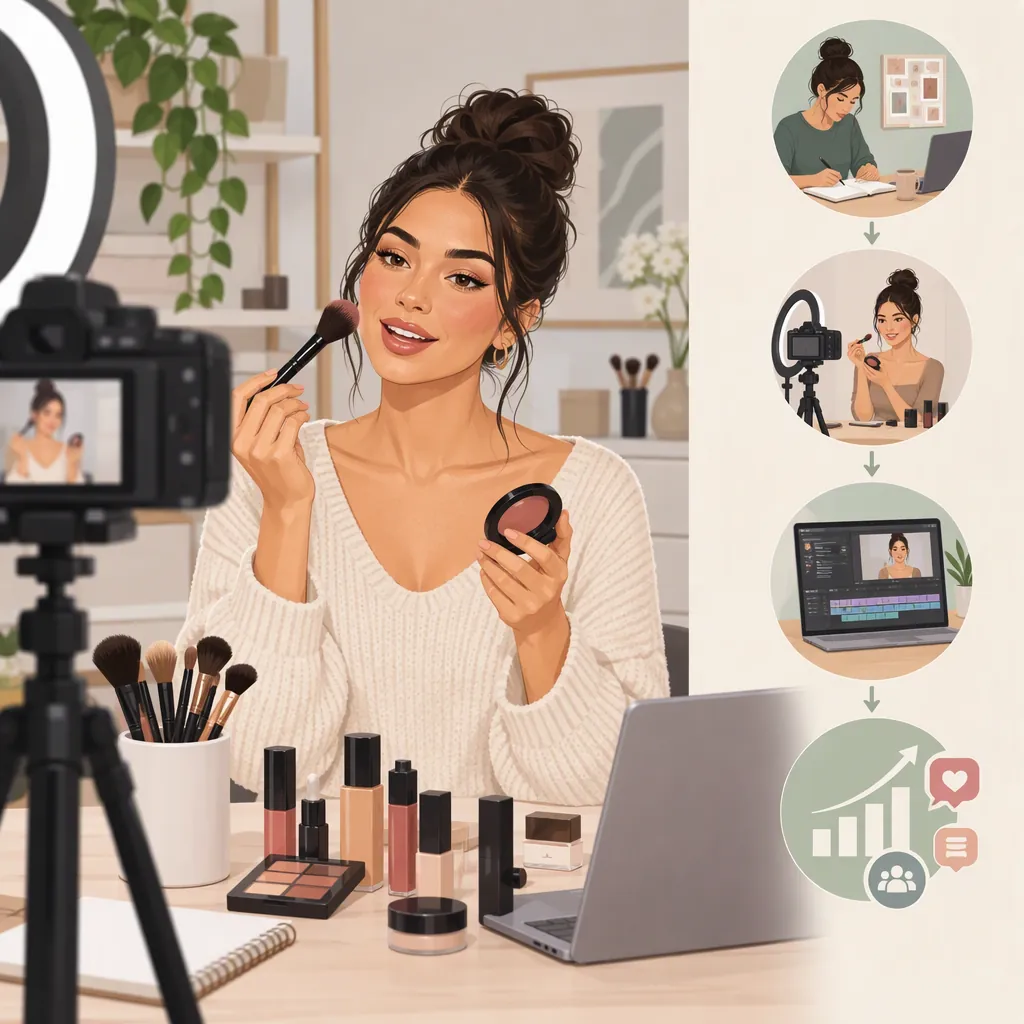
How to Become a Beauty Content Creator
To become a beauty content creator, choose a specific audience and beauty topic, start with one main platform, and practice making clear tutorials, reviews, or demonstrations. Publish on a manageable schedule, learn from audience feedback, and build a portfolio before pursuing paid collaborations. Content production, audience engagement, and transparency are core skills; the provided career guidance does not establish a guaranteed income or growth timeline.
Choose Your Beauty Focus and Audience
Start with a subject you can explain honestly and demonstrate repeatedly. QC Makeup Academy’s career guide recommends identifying your niche, defining your audience, and developing a consistent voice. It also distinguishes creators, whose focus is producing content, from influencers, whose focus includes shaping audience decisions; the roles can overlap. [c3]
Instead of choosing the broad topic “beauty,” pair a subject with a viewer need. Possible starting angles include:
- Beginner makeup techniques explained one step at a time.
- Colorful eye looks using products already in your collection.
- Hands-only nail art demonstrations.
- Hair-styling diaries that clearly describe your own hair and experience.
- Product-texture demonstrations without claims about treatment results.
Treat your first niche as a working hypothesis, not a permanent identity. Choose something you can sustain without constantly buying products. Define what you will cover—and what is outside your knowledge.
Beauty Content Positioning Worksheet
Complete these prompts before planning your first posts:
- I want to help: [specific viewer].
- Their recurring question is: [question or difficulty].
- My main subject is: [makeup, hair, nails, or another focus].
- My repeatable format is: [tutorial, demonstration, diary, or review].
- My perspective comes from: [actual skills or experience].
- I will not make claims about: [topics outside my knowledge].

Positioning sentence: I create [format] about [subject] for [viewer], with a focus on [specific need].
Pick One Platform and Practice Production
Choose your first platform by the content you want to make, rather than by promises of fast growth. QC Makeup Academy describes YouTube as an option for detailed demonstrations, Instagram for visual posts and video, and blogs for longer written explanations. Both QC Makeup Academy and Afluencer advise concentrating on one or two platforms rather than spreading your effort too thin. [c3] [c1]
For a beginner, one primary platform is a practical starting point. Choose short video for a single technique, longer video for a complete walkthrough, or writing with photos when the explanation needs detail.
Afluencer’s guide recommends clear visuals and good lighting, while explicitly advising beginners not to wait for ideal equipment. [c1] Start with the camera you have and make a test recording before buying anything:
- Check whether the viewer can see the relevant detail.
- Listen for understandable speech without distracting background noise.
- Keep framing and lighting steady during demonstrations.
- Trim pauses that do not help the explanation.
- Review captions for spelling, product names, and accuracy.
Avoid changing skin texture or color in a way that misrepresents what you are demonstrating. QC Makeup Academy recommends transparency about filters and editing. [c3]
Create a Repeatable Content Plan
QC Makeup Academy recommends planning a content calendar and developing photography, video editing, social media management, and writing skills. [c3] Turn those recommendations into a small production routine rather than an ambitious daily-posting commitment.
Use three recurring formats: teach one technique, answer one question, and document one experiment. Each post should have a clear purpose. For example, a brush-placement tutorial should explain placement—not also attempt a complete routine and a product roundup.
The following four-week plan is an illustrative practice schedule, not a proven growth formula. Adjust the workload to your available time. Its purpose is to help you finish posts, identify production problems, and build a small body of work.
Four-Week Beginner Practice Plan
Week 1 — Define and Test
- Complete your positioning sentence.
- List six viewer questions within your knowledge.
- Record one private test clip and review lighting, framing, and audio.

Week 2 — Produce
- Choose two questions from your list.
- Draft each post as: question → demonstration → explanation → limitation.
- Film and edit both posts. Check captions and factual statements.

Week 3 — Publish and Listen
- Publish at a pace you can maintain.
- Respond to relevant comments.
- Record recurring questions without collecting private audience information.

Week 4 — Review and Repeat
- Compare the posts using available platform metrics and viewer feedback.
- Identify one production improvement and one follow-up topic.
- Save your strongest work in a portfolio folder.
Build Trust and Learn from Feedback
Make the boundary between observation and advice visible. Describe what you actually did, what viewers can see, and what you cannot conclude. A personal product experience is not proof that everyone will get the same result.
QC Makeup Academy recommends disclosing partnerships and affiliate links, avoiding misleading claims, respecting intellectual property, and engaging genuinely with viewers. [c3] Apply those principles from your earliest posts:
- Identify paid, gifted, and affiliate relationships clearly.
- Do not present an untested product as something you have used.
- Check factual statements before publishing; remove claims you cannot support.
- Use your own material or material you have permission to use.
- Keep criticism specific to your observations rather than making unsupported accusations.
- Avoid presenting cosmetic content as diagnosis or treatment advice.
For improvement, look beyond follower count. QC Makeup Academy suggests reviewing comments, shares, saves, and other available analytics. [c3] Ask whether viewers understood the demonstration, what they wanted clarified, and which topics prompted useful questions. Compare similar posts where possible; one unusually popular post is not a dependable career forecast.
These are editorial and ethical starting points, not a complete statement of advertising law or platform rules.
Build a Portfolio Before Pursuing Paid Work
A portfolio should show what you can produce, not imply a professional history you do not have. Select a few strong examples that demonstrate different skills: explaining a technique, filming detail clearly, and writing a useful caption or review.
QC Makeup Academy recommends a media kit containing an introduction, content examples, audience information, social metrics, and contact details. It also discusses sponsored content, affiliate marketing, advertising revenue, subscriptions, and freelance work as possible revenue streams. [c3]
For a beginner’s kit, include only information you can verify:
- Your subject area and production formats.
- Links to published examples or clearly labeled sample work.
- Current metrics, with the platform and measurement period stated.
- Services you can actually deliver.
- Your contact information.
Leave out client testimonials and previous collaborations if you do not have them. Before accepting an assignment, clarify deliverables, deadlines, revisions, payment, content usage, exclusivity, and disclosure expectations in writing. Treat this as a discussion checklist, not a substitute for legal advice.
Affiliate work is different from a fixed-fee assignment. Ulta Beauty’s affiliate page describes earning commission through sales and separates its UB Creates creator program from its Impact program for publishers. It states that a website or blog is not required for UB Creates. [c2] This is one documented example, not a recommendation or an assurance of acceptance. The supplied page does not establish what a particular beginner would earn.
Set Realistic Career Expectations
Separate three goals: learning to make content, building an audience, and earning sustainable income. Progress in one does not automatically establish the others.
QC Makeup Academy notes that earnings depend on factors such as audience size and engagement, platforms, expertise, location, and brand partnerships; it does not give a single dependable salary figure. [c3] The provided references also do not establish a guaranteed time to profitability.
Use practical checkpoints instead of an arbitrary follower target: Can you explain a technique clearly? Finish content on schedule? Correct mistakes openly? Show consistent work in a portfolio? Understand the terms of a paid assignment?
Track your spending and production time alongside any revenue. Keep the initial workload manageable, and reconsider purchases or commitments that make the process financially difficult. A useful first milestone is a repeatable workflow and an honest portfolio—not an assumption that content creation will immediately replace other income.
FAQ
Do I Need Expensive Equipment to Start?
No. Afluencer’s guide advises beginners not to wait for ideal equipment and describes using a phone to begin. Make a test recording first, then consider an upgrade only when you can identify a specific problem with lighting, sound, or framing.
Can I Create Beauty Content Without Showing My Face?
Yes, depending on the subject. Afluencer identifies hands-only tutorials, product reviews, and close-up techniques as possible formats. Choose demonstrations viewers can understand without a full-face view, and describe the limits of what the footage shows.
How Much Can a Beginner Beauty Creator Earn?
The provided references do not establish a reliable beginner income figure. QC Makeup Academy describes several revenue streams but says earning potential varies with audience, platform, expertise, and partnerships. Plan around actual paid work and costs rather than projected earnings.
Do I Need a Blog to Join a Beauty Affiliate Program?
Not necessarily. Ulta Beauty states that its UB Creates program is open to creators across major social media platforms without a website or blog, while directing traditional publishers to its Impact program. That example should not be treated as a rule for every affiliate program.