Soccer B-Roll: What to Film, How to Capture It, and How to Use It
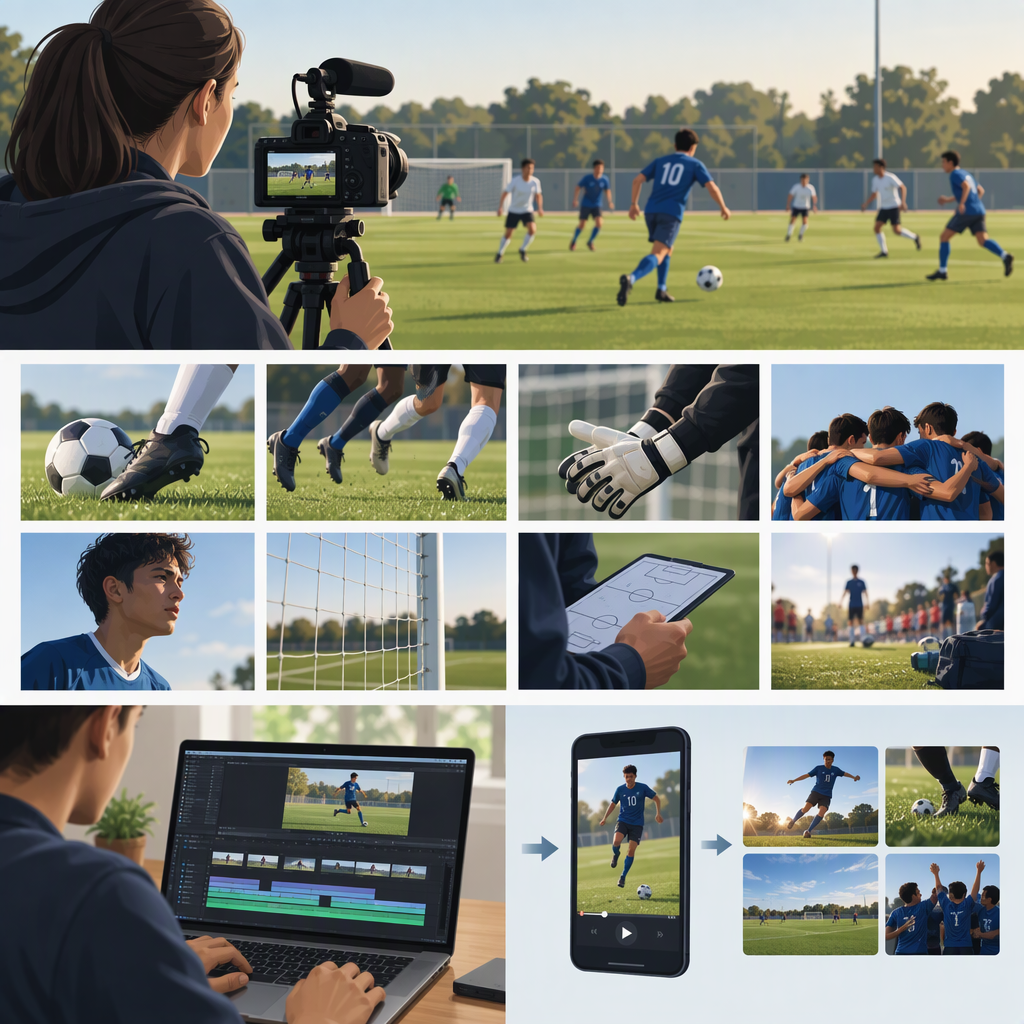
Soccer B-roll is supporting footage that helps tell a soccer story without being its main action. Depending on the video, that could mean a field establishing shot in a player profile, or a close-up of a ball before a match recap. Use it to add context, smooth a transition, or illustrate narration—not as a substitute for the key play when the play itself is the story. Adobe describes B-roll as footage that supplements the main video and can establish a scene, smooth a transition, or add meaning. (adobe.com)
What Counts as Soccer B-Roll?
The label depends on the video’s purpose. In a highlight reel, a goal may be the main action, while a shot of the sideline or a player preparing to enter could support the story around it. In a profile built around an interview, practice footage or details of the training ground could give viewers relevant visuals while the player speaks. These are illustrative examples: a shot is B-roll because of the role it plays in the edit, not simply because it shows a soccer setting.
B-roll may be recorded for the project or sourced from elsewhere, such as an archive. If it is not your footage, check its copyright status and usage terms before using it; finding a clip online does not by itself establish permission. The U.S. Copyright Office explains that permission or a license may be needed unless a limitation applies, and that the Office cannot decide whether a limitation applies to a particular use. (copyright.gov)
Plan a Soccer B-Roll Shot List
Start with the story you need to tell, then choose a few shots that serve specific purposes. The list below is a starting point, not a universal checklist. What you can film depends on the format, your access, and any event or venue rules.
| Editorial purpose | Illustrative shots to consider | Why they may help |
|---|---|---|
| Establish the place | Field or venue exterior, empty pitch, goal and net | Orient viewers before the main story begins. |
| Add preparation details | Ball being placed, boots being tied, cones at a practice | Give a training or pre-match segment visual detail. |
| Support narration or an interview | A relevant practice drill, a player listening to a coach, a wide view of a session | Show related activity while the speaker explains it. |
| Bridge a transition | Players walking toward the pitch, teams gathering, a view of the field between sections | Connect two parts of an edit without implying a play occurred. |
| Show a result or reaction | A celebration after a verified goal, or a quiet post-match moment | Add a human detail when it fits the story and context. |
Example: a short match recap. If the recap is mainly about a decisive goal, the goal and its immediate lead-up are likely the primary footage. A field-wide opening, a verified scoreboard view, and a relevant post-match reaction might provide context around it. Don’t use an unrelated celebration as if it followed that goal.
Example: a player profile. If the central material is an interview, consider practice footage connected to what the player discusses, along with a few details that establish the training setting. Keep the shots relevant to the person and story rather than collecting generic match footage just to fill space.
Capture Footage That Can Work in the Edit
- Check access before planning shots. Confirm where you may film and whether the event organizer or venue sets recording conditions. Rules can differ by event. For instance, EDP Soccer’s policy for certain showcase events says outside professional recording services are not permitted where its contracted service providers are present; that is an event-specific example, not a universal soccer rule. (edpsoccer.com)
- Protect the main recording if you are filming alone. If you need continuous match coverage, prioritize it over cutaways; plan supporting shots for before or after play, or use another operator only if allowed. This is a practical way to avoid missing the action your edit depends on, not a technical requirement.
- Write down the purpose of each shot. A short list helps you capture footage that supports the story instead of accumulating unrelated clips. Adobe likewise recommends planning B-roll with a shot list. (adobe.com)
- Keep each shot useful and understandable. Before recording, check that the intended subject is visible and that the framing fits its purpose. If your goal is to show a player’s expression, that calls for a different view from one meant to show the setting. For full-match analysis, the requirements can differ: Hudl’s soccer guidance notes that players and fans may prefer closer action, while coaches and analysts may prefer a wider view of formations and spacing. (hudl.com)
- Make a brief review pass. Check that the footage is steady enough to use, the subject is clear, and the shot says what you intended. Note the useful clips so you can find them during editing.
There is no single framing or equipment setup that fits every B-roll shot. A close view may communicate a detail; a wide view may explain the setting. Choose for the story and for the access you actually have, rather than treating match-analysis recording advice as a universal B-roll prescription.
Select and Use B-Roll Responsibly
For each clip, ask: What does this show, and what will viewers think it shows in this edit? Place a shot over narration when it genuinely illustrates the point. Use a transition shot to bridge sections, not to imply a specific event. Keep the sequence, captions, and surrounding audio consistent with what happened.
This matters especially in recaps and news-style videos. A visually plausible shot can still create a false impression if it is from a different moment or is presented as a reaction to an event it did not follow. The National Press Photographers Association’s visual-journalism code calls for accurate representation, context, and editing that preserves the integrity of images’ content and context. (nppa.org)
If you are filming youth soccer, also follow the club, event, and venue’s guidance for filming and sharing. Safeguarding advice varies by organization and jurisdiction; The Football Association’s guidance, for example, addresses risks around filming and sharing images of children, but it applies within its own football context and is not a substitute for local rules. (thefa.com)
For footage you source from someone else, check the license or obtain permission when required, and keep a record of the terms. For footage you recorded yourself, still check applicable event or venue conditions before filming or publishing. This article is general educational guidance, not a determination of the rights that apply to a particular match, clip, or jurisdiction.
Quick Checklist
- Does each supporting shot serve a clear purpose in this specific video?
- Have you protected the main action if it is essential to the story?
- Is the footage relevant to the narration and the moment it appears to depict?
- Have you checked event or venue filming conditions?
- For third-party footage, have you checked its source, rights, and usage terms?
- If children appear, have you followed the applicable safeguarding and sharing guidance?
The most useful soccer B-roll is not simply extra footage: it is footage that gives the viewer relevant context without changing the meaning of the story.