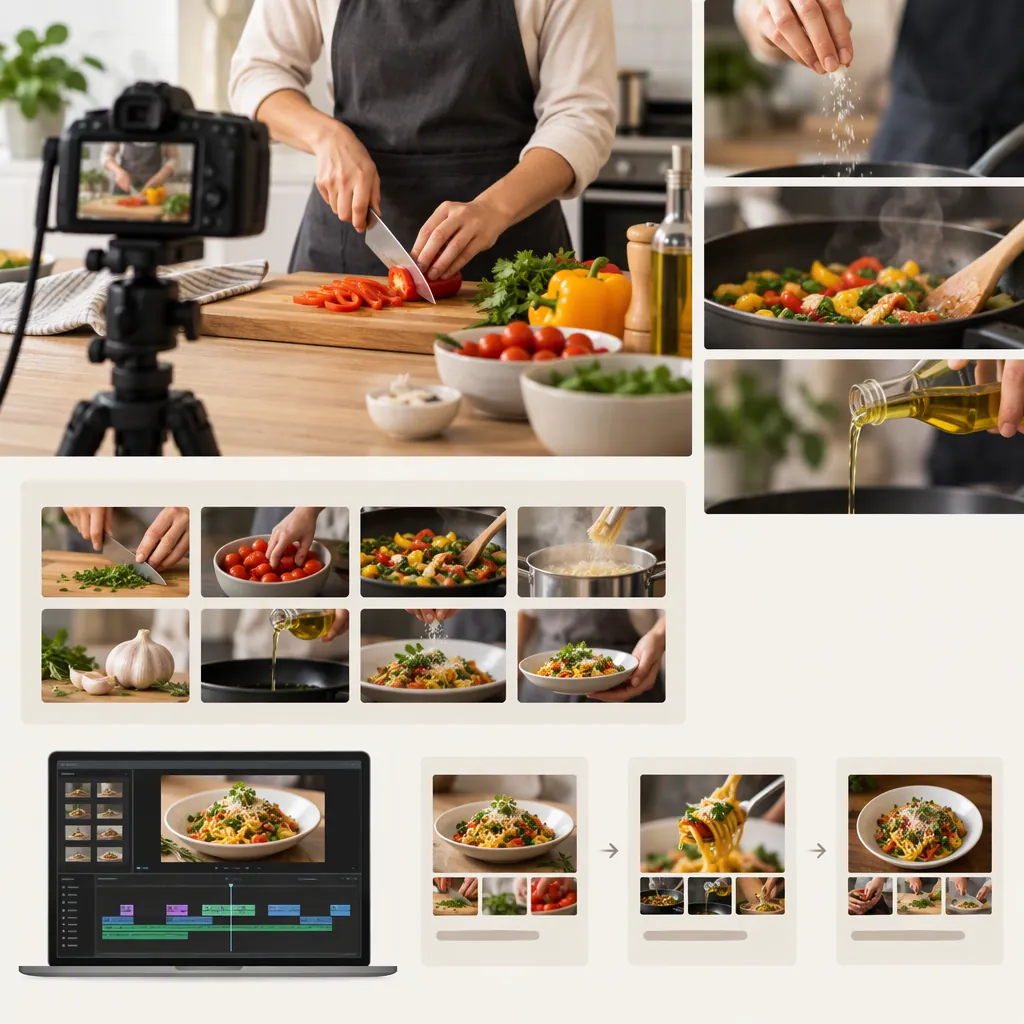
Cooking B-Roll: What to Film and How to Use It
Cooking B-roll is supporting footage of ingredients, preparation, cooking, and finished food used alongside a video's main explanation or demonstration. Plan each shot around what the viewer needs to see: the ingredient being discussed, the action being explained, or the result of a step. Start with a view of the workspace, add close details of key actions, and finish with the plated dish.
Give Each Shot a Purpose
Use cooking B-roll to answer a visual question rather than simply fill time. What goes into the pan? What does the mixture look like after stirring? What is being served?
For planning purposes, separate your main explanation from its supporting images. A continuous demonstration of a recipe step may be the main footage; a close-up inserted while the cook explains that step serves as B-roll. Choose the role according to your edit, not just the camera angle.
The supplied reference, Nibble Me This's “B-roll Footage,” uses the term for cooking photographs that did not become standalone recipe posts. It includes pasta with ham and peas, burgers, chicken, and steaks. That is food-content context, not a technical definition of video B-roll. The workflow below is a proposed filming approach, not a method documented by that post. [citation-1]
Build a Shot List Around the Recipe
Choose one dish and list its meaningful stages before filming. For each stage, propose a context shot and a detail shot. Prioritize steps that would be difficult to understand from narration alone.
For a pasta sequence, for example, plan ingredients on the counter, sauce being stirred, pasta being added, and the finished bowl. Treat this as an illustrative sequence—not a reconstruction of the reference author's cooking process.
Mark actions that cannot easily be repeated, such as a first pour or the final garnish. Decide where the camera will be before beginning those actions.
Cooking B-Roll Shot List
- [ ] Workspace: show the cooking area and ingredients.
- [ ] Ingredient detail: show an ingredient relevant to the explanation.
- [ ] Preparation: record one clear action from start to finish.
- [ ] Cooking: show the food during a meaningful stage.
- [ ] Progress detail: record the appearance you will discuss.
- [ ] Plating: capture the transfer or garnish.
- [ ] Finished dish: hold a clear view of the result.
- [ ] Edit note: identify the narration or recipe step each clip supports.
Film Clear, Usable Food Details
Begin with a simple setup. Secure the camera outside the working area, compose the shot, and check that the hands, utensil, and food remain visible throughout the action. Do not sacrifice safe handling of knives, hot cookware, or food to obtain a shot.
Try a wider view for orientation and a closer view for one important detail. Avoid changing angles merely to add variety; choose an angle that shows the action clearly.
Before a nonrepeatable step, record a short test and review framing, focus, brightness, and sound. Leave a brief pause before and after the action so you have room to choose the cut. If you want chopping, pouring, or stirring sounds, record a separate take without talking and review it before continuing.
Keep a simple continuity note: ingredient state, utensil, pan position, and stage of cooking. If you recreate a detail later, label it in your clip notes rather than assuming it belongs anywhere in the sequence.
Use B-Roll Without Obscuring the Recipe
Build the edit around the explanation first. Then place supporting shots where they illustrate the ingredient, action, or result being discussed.
Use this review test for every insert:
- Does the image match the current step?
- Can the viewer identify the relevant action or detail?
- Does the cut preserve the recipe's order?
- Is any essential instruction lost while this shot is on screen?
Shorten decorative shots when they compete with the explanation. If you condense a cooking stage, avoid presenting the shortened sequence as the actual elapsed cooking time. Keep necessary timing and doneness instructions explicit rather than asking viewers to infer them from a montage.
Finish by checking the sequence with sound, then without sound. Look for mismatched ingredients, unexplained jumps, or a finished dish appearing before the preceding step is clear.
FAQ
Is Every Close-Up of Food B-Roll?
No. Classify a shot by its role in the video. A close-up may carry the main demonstration, or it may support an explanation delivered elsewhere. For your shot list, label what each clip is meant to communicate.
How Long Should a Cooking B-Roll Shot Stay on Screen?
Choose the duration according to the information being shown. Let viewers recognize the ingredient or action, then cut when the shot has served its purpose. Avoid applying one fixed duration to every clip.
Should I Repeat a Cooking Action for Another Angle?
Only consider a repeat when it is safe and does not misrepresent the step. For irreversible actions, plan the angle in advance. If a later detail shot depicts a different stage, do not edit it as though it shows the original moment.
Sources
- [citation-1] B-roll Footage