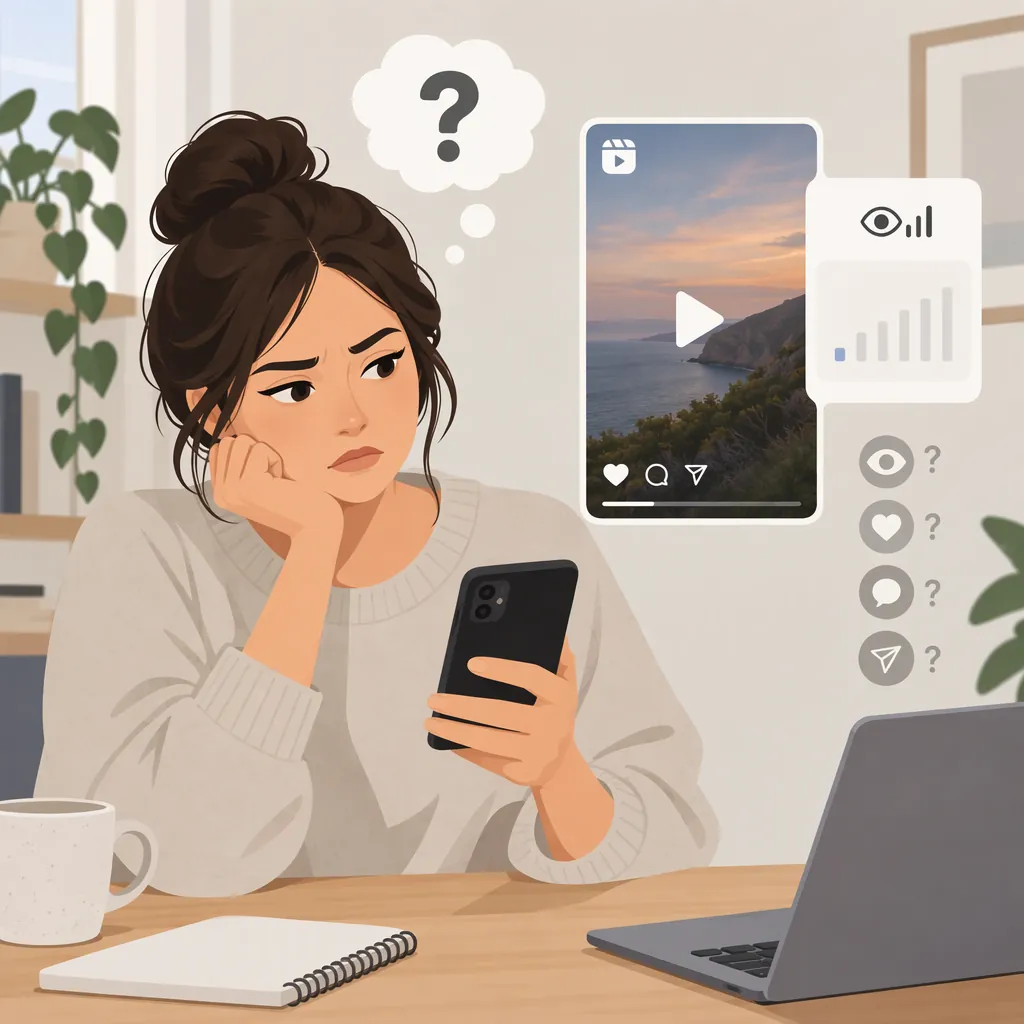
Why Aren’t My Reels Getting Views? a Troubleshooting Plan
Low Instagram Reels views do not identify a single cause. Possible explanations include account restrictions, upload problems, repetitive content, audience mismatch, or changes in posting patterns. The supplied source discusses these possibilities, but it cannot establish which applies to your account. Start with account notices and playback checks, then compare similar Reels and test one content change at a time. [c1]
First, Identify What Changed
Before changing your posting strategy, separate three situations:
- One Reel underperformed: Inspect that upload and its topic before treating the result as an account-wide problem.
- Several recent Reels dropped: Look for shared changes in format, subject, posting time, or production workflow.
- Views fell after an unusually successful Reel: Compare with your typical posts, not only the exceptional result.
The source distinguishes isolated underperformance from a sustained decline and discusses audience mismatch after a viral Reel. These are useful diagnostic possibilities, not proof of how Instagram distributed your posts. [c1]
For a practical comparison, select several recent Reels and several earlier Reels with similar topics and lengths. Record results at the same time after publication—for example, at a consistent checkpoint you choose. Avoid comparing a newly published Reel with one that has been available much longer.
Reels Comparison Worksheet
For each Reel, record:
- Publication date and time:
- Time elapsed when checked:
- Topic and intended audience:
- Format and duration:
- Views:
- Accounts reached, if available:
- Watch-time metrics, if available:
- Shares, saves, and comments:
- Playback or account notices:
- What changed from comparable earlier posts:

Use “unavailable” for missing metrics rather than treating them as zero.
Check Account Notices and the Published Reel
The source recommends checking Instagram’s Account Status for flagged or restricted content. [c1] Look for that setting and read any explanation shown for your account. If a notice provides a corrective action or review option, follow the instructions displayed rather than guessing from the view count.
Next, inspect the published Reel, not just the original file:
- Does it open and play normally?
- Is the image clear enough to understand?
- Is speech audible and synchronized?
- Is important text readable and on screen long enough?
- Did the upload preserve the intended opening and ending?
The source lists image degradation and audio-processing problems among possible issues. [c1] A visible defect gives you a specific problem to correct; low views alone do not.
Do not assume that deleting and reposting will reset distribution. Preserve the post’s results before making changes, and avoid deleting a working upload solely because its count is disappointing.
Review the Opening, Payoff, and Audience Fit
If you find no clear notice or playback defect, review what the viewer is being offered. The source suggests investigating repetitive formats and a mismatch between recently acquired followers and regular content. [c1]
Use these questions as editorial checks, not as a formula for ranking:
- Who is this for? Name a specific audience and the question, problem, or interest the Reel addresses.
- Is the opening understandable? Consider whether a viewer unfamiliar with you can recognize the subject without a long introduction.
- Does the Reel deliver its promise? Check whether the demonstration, explanation, or result actually appears.
- Is there unnecessary material? Try removing repetition or setup that does not help the viewer understand the payoff.
- Is the angle meaningfully different? Keep a recognizable subject while testing a new question, example, or presentation.
If watch-time metrics are available, use them alongside your playback review. If shares or saves differ across comparable posts, inspect the content differences rather than assuming a particular algorithmic cause. These observations can help choose the next experiment; they cannot reveal Instagram’s internal ranking decision.
Test One Change Instead of Changing Everything
Choose the clearest issue from your review and make a small, deliberate test. The source recommends reviewing posting times and trying different content formats. [c1] Treat those suggestions as hypotheses, not guaranteed fixes.
| Observation | A Practical Test |
|---|---|
| The subject is unclear at the start | Open with the question or result instead of an introduction. |
| Several posts repeat the same explanation | Keep the subject, but answer a different audience question. |
| Speech or text is difficult to follow | Improve audio clarity or text readability. |
| Posting times changed during the decline | Compare similar posts in two consistent time windows. |
| A successful Reel covered an unusual topic | Test a related topic that also fits your regular audience. |
Keep other choices reasonably stable. Decide in advance when you will check results and which available measures you will record. Repeat the test across comparable posts before treating one result as a dependable pattern.
A test can help you decide what to try next, but it does not isolate every influence on views or guarantee recovery.
One-Variable Test Card
Observation:
Hypothesis:
One change to test:
What will stay similar:
Comparable earlier Reels:
Results checkpoint:
Metrics available:
Outcome:
Alternative explanations:
Next decision: repeat, revise, or stop.
Avoid Unsupported Diagnoses and Reset Promises
Do not label a low-view Reel a “shadowban” based only on its count. Likewise, reports of other creators losing views do not establish that a platform-wide algorithm change caused your decline.
The supplied reference is a commercial third-party article, not Instagram documentation, and it includes paid-engagement promotion. [c1] Its precise claims about distribution stages, ranking weights, and recovery timelines are not established here. This troubleshooting plan therefore does not rely on those claims or recommend purchasing engagement.
If an account notice identifies a problem, use the available in-app instructions. If playback fails, document the defect and investigate the upload. If neither is apparent, continue with measured content tests rather than assuming that a posting break, account-type switch, or deletion will reset reach.
FAQ
Do Low Reels Views Mean I Am Shadowbanned?
Low views alone are not enough to make that diagnosis. The supplied source recommends checking Account Status for notices, but its discussion does not establish that a particular account is being suppressed. Start with the information Instagram displays and any observable playback problems. [c1]
Should I Delete and Repost a Reel with Low Views?
Not simply to reset its reach. The supplied source says there is no confirmed evidence that deleting underperforming Reels restores views. If the upload has a concrete defect or a policy notice, address that issue; otherwise, keep the result for comparison and improve the next test. [c1]
How Long Will It Take for My Reels Views to Recover?
There is no recovery deadline established by the supplied evidence. Although the source offers estimated timelines, it cannot predict your account’s outcome. Track comparable posts at consistent checkpoints and separate confirmed account or upload problems from content hypotheses. [c1]