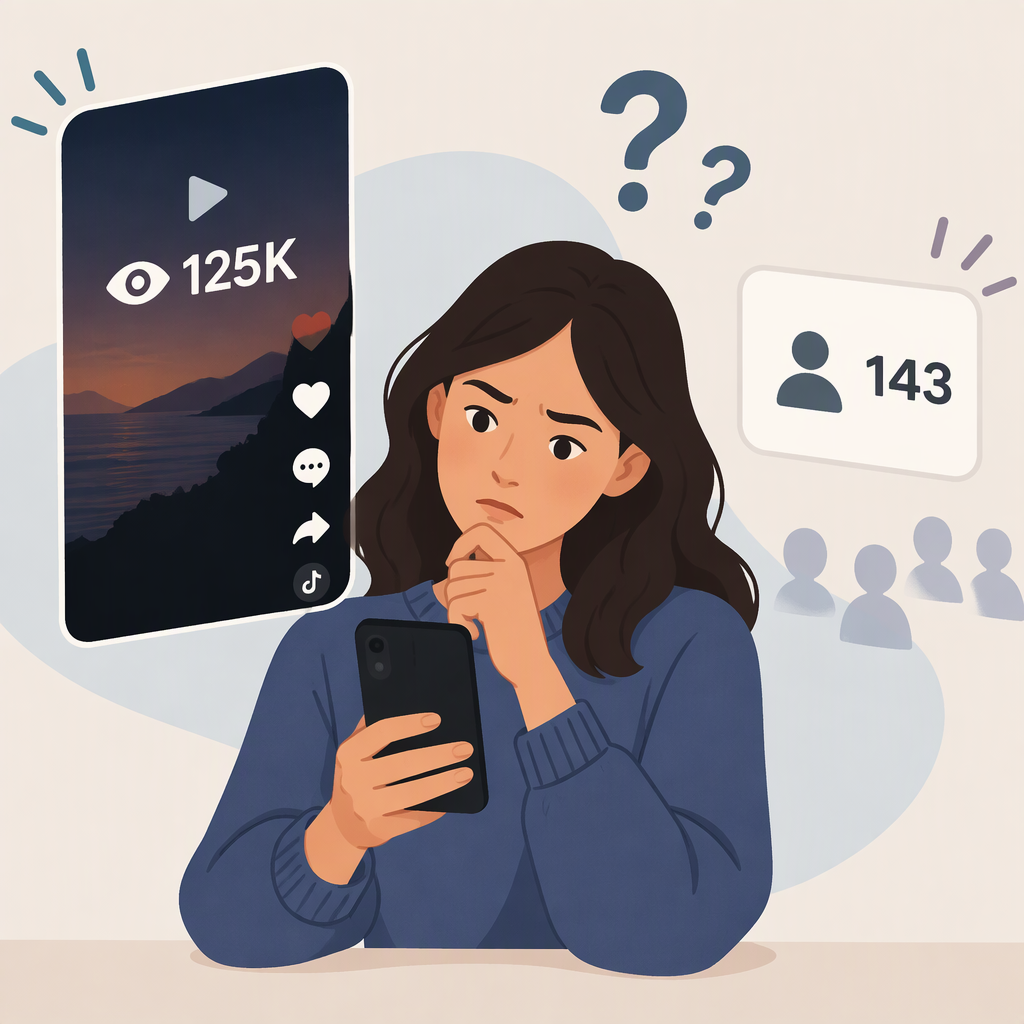
Why Am I Getting Views but No Followers on TikTok?
A TikTok video can get views without giving viewers a clear reason to follow the account. A person may enjoy one video but not know what to expect from the rest of your page; your profile may not clearly match the video that brought them there; or your posts may cover subjects that feel unrelated to a new viewer. Those are possibilities to investigate—not conclusions you can draw from views alone.
To find the likely friction point, look at three stages: views on the video, signs that viewers want to know more about the account, and changes in followers. TikTok’s analytics can show account-level and individual-post information, but the tools and metrics available may vary. Compare like with like, make one focused adjustment, and treat the result as a clue rather than proof.
Why Views Don’t Automatically Become Follows
Views and follows reflect different outcomes. A view tells you the video was watched according to TikTok’s measurement; it does not, by itself, tell you whether the viewer understood what else your account offers or wanted more of it.
TikTok says its For You recommendations use a combination of signals, including viewer interactions and video information. That helps explain why a video can reach people interested in that particular subject without showing whether those people are interested in the account overall. It does not identify why a particular video did or did not lead to follows. (newsroom.tiktok.com)
Consider these hypotheses:
- The video works on its own. It answers one question, makes one joke, or shows one surprising moment, but viewers may not see a reason to seek out more from the account. Check whether the video’s topic or format is clearly connected to other posts.
- The account’s recurring value is hard to recognize. Someone who visits your profile may not be able to tell quickly what you usually post or who it is for. Look at your bio and recent videos together: do they tell a coherent story about what a viewer can expect?
- The video and profile set different expectations. A video might promise a tutorial, series, or point of view that is difficult to find on the profile. Check whether the videos a new viewer sees next support the promise of the popular post.
- The reach and follow counts cover different things. A post’s views and your account’s net follower change are not necessarily an attributed, one-to-one record of who watched and then followed. Avoid treating them as a precise conversion measure unless your available analytics explicitly provide that relationship.
Diagnose the Gap: Video, Profile, Then Follows
1. Start with the Posts That Drew Views
In TikTok Studio, review individual-post insights if they are available for your account. TikTok says creators can access analytics for individual posts, and its tools include account and content analytics. Some metrics may require analytics to be turned on, and tool availability can differ by region, eligibility, and app or web experience. (support.tiktok.com)
For each post, note its topic, format, audience promise, views, and any other engagement measures TikTok actually displays to you. Then compare posts that are reasonably similar. Ask:
- Are the higher-view videos about one topic that is unusual for your account?
- Do they deliver a complete one-off payoff, or introduce a subject viewers could expect to see again?
- Do comments suggest viewers understand the account’s broader focus—or are they responding only to the moment in that video?
These clues can help you form a hypothesis about the content. They cannot tell you exactly why a viewer did not follow.
2. Check Whether the Profile Supports the Video’s Promise
Look at your profile as if you had just arrived from one of the videos with the most views. Is the account’s subject or intended audience easy to understand? Do the bio and recent posts make it clear what similar value a viewer might find next?
If TikTok shows profile-related analytics in your account, you can record them as an additional signal. Do not assume every account has the same profile metric, or that a profile visit proves someone considered following. If profile data is unavailable, use observable clues instead—for example, whether comments ask what you post or request more videos on the same subject. Those clues are suggestive, not a substitute for analytics.
3. Review Follower Data Separately
TikTok’s support guidance describes analytics for key metrics, content, and followers; its creator tools also list total views and net followers among the available analytics. The help page notes that some metrics may require analytics to be enabled and that availability can vary. (support.tiktok.com)
Check the follower information TikTok makes available for the relevant time period, and write down the dates. Be careful about attribution: an account’s net follower change over a period does not establish which post caused it. If several posts went out during that period, the account-level change is context, not a per-video result.
A practical tracking sheet could include:
| What to record | What it can help you investigate | What it cannot establish by itself |
|---|---|---|
| Post topic and format | Whether a high-view post differs from your usual content | Why viewers responded to it |
| Post views and other displayed post insights | Which posts attracted more measured activity | Whether those viewers wanted to follow |
| Profile-related data, if TikTok shows it | Whether there was a visible change in profile activity | Whether visitors liked the account or followed later |
| Account follower change over a chosen period | Whether the account gained or lost followers during that period | Which post or change caused that outcome |
Choose One Adjustment That Matches the Suspected Friction
Treat changes as experiments, not proven fixes. Choose one that addresses the clue you observed, and decide in advance what you will compare.
- If a popular video seems disconnected from your other posts: Make the next related videos easier to recognize as part of a recurring subject, format, or audience promise. Then check whether comparable posts show a different pattern in post insights, profile signals if available, or follower change during the measurement period.
- If the profile does not explain the account’s value: Make the bio and recent posts more consistent with what the video promises. Look for observable signs that new visitors can identify the account’s subject, while remembering that profile activity alone does not prove intent to follow.
- If the account covers many unrelated subjects: Try a more recognizable recurring theme for a small set of posts. A clearer theme may make the account easier for a new visitor to understand, but it can also mean less variety in what you publish. Decide whether that trade-off fits your creative goals; do not assume a narrower topic will automatically increase follows.
- If you add a follow prompt: Make it relevant to the video and specific about what viewers could return for. A prompt is not a substitute for a clear reason to follow, and its presence alone does not show it worked.
An Illustrative Example
Suppose one cooking video gets noticeably more views than your other posts, while your account also features unrelated travel and comedy clips. That does not prove the cooking video attracted the “wrong” audience. It gives you a testable question: would viewers respond differently if the profile and a few later posts made the cooking content’s recurring value clearer? You could publish several comparable cooking posts, keep notes on their available post insights, and review account follower changes over the same period. Any difference would be a signal worth examining—not proof that the profile change caused it.
How to Assess a Change Without Overreading the Result
- Write down the suspected friction. For example: “The high-view post may not make clear what related content the account offers.”
- Change one main thing. Adjust the recurring theme, the profile’s alignment with the videos, or the relevance of the follow prompt—not all at once if you want to learn which change may matter.
- Compare several reasonably similar posts. Similarity could mean the same topic and format, with a comparable audience promise. There is no universal number of posts or follow-rate threshold established here; choose a practical observation period and keep it consistent.
- Use the same signals each time. Record post-level information TikTok provides and account-level follower changes for the same chosen periods. Label any unavailable signal as unavailable rather than estimating it.
- Look for a repeatable pattern, not a single winning post. Views can vary for reasons you have not measured. One post cannot establish the cause of a change or guarantee the result will repeat.
TikTok Studio can be accessed in the app through Profile → Menu → TikTok Studio, or on the web. TikTok notes that analytics may also be available from the web upload area, and that features can differ across app and web experiences or require eligibility. If a metric or menu described in guidance does not appear for your account, do not substitute an assumed number; work with the signals you can actually see. (support.tiktok.com)
Bottom line: Views without follows are a reason to investigate the handoff from a single video to the account—not proof that your content or profile has one specific problem. Check what the video promises, whether the profile reinforces it, and what follower information is actually available. Then test one aligned change across comparable posts and interpret the outcome cautiously.