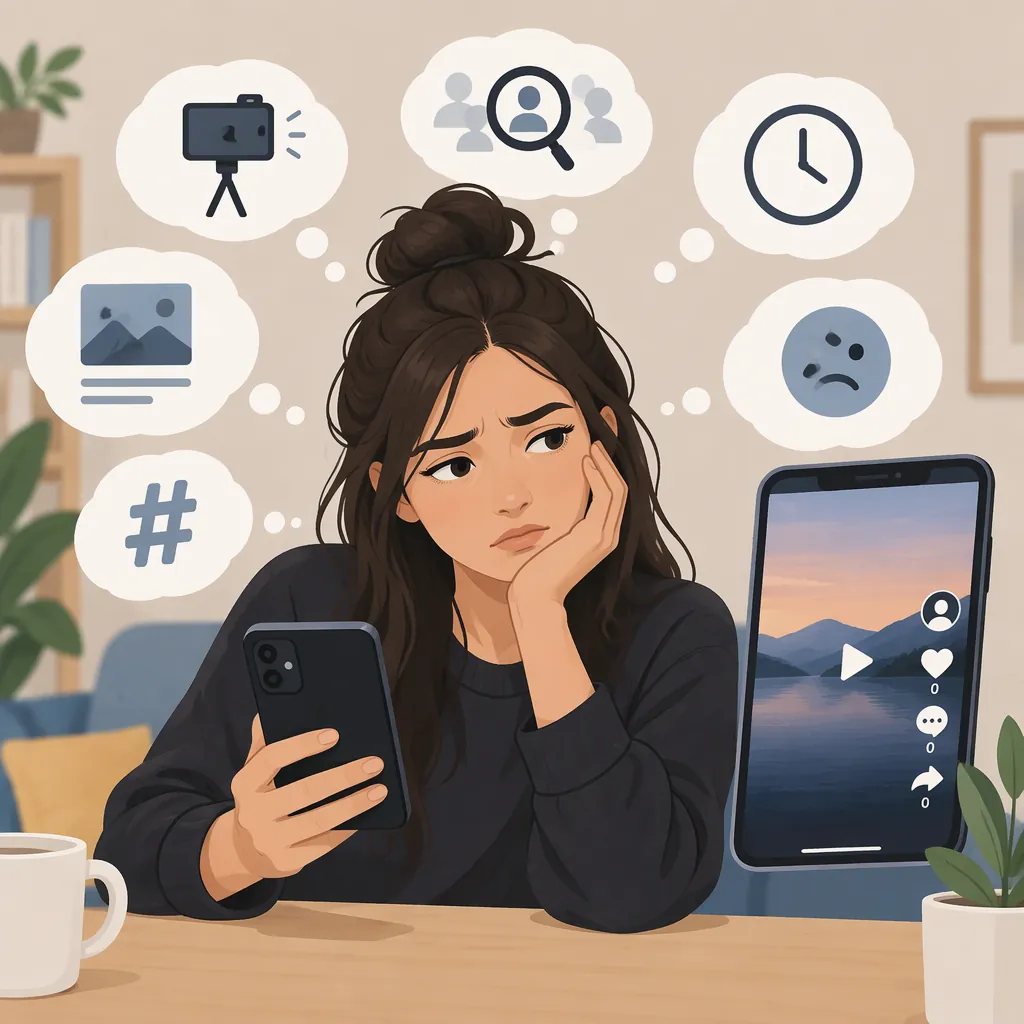
Why Am I Not Getting Likes on TikTok?
Start by checking whether your videos have few views or views but few likes. With few views, review visibility settings and account notices first. With views but few likes, examine the opening, payoff, audience fit, captions, and audiovisual clarity. Reviewing these elements alongside analytics can help you choose what to test next, but it cannot establish the cause of low likes on its own. [c1]
Separate Low Views from Low Likes
A low like count alone does not tell you where the problem is. Compare recent posts and follow the branch that fits what you observe.
If Your Videos Have Few Views
Work through these checks in order:
- Check the post’s audience setting. Does it match who you intended to reach? If not, address that setting before treating low views as a content problem.
- Review any notices available in your account. If a notice identifies an issue, follow its guidance and investigate that issue first. Low counts alone are not evidence of a restriction.
- Compare posts at a similar age. Avoid comparing a newly published video with one that has been available much longer.
- Look for a recurring pattern. Is low exposure affecting one post, one topic, or most recent uploads? Compare similar formats rather than combining unrelated videos.
- If you find no clear setting issue or notice, review the content. Check whether the opening makes the subject recognizable and whether the video is understandable.
These checks help organize your investigation; they do not prove how TikTok distributed a video. Analytics can provide additional context about stronger and weaker posts, traffic sources, and viewer interest. [c1]
If Your Videos Have Views but Few Likes
Review what viewers receive after they start watching:
- Does the video deliver what the opening promises?
- Is the intended audience clear?
- Is there a useful takeaway, entertaining moment, or result?
- Is this pattern repeated across comparable posts, or limited to one upload?
For your own comparisons, calculate:
Likes-to-views ratio = likes ÷ views × 100
For example, 10 likes on 500 views gives a ratio of 2%. This is a descriptive calculation, not an official TikTok benchmark or a measure of unique viewers. It is undefined when views are zero, and small view counts make comparisons fragile.
Compare both the raw counts and the ratio. More views can produce more total likes without a higher proportion of likes per view.
Review the Opening and Payoff
Check the hook, captions, distinctive content, and production quality before making broad changes to your account. These are content-review areas recommended in The Seeker’s article, not confirmed explanations for any individual video’s performance. [c1]
Watch an underperforming video and ask:
- Opening: Can someone quickly recognize what the video is about?
- Promise: Does the opening accurately describe what follows?
- Payoff: Does the video deliver the result, answer, or moment it sets up?
- Clarity: Are important text and visuals readable, and is essential audio understandable?
- Focus: Is there setup or repetition you could remove without losing meaning?
For a tutorial, test showing the finished result before explaining the process. For a story, test removing setup that does not help viewers understand the main event. Treat these as editing experiments, not guaranteed ways to earn likes.
If available analytics show viewers losing interest early, prioritize reviewing the opening and clarity. If interest drops later, inspect the pacing and promised payoff. Viewer-interest data can help locate a section to review, but it does not establish why viewers left. [c1]
Check Audience Fit and Context
Define who the video is for, then check whether the opening, caption, and subject communicate that purpose. A consistent topic focus, contextual captions, and relevant hashtags are suggested starting points. [c1]
Use this checklist:
- Intended viewer: Complete the sentence, “This video is for someone who wants to learn, understand, or enjoy ___.”
- Opening: Would that person recognize the subject without needing background information from your profile?
- Caption: Does it add a useful detail rather than simply repeat the video?
- Hashtags: Do they accurately describe the subject?
- Recent posts: Are you comparing videos aimed at similar audiences?
If your recent posts cover unrelated subjects, try a small series around one audience need. This gives you a clearer basis for comparison.
Where available, review traffic sources and audience information alongside the content. The Seeker identifies these as useful analytics categories. [c1] A change in where views come from, or a difference between your intended audience and the audience information available, can prompt an audience-fit review. Neither observation proves a mismatch caused low likes; follower information may also differ from the viewers of a particular post.
Do not assume a particular hashtag count or trending sound will fix low engagement. Use relevant context as one variable to test, not as a formula.
Run a Focused Content Test
Choose one suspected weakness and test one specific adjustment across comparable posts. Using analytics to guide content decisions is a useful starting point; the worksheet below turns that general recommendation into a repeatable review. [c1]
For example, test showing a tutorial’s finished result earlier while keeping the topic and overall format similar. Record views, likes, and any available viewer-interest information at a similar post age.
Use the results to narrow your next question:
| Observation | What to review next | What it does not establish |
|---|---|---|
| Few views, with an unintended audience setting or an account notice | Address the setting or investigate the notice first | That editing is the primary problem |
| Few views, with no clear setting issue or notice | Compare similar posts, traffic sources, and topic clarity | That the account is restricted |
| Viewers appear to lose interest early | Review the opening, readability, and audio clarity | Why viewers stopped watching |
| Interest drops before the promised result | Review pacing and whether the payoff arrives as expected | That moving the payoff will increase likes |
| Traffic sources or audience information differ across posts | Check whether the posts target comparable audiences | That audience mismatch caused the difference |
| Views rise but the likes-to-views ratio does not | Record increased views without a stronger like ratio | That viewers responded more positively |
Look for a repeated pattern rather than declaring success or failure from one upload. Changing one element makes comparisons easier, but ordinary posting tests do not isolate every influence on performance.
Low-Likes Review Worksheet
Copy this record for each comparable post:
- Post and publication date:
- Age of post when measured:
- Intended viewer and topic:
- Audience setting checked:
- Relevant account notices, if any:
- Views:
- Likes:
- Likes ÷ views × 100, if views are above zero:
- Viewer-interest or drop-off observations, if available:
- Traffic sources, if available:
- Audience information, if available: Note whether it describes followers or viewers.
- Opening promise:
- Delivered payoff:
- One change tested:
- Result compared with similar posts:
- Alternative explanations:
- Next test:
Leave unavailable fields blank rather than guessing. Keep observations separate from explanations: “Fewer views” is an observation; “TikTok suppressed this post” is an explanation that these counts alone cannot establish.
Understand the Limits of the Diagnosis
Low likes alone cannot confirm an account restriction, a platform fault, or a specific recommendation-system decision. Likewise, a better-performing post does not prove that one editing change caused the improvement.
The content and analytics suggestions cited here come from The Seeker’s third-party article, attributed to a Commercial Team and labeled as published in partnership with a third party. It is not official TikTok documentation and cannot verify your account’s status. [c1]
The goal is to leave with a narrower question: Is the recurring issue limited exposure, unclear content, possible audience mismatch, or few likes relative to views? Choose your next check or test around that question rather than expecting a guaranteed recovery.
FAQ
Why Do I Get TikTok Views but Few Likes?
Views and likes alone do not reveal the reason. Compare similar posts and review whether the opening, payoff, caption, and intended audience align. Hooks, content clarity, and analytics are useful review areas, but there is no verified like-rate threshold in the cited article that diagnoses an individual video. [c1]
What Should I Check First If I Have Both Low Views and Low Likes?
Check the post’s audience setting and any account notices before changing the content. If neither identifies a clear issue, compare posts at a similar age and within a similar format. Then use available analytics to review content performance and traffic sources. Those comparisons can guide investigation, but they do not prove a distribution problem. [c1]
Will Different Hashtags Fix Low Likes?
Treat relevant hashtags as one variable to test, not a guaranteed fix. The Seeker recommends topic-relevant hashtags, but its article does not establish that a specific hashtag combination will increase your likes. [c1]
Should I Post More Often to Get More Likes?
Choose a sustainable pace that lets you make comparable videos and review the results. The Seeker recommends consistent posting, but its frequency advice is not a verified rule for every account. More uploads alone do not demonstrate that engagement will improve. [c1]
Which Analytics Should I Review Besides Views and Likes?
Where available, review viewer-interest patterns, traffic sources, and audience information. These categories can help you decide whether to inspect the opening, pacing, or audience fit next. The Seeker recommends reviewing them, but they provide clues rather than proof of why a video received few likes. [c1]