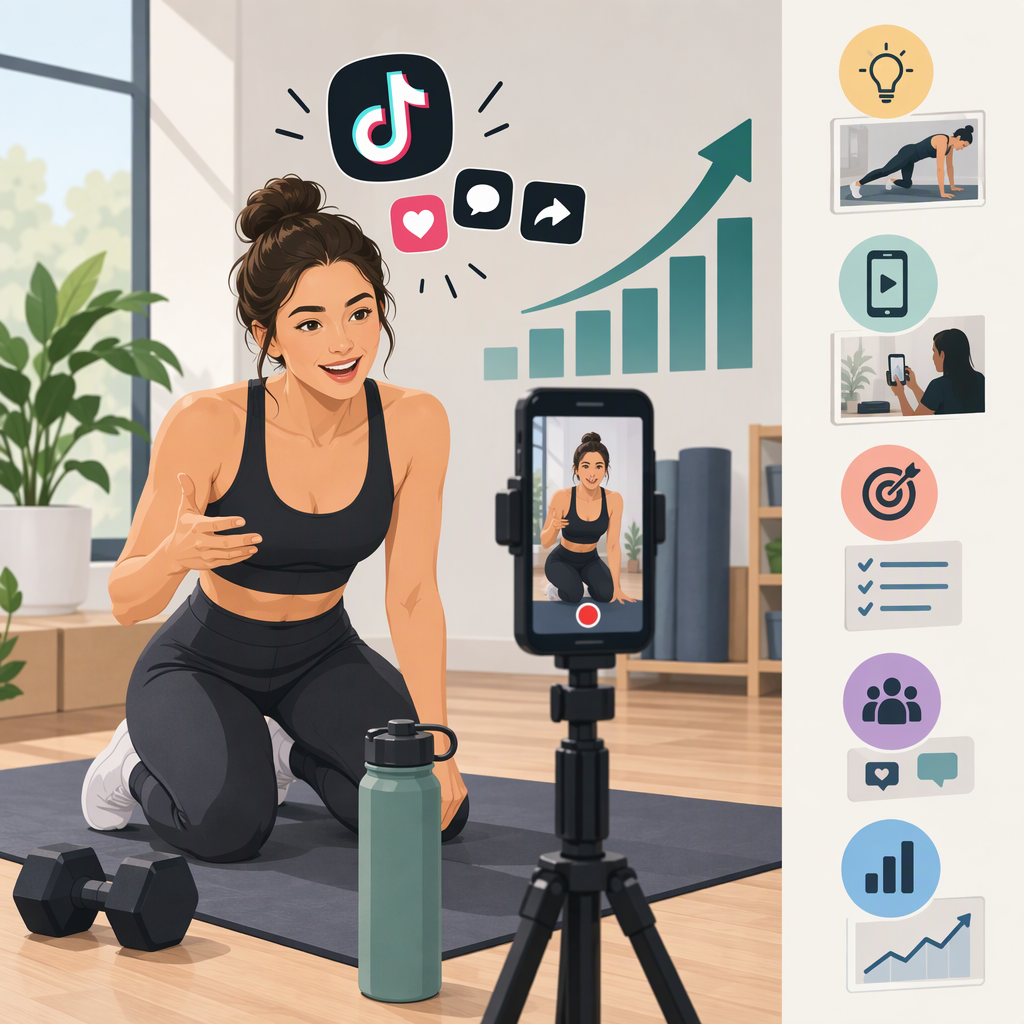
How to Grow a Fitness TikTok: A Practical Guide for Creators
To grow a fitness audience on TikTok, give a specific group of viewers a clear reason to watch—and a reason to come back. Choose whom you want to help, make videos that address their questions or interests, explain each video’s value early, and use results to decide what to test next. No format, posting schedule, hashtag, or view count can guarantee follower growth.
This guide focuses on decisions creators can make: audience, content, clarity, and learning. TikTok’s features and analytics can vary, so treat platform-specific details below as guidance to check against what is available in your app and account.
1. Choose an Audience and a Clear Content Promise
“Fitness” is a broad topic. Pick a starting audience you can serve consistently, such as people new to strength training, runners adding basic mobility work, or busy adults looking for short home-workout ideas. These are examples for planning—not proven growth niches.
Write a one-sentence content promise:
I help [specific audience] with [useful value] through [kind of content].
For example: “I help people new to strength training understand basic lifting movements through short, beginner-friendly demonstrations.” This makes it easier to judge whether an idea belongs on the account. A defined focus can make your offer easier to understand; it does not mean you must cover only one subject forever.
Before choosing a niche, ask:
- Which viewers’ questions can I answer responsibly?
- What can I explain or demonstrate clearly?
- Which subjects could I return to without making every video feel the same?
2. Turn Audience Needs into Repeatable Video Ideas
Start with a small set of themes rather than trying to invent a new account identity for every post. For example, a beginner-focused creator might use:
- Basics: explain a movement or common training term.
- Technique: demonstrate one movement cue, with appropriate context.
- Planning: show how to organize a simple workout or routine.
- Questions: respond to a genuine viewer question.
Then turn a theme into a specific idea. Illustrative prompts—not claims about what will perform—include “One setup detail to check before a beginner goblet squat,” “What ‘rest day’ can mean in a training week,” or “A simple way to organize a home workout when you have limited equipment.” Keep each video focused on one main point.
A manageable plan is one you can sustain while keeping the content accurate. You do not need to adopt a universal posting frequency. Instead, choose a pace that fits your time, then review whether the posts are helping you learn what your intended viewers find useful.
3. Make the Topic and Value Clear
A viewer should be able to quickly understand what a video is about and why it might matter to them. Treat clarity as an editorial practice—not a promise that a particular edit will trigger distribution.
Before publishing, check:
- Opening: Does the beginning identify the question, movement, or problem?
- Audience: Is it clear who the explanation is meant for, if that context matters?
- Main point: Does the video deliver the value suggested by its opening?
- Context: Are spoken or on-screen explanations accurate and easy to follow?
- Caption: Does the caption describe the video honestly and add useful context?
- Finish: Is there a natural next step, such as asking viewers what they want explained next?
TikTok’s Help Center describes search as a way to find posts, creators, sounds, and hashtags, and says relevant results appear in the Top tab. That makes accurate, plain-language wording useful for helping people understand what they are searching for; it does not establish that adding a particular keyword or hashtag will raise a video’s reach. Discovery features may also differ by viewer or location. (support.tiktok.com)
TikTok says the For You feed is personalized and uses a combination of factors. Its public explanation is not a reliable basis for claiming that one tactic—such as a specific length, hashtag count, or posting time—will make a fitness video go viral. Focus on making a relevant, understandable video, then learn from your own results. (newsroom.tiktok.com)
4. Review Results and Choose One Next Experiment
Before posting, decide what you want to learn. Is the video meant to introduce the account to new viewers, answer a common question, or encourage interested viewers to explore more of your content? The goal helps determine which available results are worth looking at.
After a reasonable review period, use whatever measures TikTok makes available for your account and the post. Views can indicate exposure, but by themselves they do not show whether viewers understood the content, followed the account, or will return. If available, consider post reach or views alongside relevant signs of interest, such as follows or profile activity. Metric names, availability, and reporting can vary; do not assume every account has the same dashboard.
A simple review cycle:
- Note the post’s audience, theme, and intended outcome.
- Compare it with a few reasonably similar posts, rather than treating unlike videos as a clean test.
- Ask what changed: topic, explanation, opening, or format?
- Write down one observation and choose one change to try next.
Hypothetical example: Suppose two beginner-exercise videos receive similar views, but one leads to more profile visits or follows in the results available to you. That could be a reason to test another video on that audience need—not proof that the format caused the difference. Other factors may have changed, and a small number of posts is not a reliable benchmark. Keep a simple note of what you tried and what you observed.
The trade-off is that a broadly appealing video may reach more people, while a narrower, more relevant explanation may better fit the audience you want to serve. Decide which outcome matters for each post; do not treat maximum views as the only definition of progress.
5. Keep Fitness Content Responsible
Make demonstrations and explanations appropriate to the context, and avoid presenting one person’s routine as suitable for everyone. Be especially careful with sweeping health claims, guaranteed outcomes, or advice that ignores a viewer’s experience or circumstances. This is a communication checklist, not medical advice.
For general U.S. activity guidance, the CDC notes that recommendations vary by age and other factors. Its guidance for adults ages 18–64 includes at least 150 minutes a week of moderate-intensity activity and muscle-strengthening activity on at least two days a week; it also advises people who cannot meet the recommendations to be as active as they can. If you discuss public-health recommendations, give the population and context rather than presenting a single routine as universal. (cdc.gov)
TikTok says its Community Guidelines apply to content shared on the platform. Read the applicable guidance directly if your post raises a policy question; do not assume a growth tactic overrides platform rules. (support.tiktok.com)
A Practical Starting Checklist
- Audience: Can I name whom this account is for?
- Value: Can I explain what useful perspective or information it offers?
- Ideas: Do I have a few recurring themes and specific next posts?
- Clarity: Can a viewer quickly understand each video’s subject and context?
- Learning: Have I chosen a relevant result to review and one next experiment?
- Responsibility: Is the fitness guidance accurate, appropriately qualified, and not framed as universal medical advice?
Growth is uncertain. A focused audience, clear content, and a repeatable review habit give you a practical way to improve your decisions without relying on unsupported promises.