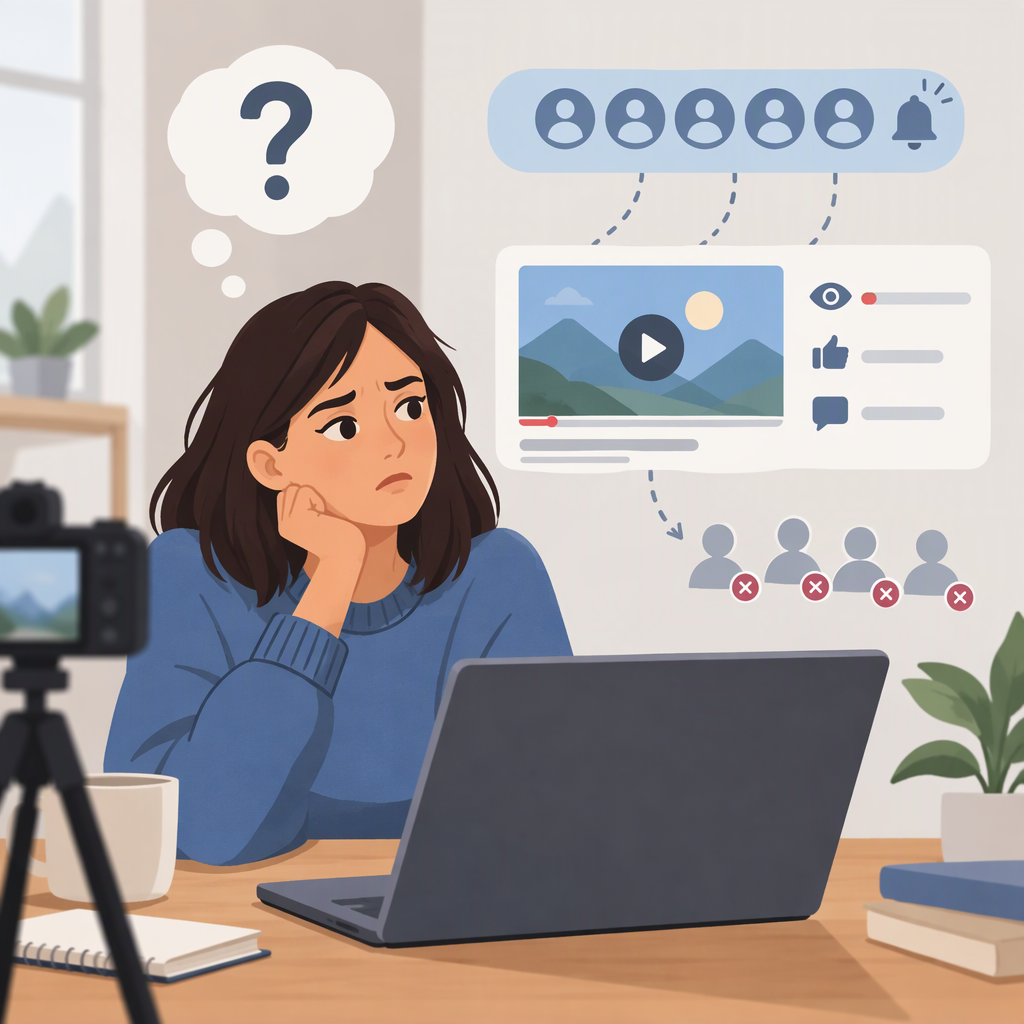
Why Are My Subscribers Not Watching My New Videos?
Short answer: Having subscribers does not mean each one saw or chose to watch a particular upload. Some may be inactive; others may have subscribed for a different topic or format. Your new video’s topic, title, or thumbnail may not catch the right viewers’ interest, or its opening may not deliver what they expected. These are possibilities, not diagnoses. Compare similar recent videos with your own channel’s usual performance, find where viewers are dropping off, and test one relevant change at a time.
Why Subscribers Might Skip a New Video
A subscriber count is not a count of people who watched a specific upload. Without knowing how your platform reports exposure—and without looking at your video’s data—you can’t tell whether people didn’t see the video, saw it but passed, or clicked and left.
Common possibilities to investigate include:
- Some subscribers may no longer be active. A subscription can remain even if someone has stopped watching your channel.
- Your topic or format may have shifted. People who subscribed for one subject or style may be less interested in a different one.
- The video may not look relevant at a glance. The title and thumbnail might not make the value clear to the audience you want to reach.
- The video may not match its promise. Viewers may leave early if the opening takes too long to get to the point or the content differs from what the title and thumbnail led them to expect.
None of these explanations, on its own, proves that your channel has a problem. Use your own data to narrow down what may be happening.
Find the Weak Point in the Viewing Path
Compare your new video with a few similar recent uploads—for example, videos with roughly the same topic and format. Use a comparable time window where possible, and note whether the new upload is an outlier or part of a broader change. Your channel’s own patterns are more useful here than a universal target: metrics can vary with audience, subject, format, and where viewers find a video.
Then work through this sequence, using whichever reports your platform provides:
- Was the video shown to people? Look for an exposure or reach measure, if available. If exposure is lower than on comparable uploads, consider whether the topic or format changed, or whether a platform-specific setting or limit is relevant. Low exposure alone does not tell you why it happened.
- If people saw it, did they choose it? If exposure looks comparable but viewing is weaker, review whether the topic, title, and thumbnail make the video’s relevance clear. Check traffic sources too, if available: viewers arriving from search may respond differently from viewers encountering a recommendation or a subscription feed.
- If people clicked, did they stay? If clicks seem comparable but viewing drops early, inspect the opening, pacing, and match between the video’s promise and what it delivers. Look for where the drop begins rather than assuming the entire video is the problem.
- Is the pattern specific to subscribers? If your platform separates subscriber and non-subscriber viewing, or offers returning-viewer or notification-related reports, use those as context. These reports may not be available everywhere, and their definitions differ by platform.
If you mean YouTube: YouTube Studio offers impressions and impressions click-through rate to help assess thumbnail exposure and the views that follow; its documentation also cautions that CTR varies by traffic source and audience. Audience-retention reports can show how attention changes during a video. YouTube’s notification reports are separate, and some appear only when a channel has enough reachable subscribers. Use those platform-specific reports rather than treating subscriber count as a direct measure of exposure. (support.google.com)
A Hypothetical Example
Suppose two similar uploads usually get roughly 8,000 thumbnail impressions, around 400 clicks, and steady viewing through their opening. A new video gets about 8,000 impressions but only 200 clicks. That pattern would make the topic and packaging reasonable things to examine first; it would not prove that the thumbnail alone caused the difference. If the new video instead gets about 400 clicks but viewers leave much earlier, the opening and expectation match may be the more useful first investigation. These numbers are illustrative only, not a benchmark or expected result.
Choose One Focused Change to Test
Match the change to the part of the path that looks weakest:
- Exposure appears lower: Keep the next upload close to a topic or format your intended audience has shown interest in, or check relevant platform settings and reports. Don’t assume limited exposure means suppression.
- Exposure looks reasonable, but clicks are weaker: Make the title and thumbnail more clearly communicate what the video offers to the intended viewer. Avoid promising something the video does not deliver.
- Clicks look reasonable, but viewers leave early: Get to the promised value sooner, tighten the opening, or make the video’s first moments better match its title and thumbnail.
- The audience or format may have shifted: Try a topic or format that connects the new idea to what the channel’s returning viewers have watched before.
Change one main thing for the next comparable upload, then review the same measures again. Changing the topic, format, title, thumbnail, and opening all at once makes it harder to learn which change might have mattered. One upload is also a noisy basis for a larger strategy decision, so look for a pattern across comparable videos—not a guaranteed result from one test.
A Quick Checklist Before Your Next Upload
- Compare the video with similar uploads, not just your channel’s overall average.
- Check available exposure, click, and retention data in that order.
- Use subscriber, returning-viewer, traffic-source, or notification reports only if your platform provides them, and check what each metric actually means.
- Choose one change that fits the weakest apparent stage.
- Review the same measures across more than one comparable upload before changing your broader channel strategy.
Low views from subscribers are a question to investigate, not proof that your subscribers—or the platform—have rejected your channel. Find the weakest visible stage, choose one test that addresses it, and let a pattern in your own data guide the next decision.