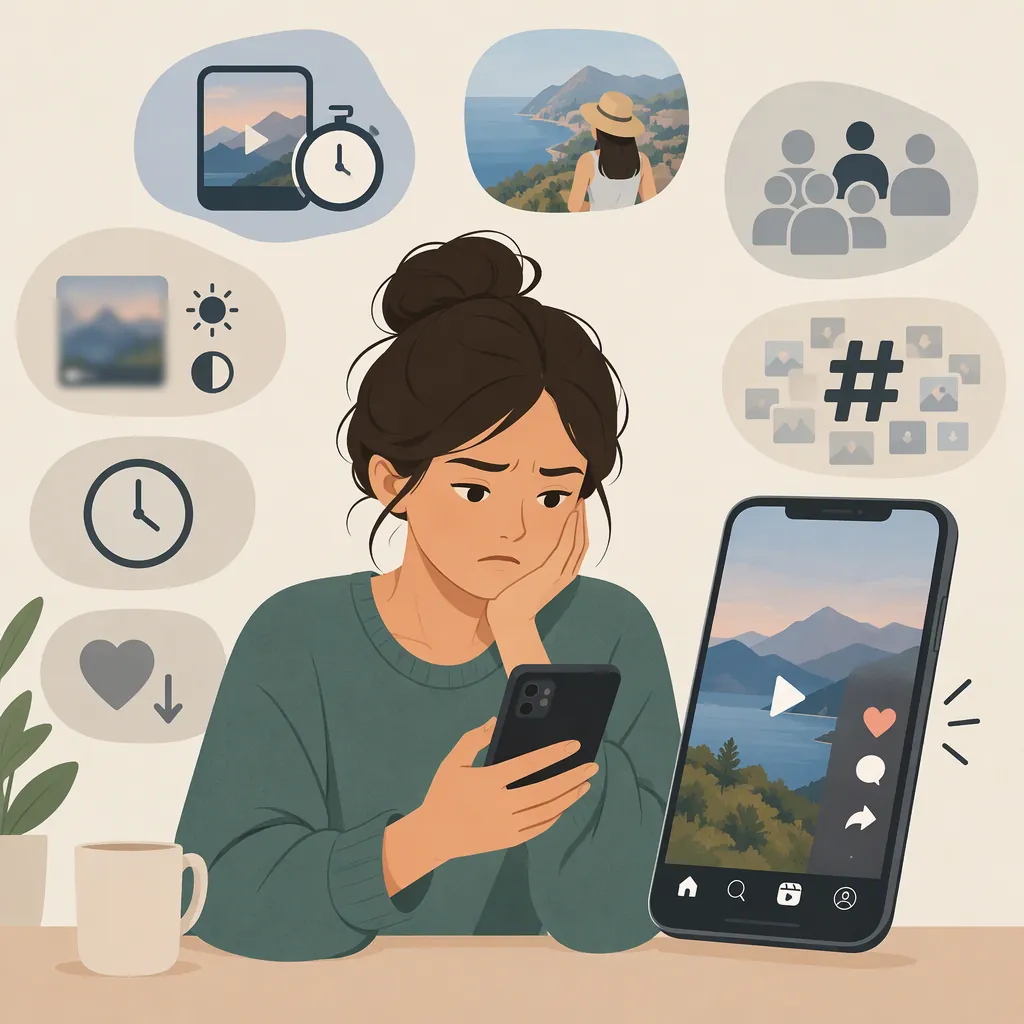
Why Your Reels Are Not Getting Likes—And What to Check
Start by separating two questions: are too few people seeing your Reels, or are people seeing them without liking them? Compare reach and likes across similar posts, then review the opening, audience relevance, and clarity. The supplied source recommends checking these areas alongside watch time and other interactions, but low likes alone do not establish a specific cause or an algorithm penalty. [citation-1]
Separate Low Reach from Low Response
A small like count needs a denominator. Before changing your content, record the likes and accounts reached for several comparable Reels, using the same elapsed time after publication.
For a simple personal comparison, calculate likes divided by accounts reached, optionally multiplied by 100. Treat this as a working ratio, not a universal engagement benchmark. Do not substitute views for reach midway through your comparison.
Use the results to choose a starting point:
- Lower reach, similar likes per reached account: investigate exposure and whether the opening gives viewers a reason to keep watching.
- Similar reach, fewer likes per reached account: investigate topic relevance and whether the Reel delivers what its opening promises.
- Both lower: test one content change first rather than changing the topic, editing, timing, and caption together.
The source recommends comparing views, reach, retention, likes, comments, shares, and saves. Check the metrics actually available to your account; an unavailable metric is missing information, not a zero. [citation-1]
Reel Comparison Worksheet
Copy one row per Reel:

| Reel | Topic and intended viewer | Time since posting | Accounts reached | Likes | Likes ÷ reach × 100 | Other available interactions | Opening and takeaway |
|---|---|---|---|---|---|---|---|
| Fill in | Fill in | Fill in | Fill in or unavailable | Fill in | Calculate only if reach is above zero | Fill in or unavailable | Fill in |

Compare posts at the same age. Keep unavailable values separate from zero. Use your own comparable posts as the baseline.
Check Whether the Value Is Clear Early
Review the first moments of the Reel before focusing on hashtags or posting time. The source recommends removing slow introductions, leading with a useful or interesting moment, tightening edits, and adding readable on-screen text. [citation-1]
Ask three concrete questions:
- Can a viewer identify the subject without reading a long caption?
- Does the opening show a result, problem, or moment worth watching?
- Does the rest of the Reel deliver that promise?
Watch once with sound and once without it. Check whether essential speech needs captions, text is readable, and music competes with the explanation. If watch-time or retention information is available, use it to locate possible weak points—not to assume that a particular edit caused the drop.
For the next comparable Reel, test a clearer first frame or a shorter introduction. Keep the central topic and intended audience similar.
Check the Topic Before Asking for More Likes
A polished Reel can still be aimed at the wrong viewer. The source emphasizes audience relevance, a clear takeaway, and consistency with the topics viewers expect. [citation-1]
Write one sentence before your next edit: “This Reel is for someone who wants to understand, solve, or enjoy ___.” If the answer is vague, narrow the topic.
Compare a weaker Reel with a stronger one serving the same audience. Look for differences in specificity: a recognizable problem, a concrete demonstration, or an answer to a question in your comments. Avoid copying only the stronger Reel’s music or caption while overlooking its subject.
Also record saves, shares, and comments where available. These provide additional context alongside likes; the source recommends evaluating multiple forms of engagement. [citation-1] Do not assume every useful Reel must produce the same mix of reactions.
Run a Focused Test Instead of Changing Everything
Choose one explanation to investigate and one matching change. The source recommends testing hooks, video length, and posting times while tracking performance. [citation-1]
Treat sequential posts as an informal comparison, not a controlled experiment: their audiences and distribution can differ. Review more than one comparable result before adopting a change.
Posting time can be a test variable, but do not treat a universal “best hour” as a diagnosis. Likewise, adding trending audio or more hashtags does not establish why an earlier Reel received few likes.
One-Variable Test Plan
Hypothesis: Viewers may not understand the benefit early enough.

Change: Show the outcome in the first frame instead of opening with an introduction.

Keep similar: Topic, intended audience, approximate length, and posting window.

Record: Reach, likes, likes relative to reach, and any available watch-time or interaction metrics at the same elapsed time.

Review: Does the pattern recur across comparable posts? If results are mixed, mark the test inconclusive rather than declaring a fix.
Do Not Diagnose a Penalty from Likes Alone
Keep the conclusion proportional to the evidence. “This Reel received fewer likes than my comparable posts” is an observation. “Instagram is suppressing my account” requires information beyond that observation.
The reference is a third-party article about low Reel views, not an official Instagram explanation or an assessment of your account. It offers useful review areas, but its statements about ranking, shadowbans, and guaranteed growth should not be treated as proof of your situation. [citation-1]
The practical outcome of this review is a narrower next test—not a promise of more likes. Preserve your notes so that repeated patterns, rather than one disappointing post, guide the next decision.
FAQ
Why Are My Reels Getting Views but Not Likes?
Views alone do not identify the reason. Compare likes relative to reach, review whether the topic fits your intended audience, and check whether the opening delivers a clear payoff. Include comments, shares, and saves in the review rather than treating likes as the only response. These are investigation areas recommended by the supplied source, not a diagnosis. [citation-1]
Should I Delete a Reel Because It Received Few Likes?
Low likes alone are not a strong reason to delete it. The source recommends retaining underperforming Reels so their results can inform later content. Incorrect information, privacy concerns, or other content problems are separate reasons to reconsider keeping a post public. [citation-1]
What Should I Change First?
Start with the clearest weakness you can observe. If the subject is unclear at the beginning, test a more direct opening. If the topic differs from what your audience usually responds to, test a more specific audience-relevant idea. The source recommends reviewing both hooks and relevance; changing one at a time makes the comparison easier to interpret. [citation-1]
Sources
- [citation-1] Why Are My Instagram Reels Not Getting Views? (2025)