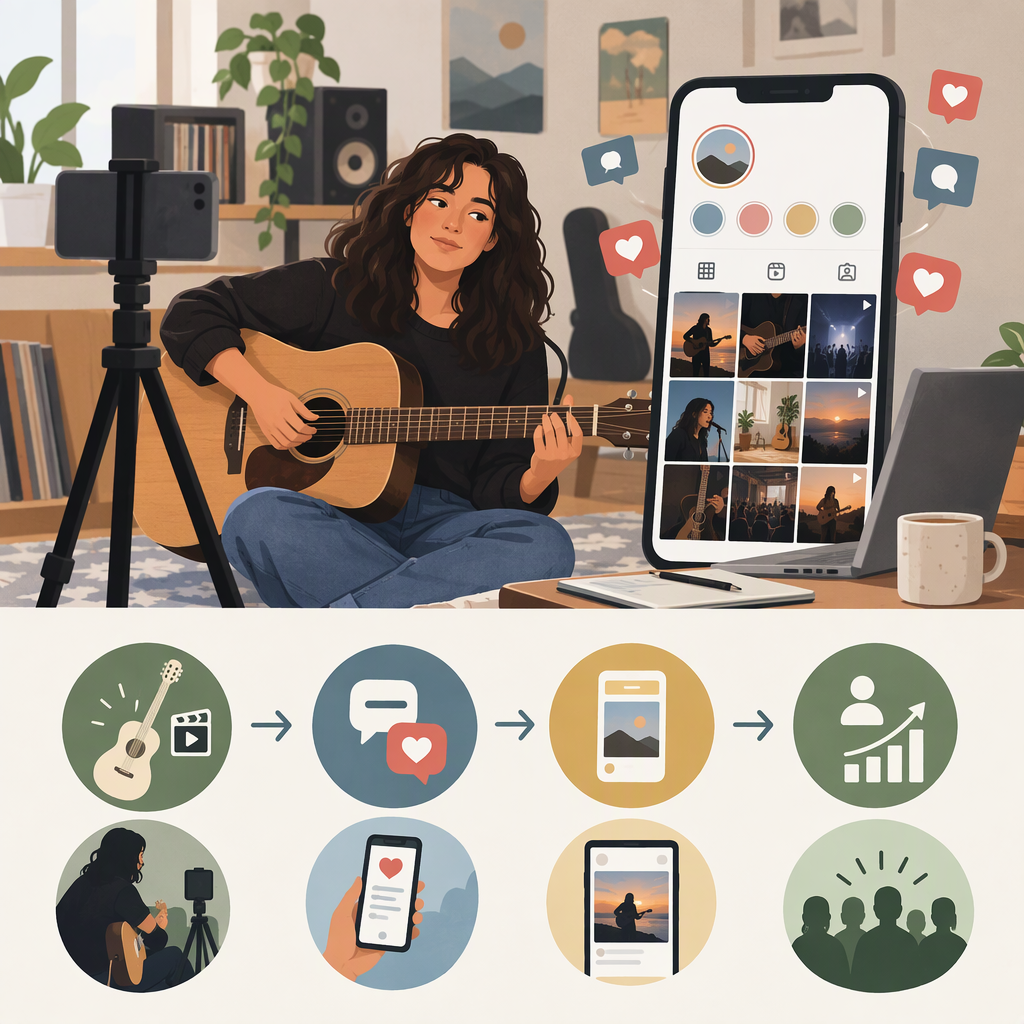
How to Grow Your Instagram as a Musician: A Practical Organic Guide
Growing your Instagram as a musician starts with making it easy for the right listener to recognize your music, understand what you share, and find a reason to stay. Build a clear profile, post music-centered content you can sustain, add useful context, interact with people genuinely, and review available audience signals to decide what to try next. These are practical choices—not guarantees of reach or follower growth.
Make Your Profile Understandable at a Glance
Think of your profile as a quick introduction for someone who has just encountered your music. Check that:
- Name and handle: Your artist name is easy to recognize and, where possible, consistent with how you identify yourself elsewhere.
- Profile image: It is recognizable at small size and fits the identity you want listeners to remember.
- Bio: It says what kind of music you make and gives a newcomer a useful detail—such as your location or scene, current project, or what you are working on.
- Link: It leads to a relevant next step, such as hearing a track, finding show information, or choosing among your music links. Make sure it works.
- Featured content: If pinning posts or using Highlights is available on your account, use them to surface a strong introduction, a representative performance, or current information. Revisit anything that has become outdated.
The goal is not to fill every available space. It is to make the artist, the music, and a possible next step clear. No profile arrangement guarantees that visitors will follow.
Hypothetical illustration: A jazz vocalist might use the artist name as the searchable name, describe the music as “vocal jazz and original songs,” mention the city where they perform, link to a page with listening and show options, and feature one live performance. That is one possible introduction, not a formula or a real artist case.
Choose Music-Centered Content You Can Repeat
Build a small menu of post ideas around what you already do. For example:
- The music: A chorus, instrumental passage, lyric, demo comparison, or short explanation of how a song came together.
- The process: Rehearsal moments, arranging choices, instrument or vocal practice, and the work behind a finished recording.
- The people and place: Band introductions, collaborators, venues, local scenes, or a meaningful influence—with context that helps a new listener understand the connection.
- The invitation: A release announcement, show details, a question about a musical choice, or a prompt to hear another track.
One activity can produce several distinct pieces without repeating the same post. A rehearsal, for instance, might lead to a short performance excerpt, a brief explanation of a challenging arrangement, and a photo or clip introducing a bandmate. Choose the parts that feel natural and useful; you do not need to turn every moment into content.
There is no universal posting frequency that suits every musician. Start with a pace you can maintain alongside making music. Instagram says its Professional Dashboard includes a Best Practices area with guidance on creation, engagement, reach, and other topics; it also says some guidance is personalized. If that area is available to you, use it as platform guidance for your account—not as a promise of results. (about.fb.com)
Make It Easier for New Listeners to Understand a Post
Before publishing, ask:
- Can a new viewer tell what they are seeing or hearing? Name the song, instrument, performance, or idea when it is not obvious.
- Does the opening give context? A short on-screen phrase or caption can explain why a clip matters, especially if the viewer does not know you yet.
- Is the post suited to the material? Use a performance clip when the performance is the point; use a photo or written explanation when the story or detail matters more. Treat format choices as creative decisions to test, not as guaranteed reach tactics.
- Is the context accurate and relevant? Mention collaborators, the venue, event, or release where that information helps people understand the post. Tag relevant accounts when appropriate, rather than adding unrelated tags.
- Could a genuine collaboration make sense? A jointly created performance, rehearsal, or conversation with a compatible musician or venue can introduce each participant’s work to the other’s audience. Choose the collaborator for the musical fit and the shared idea; do not assume the post will expand reach.
You control the clarity, accuracy, and relevance of what you publish. You do not control who Instagram recommends it to or how many people see it. Avoid treating a particular hashtag, audio choice, or posting time as an algorithm shortcut unless you have reliable, current evidence for that specific claim.
Interact, Review Signals, and Choose One Experiment
Audience growth is not just a follower count. Reply thoughtfully to comments and questions, thank people who come to a show or share your work, and ask questions you genuinely want answered. Meaningful exchanges can help you understand which parts of your music or story listeners connect with; they do not guarantee further distribution.
If audience insights are available on your account, review them periodically alongside the posts themselves. Depending on what Instagram currently shows you, useful signals may include how many people encountered a post, visits to your profile, follows, and substantive interactions. Treat these as clues, not proof of what caused a result. Instagram describes Insights as a way to learn about account and content performance, but the specific information available can depend on the account and interface. (meta.com)
Try a simple review:
- Notice: Which post seemed to bring relevant listeners or prompted meaningful responses?
- Ask: Was its subject especially clear, was the song familiar to your audience, or did the context make it easier to connect with?
- Change one thing: For the next comparable post, adjust one element—such as the opening text or the amount of song context—while keeping the rest reasonably similar.
- Observe: Compare the available signals and audience responses, and note other differences. One post cannot establish that the change caused a result.
Hypothetical example: Suppose a musician notices that a rehearsal clip led to more profile visits than another recent post. For the next rehearsal clip, they could keep the basic format but identify the song in the opening text, then see whether profile visits or relevant comments change. Other factors may explain any difference, so the result is a reason to keep observing—not proof that the wording drove it.
A manageable routine is better than an elaborate plan you abandon: keep a short list of post ideas, share at a sustainable pace, and review a few recent posts when you have enough to compare. Keep what feels useful to your audience and your music; revise what is unclear or difficult to sustain.