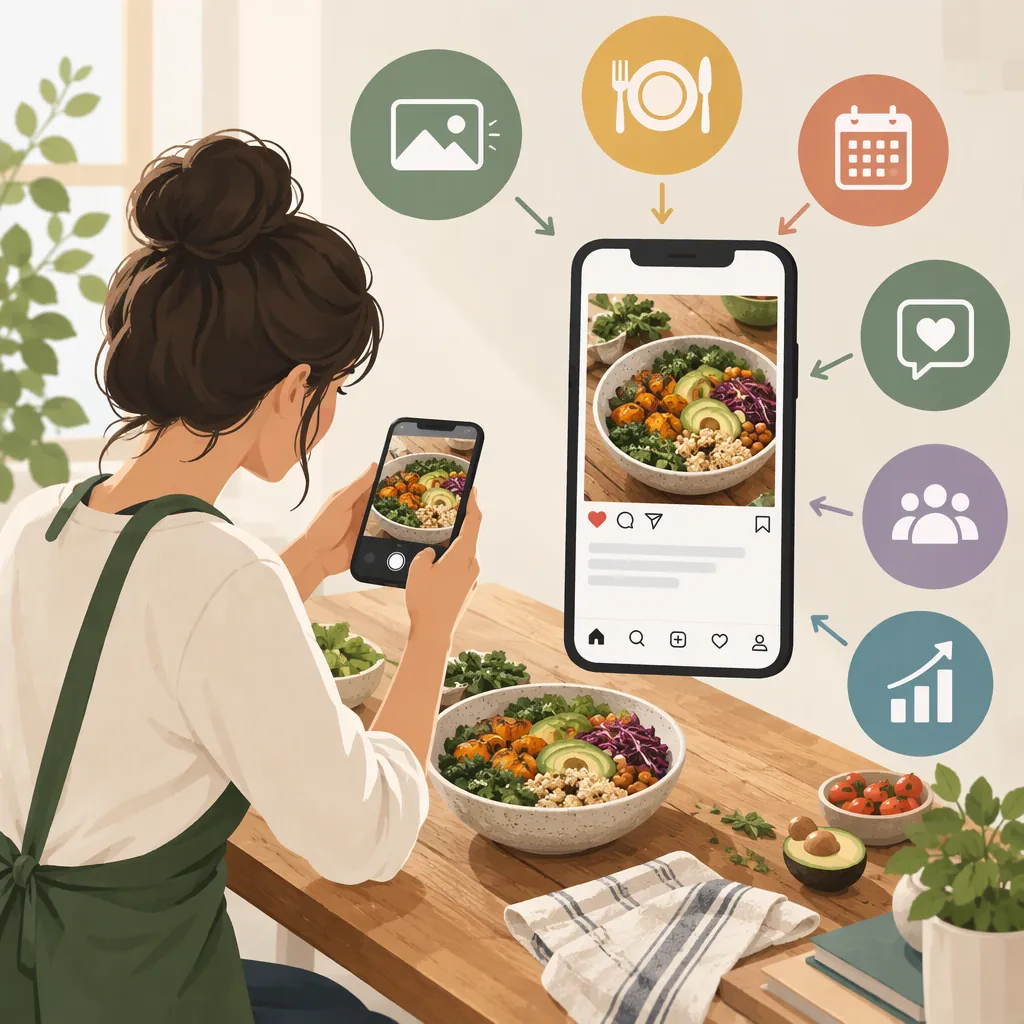
How to Grow Your Food Instagram Audience and Reach
To grow your food Instagram, choose a clear audience, make your profile explain what they can expect, and publish useful food content on a schedule you can maintain. Then test specific topics and formats, compare their reach at the same point after publication, and use relevant audience questions to plan your next posts.
Evidence note: The reference behind this guide is written for local food vendors, not audience-building food creators. It distinguishes those goals and recommends clear profiles, consistent posting, product photos, and process content for vendors. The creator-focused plans below are suggested experiments—not a proven growth formula or a guarantee of followers. [food-instagram-source]
Choose the Audience You Want to Grow
Before planning posts, finish this sentence:
“My account helps ___ discover or make ___.”
Possible directions include beginner home cooks, people looking for affordable lunches, or diners exploring one city's food scene. These are planning examples, not proven growth niches.
Choose a focus specific enough to guide your next several posts. “Food I enjoy” leaves many possibilities open; “simple vegetarian dinners for beginner cooks” gives you a clearer filter for recipes, explanations, and questions.
For audience growth, ask who would find your posts useful enough to keep following—not just who might enjoy one attractive image.
Audience Positioning Template
- Audience: Who the account serves.
- Food focus: Cuisine, dish type, budget, skill level, or location.
- Recurring value: What viewers can learn or discover.
- Account promise: “[Food focus] for [audience], with [recurring value].”
- Content boundary: What you will leave out to keep the account focused.
For example: “Simple vegetarian dinners for beginner cooks, with clear texture cues and ingredient substitutions.” Use that promise to check whether each proposed post belongs on the account.
Make Your Profile and Posts Fit the Same Promise
Write a bio that explains your food focus plainly. Include a city or region when your recommendations are location-specific; leave geography out when it does not help define your audience. Clear bios and location information are recommendations in the vendor-focused reference. [food-instagram-source]
Then choose a small set of recurring content themes:
- A finished dish: Show the result and explain what makes it worth trying.
- One useful technique: Demonstrate a step, texture cue, or preparation choice.
- Behind the scenes: Show how a dish comes together, including a genuine challenge or adjustment.
The reference recommends product photos and behind-the-scenes process content for vendors. Those ideas provide a starting point for the educational themes above, rather than evidence that they increase followers. [food-instagram-source]
Use clear photos, uncluttered backgrounds, and captions that name the food. Treat the image and caption as one explanation: show what the viewer is looking at, then supply a useful detail they cannot get from the image alone.
Food Post Planning Card
- Topic: A specific dish or technique.
- Viewer need: The question this post answers.
- Opening image or shot: What immediately identifies the food or problem.
- Useful detail: An ingredient, step, texture cue, or relevant location detail.
- Caption: “[Dish or technique]. Here is [specific useful detail].”
- Optional discussion question: One relevant question you genuinely want answered.
Build a Posting Rhythm You Can Maintain
Choose a schedule that leaves enough time to cook, record, explain, and respond. The reference emphasizes consistency and suggests three to four weekly posts for vendors; that frequency is not established as optimal for food creators. [food-instagram-source]
As a manageable starting experiment, try:
- One finished-dish post with a useful explanation.
- One related technique post showing a step or process.
- One informal update with a preparation note or a follow-up to a viewer's question.
Use a photo when the finished food is the main point. Try a short video when movement helps explain the process. Do not assume a post will perform better simply because it is a Reel.
If the schedule becomes difficult, reduce the workload before adding more posts. The aim is to gather useful comparisons while maintaining your account's focus—not to meet an assumed algorithm quota.
A Reach Experiment for a Non-Local Food Account
Suppose your account teaches beginner cooking and you are making tomato pasta. Test two ways to present that dish:
| Test post | Opening image or shot | Question to answer | Content to include |
|---|---|---|---|
| Finished-dish photo | A clear view of the pasta with sauce coating the noodles | “What makes this a practical beginner dinner?” | Ingredients, the basic method, and one useful preparation tip |
| Technique video | A close-up of sauce being tossed with pasta | “How do I recognize the right sauce consistency?” | The adjustment being demonstrated and the texture cue to look for |
Keep the audience, dish, and level of explanation similar. Use comparable publishing slots where practical, and record any differences you cannot control.
Compare each post's available reach at the same age after publication. If your analytics show reach among non-followers, record that too; do not assume every account or post has the same metrics.
This is a comparison of two content approaches, not a clean test of photo versus video alone: the opening and instructional angle also differ. Repeat the comparison with other dishes before drawing a conclusion.
Use Relevant Context and Real Conversation
Make every post understandable to someone who has never seen your account. Name the dish, explain the useful detail, and include the location only when it matters.
For a city-focused food account, local hashtags and location tags are reasonable elements to test. The reference recommends them for vendors trying to reach nearby customers; they are less central to an account teaching recipes to viewers anywhere. [food-instagram-source]
Choose tags that accurately describe the dish, technique, or location rather than treating a fixed hashtag count as a growth rule. The reference does not establish an optimal count or a guaranteed discovery benefit.
For a non-local account, keep the experiment focused on a recognizable viewer need. In the pasta example, the caption could identify the dish and explain how to check sauce consistency. That gives you a concrete topic to compare with the finished-dish presentation without relying on local context.
Ask a focused question when it fits the post:
- Which step needs a clearer explanation?
- What substitution would you like covered?
- Which texture cue is difficult to recognize?
Respond to genuine questions and use recurring questions as ideas for future posts. Treat conversation as an editorial practice, not a promised engagement tactic. Avoid sharing private messages or identifying details without permission.
Review Growth with Comparable Post Records
Use the account analytics available to you. The reference describes Instagram Insights as a way for business accounts to review visibility, engagement, and follower activity, but its interface instructions should not be treated as current platform documentation. [food-instagram-source]
Choose an observation window before starting your test. For example, record each main post's results seven days after publication. Seven days is an organizational choice for this exercise—not a platform rule, a growth deadline, or proof that a post has finished reaching people.
Keep posts with different observation windows separate. Do not compare a post published yesterday with one that has been live for a month as though they had equal time to accumulate results.
Per-Post Review Template
| Field | What to record |
|---|---|
| Post | Topic and publication date |
| Hypothesis | What you want to investigate, such as whether texture demonstrations reach more viewers than finished-dish explanations |
| Content approach | Photo or video, opening, and question answered |
| Observation point | The same chosen interval after publication |
| Reach | The displayed reach metric, using its label consistently |
| Non-follower reach | Record only if available |
| Relevant feedback | Questions or comments showing interest in the intended topic |
| Important differences | Timing, topic, or other circumstances that limit comparison |
Track follower count at the start and end of each week separately. Weekly follower change can provide context, but it does not prove that one post caused the change.
Turn Observations into a Next Test
After repeating each approach across a few dishes, look for a pattern rather than a single winner.
For example:
If technique posts repeatedly have higher reach within the same observation window, and viewers ask relevant cooking questions, repeat that approach with another dish. Keep the instructional level similar and test a clearer opening shot next.
If one post has unusually high reach but the pattern does not repeat, investigate its topic and presentation before changing your whole plan. If results are mixed, repeat the comparison or narrow the question.
These decisions are editorial judgments, not statistical significance tests. Posting time, audience changes, and other uncontrolled differences can affect the comparison.
Weekly Audience Review
- Week: Dates covered.
- Posts ready for comparison: Only those that reached the chosen observation point.
- Follower count: Start and end of the week.
- Useful audience questions: Summarize without exposing private information.
- Promising pattern: What appeared more than once?
- Uncertainty: What else could explain the result?
- Next test: One adjustment.
- Keep unchanged: The other elements needed for a useful comparison.
FAQ
How Often Should I Post on My Food Instagram?
Choose a schedule you can repeat without sacrificing useful explanations. Three to four weekly posts is a vendor-focused recommendation, not a proven optimum for creators. Two main posts and one informal update can serve as a starting experiment; reduce that workload if necessary. [food-instagram-source]
Do I Need Reels to Grow a Food Instagram?
The reference does not establish that Reels are necessary for growth. It recommends simple process videos for vendors. Test video when movement makes a cooking step easier to understand, and compare it with photo-based content at the same observation point. [food-instagram-source]
Should I Use Local Hashtags on Food Posts?
Use them when location is part of the account's value, such as neighborhood dining recommendations. The reference's local-tag advice is aimed at vendors reaching nearby customers, not every food creator. For a recipe account serving viewers anywhere, prioritize accurate dish and technique descriptions. [food-instagram-source]
Which Results Should I Review First?
For an audience-and-reach goal, start with consistently recorded reach, non-follower reach if available, and relevant audience questions. Keep weekly follower change as context rather than attributing it to a single post. The reference supports using Insights for visibility and engagement review, but available metrics and interfaces may differ. [food-instagram-source]
How Long Will It Take to Grow My Food Instagram?
There is no reliable timeline or follower target established by the reference. Use a defined review period to learn which content approaches deserve another test. A seven-day observation window helps organize comparisons; it is not a promise of growth within seven days. [food-instagram-source]
Sources
- [food-instagram-source] How to Run a Food Business Instagram Account (Not a Food Blog)