How to Grow Your Fitness Instagram: A Practical Starting Plan
To grow a fitness Instagram, give a specific audience a clear reason to keep coming back: make useful content for them, help new visitors understand what the account offers, and use your results to choose what to improve next. There is no guaranteed posting schedule or single tactic that ensures growth. Instagram says its ranking systems personalize content across different parts of the app, and its creator guidance is updated over time. (about.fb.com)
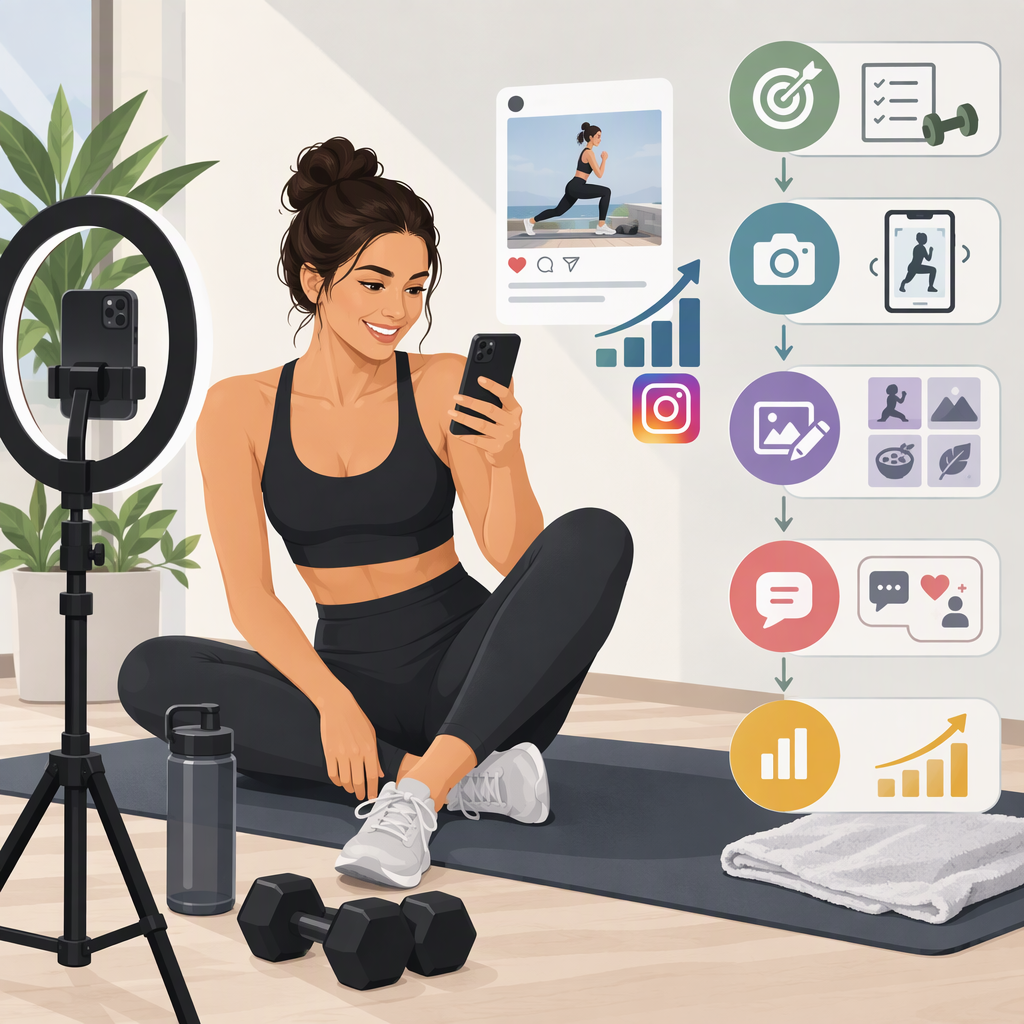
Use this cycle: define your audience and promise → choose a few content themes → publish and interact at a sustainable pace → review available results → make one considered adjustment. Treat examples below as planning ideas, not proven growth formulas.
1. Define Who the Account Is For
A fitness account is easier to plan when you can finish this sentence:
This account helps [a particular audience] with [a recurring need or interest] through [the kind of content you provide].
For example: This account helps people new to strength training understand basic exercise concepts through short demonstrations and plain-language explanations. That is an illustrative positioning statement, not a claim that this audience or format will grow faster.
Choose an audience you can serve consistently. It could be defined by experience level, training interest, equipment access, or the kind of questions people bring to you. Avoid trying to speak to everyone at once; a narrower starting point can make it easier to decide what belongs on the account.
Then check whether a new visitor can quickly understand:
- Who the account is intended for.
- What kind of fitness information or perspective it regularly shares.
- Whether the content matches what that visitor is looking for.
This is a clarity check, not a proven conversion trick. Instagram-specific profile options can change, so use the features currently available in your app rather than relying on an outdated checklist.
2. Choose a Few Repeatable Content Themes
Start with two or three themes that connect your audience’s interests to content you can make accurately and sustainably. Possible fitness-account themes include:
- Demonstrations that explain one exercise or movement concept.
- Beginner-friendly explanations of common training terms.
- Equipment-light workout ideas, with relevant limitations made clear.
- Answers to recurring audience questions.
- Progress reflections that do not promise the same result for everyone.
These are editorial examples—not evidence that a particular format performs better. Before publishing fitness information, be clear about what you know, avoid presenting personal experience as universal guidance, and substantiate claims that need support.
For each post, write down three things before you make it:
- Who is this for?
- What question, interest, or need does it address?
- What should a viewer understand or take away?
If those answers are hard to state, refine the idea before spending time producing it. A post can be visually polished and still leave its intended audience unsure what it is about.
3. Make Each Post Easy to Understand
Treat clarity as a practical editorial choice, not a promise of reach. Give the post one main idea. Use a clear opening, explain unfamiliar terms, and make any necessary context visible in the caption or on-screen. For a demonstration, for example, say what the viewer is seeing and what the explanation does—and does not—cover.
Instagram’s official Best Practices education hub was introduced in the professional dashboard with guidance on creation, engagement, reach, monetization, and guidelines. Meta said the hub would include general advice and personalized tips, including information about reach and the relationship between Reels and follower growth. If the hub is available in your account, it is a useful place to check Instagram’s current guidance rather than treating old algorithm advice as permanent. (about.fb.com)
Do not assume that a hashtag, trending audio, format, posting time, or fixed posting frequency will reliably increase distribution. Meta’s description of its ranking systems says they use AI to personalize what people see and combine multiple predictions; that is not a universal creator-side formula. (about.fb.com)
Instead, choose a format that lets you explain the idea well and that you can keep making. A short demonstration may suit one topic; a sequence of images or a longer explanation may suit another. Those are production decisions, not guarantees about performance.
4. Give Visitors a Clear Reason to Follow
Discovery and following are different steps. Someone may encounter a post without knowing whether the account will keep covering topics they care about. Make the connection between an individual post and the account’s broader promise easy to see: if a viewer likes this explanation, what related value might they reasonably expect from the account?
Review a recent post and your account together. Ask:
- Does the post make its subject and intended audience clear?
- Does the account’s overall presentation explain what it covers?
- Do recent posts offer a recognizable connection to that promise?
- Would a visitor have enough information to decide whether the account suits their interests?
These questions help you check for clarity; they are not verified conversion tactics. You do not need to make exaggerated claims or use a sales pitch to explain what the account is about.
5. Review Results and Choose One Next Adjustment
Use the performance information available in your account, if any, to look for patterns—not to prove that one post caused growth. Instagram’s Best Practices announcement says its guidance includes ways to understand engagement metrics and reach, as well as personalized tips. The exact information available to you may depend on your account and the current app. (about.fb.com)
For each post, consider the parts of the journey your available data can illuminate:
- Discovery: Did the post reach people beyond your existing audience, if your account provides that information?
- Response: Did viewers take actions that suggest the content was useful or interesting to them?
- Follow-through: Did any available information show that viewers visited the account or followed after discovering the post?
Do not assume these measures are available under those exact names, or that they identify why someone acted. Compare like with like where possible—for example, posts with similar topics or formats—and note differences that could affect the comparison. A single result is a clue, not a benchmark.
Hypothetical example: Suppose two posts address the same audience and topic. One reaches more new viewers, while the other prompts more account visits among the people who saw it. That could suggest two different follow-up questions: what made the first post easier to discover, and what made the second account presentation or topic more compelling? It does not establish that a particular opening, format, or caption caused the difference. The numbers and outcome in this example are invented for illustration, not typical results.
Choose one plausible adjustment for the next cycle: clarify the opening, answer a more specific audience question, explain the post’s context better, or make the account’s recurring themes more recognizable. If you change several things at once, it becomes harder to interpret what happened. Keep the change manageable, compare the next results cautiously, and continue only if the content remains useful and sustainable to make.
A First-Cycle Checklist
- Write a one-sentence audience-and-value statement.
- Choose two or three content themes that fit that statement.
- Plan posts around specific viewer questions or interests.
- Explain each post clearly and make relevant context easy to find.
- Publish and interact at a pace you can maintain; there is no universal cadence established here.
- Review whatever relevant performance information is available in your account.
- Choose one next adjustment, then treat the result as directional rather than proof of cause.
The aim is not to find a shortcut that guarantees followers. It is to make the account consistently useful to a defined audience, help visitors understand its value, and improve your choices as you learn what your own results can—and cannot—tell you.