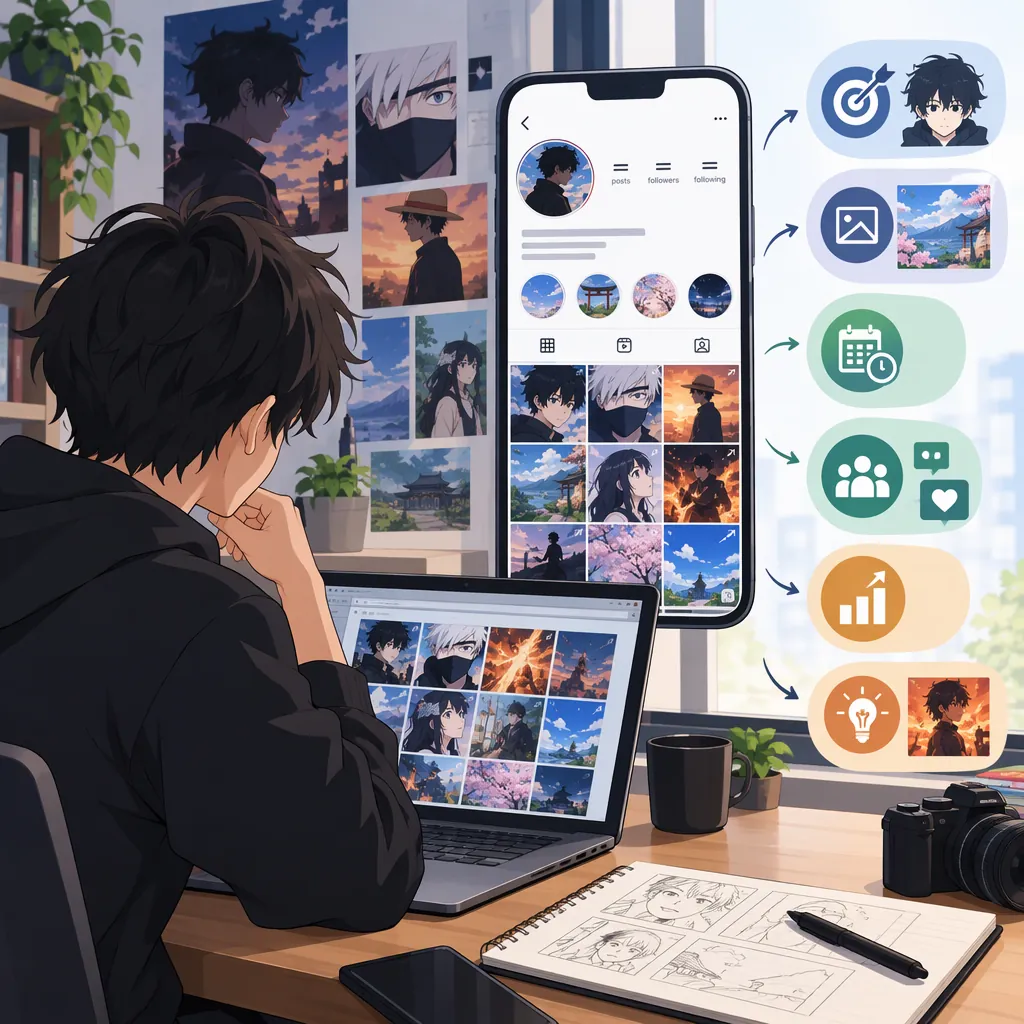
How to Grow an Anime Page on Instagram
To grow an anime page on Instagram, choose a specific audience, publish recognizable original content, connect each post to a clear reason to follow, and review results across repeatable formats. Use a schedule you can sustain and test one change at a time. These are editorial experiments—not a promise of greater reach, a particular follower count, or a growth timeline.
Choose a Specific Anime Audience
Start with a clear reason someone would follow your page rather than just enjoy one post. Instead of covering every anime topic, choose an initial focus such as spoiler-free recommendations, character analysis, original fan art, or discussion of one series.
Define three things before planning posts:
- Audience: Who are you making content for—new viewers, longtime fans, or people interested in your art?
- Promise: What will they consistently find on your page?
- Boundary: Which series, spoilers, or topics will you leave out?
Use that promise in your Instagram bio and keep your first batch of posts aligned with it. Expand later if your observations suggest another topic deserves a recurring series.
Page Positioning Template
This page is for [specific anime audience]. I publish [content type] about [topic or series]. Expect [recurring series]. Spoiler policy: [clear boundary].
For example:
Spoiler-free anime recommendations for viewers who enjoy quiet fantasy. Expect short reviews focused on atmosphere, pacing, and audience fit. No plot reveals.
Connect the Post, Profile, and Reason to Follow
Treat content reach, profile visits, and follows as separate outcomes to observe. A practical Instagram experiment is to make the same editorial promise visible at each step:
- Post opening: Identify the topic and intended audience. For example, “A spoiler-free fantasy recommendation for viewers who prefer atmosphere over action.”
- Caption: Deliver the recommendation and explain the recurring series naturally, such as “Part of this page’s quiet-fantasy recommendation series.”
- Bio: State what the page regularly covers and its spoiler boundary.
- Recent posts: Check that someone visiting the profile can find more content matching that description.
Before publishing, ask: If someone enjoys this post and opens my profile, will they find more of what interested them?
This is a test of editorial consistency, not a claim about Instagram’s distribution system. You can assess the connection through available measurements and relevant comments.
Build Repeatable Content Series
Choose two or three recurring series rather than inventing an entirely new concept for every post. For example:
- Recommendation: “Try this if you enjoy…” with your own explanation of tone, themes, and audience fit.
- Analysis: One character decision, scene, or story question explained in your own words.
- Creative process: Your own drawing, design, or interpretation, with its source of inspiration identified.
Give each post one clear purpose. Open with the subject and the value of reading or watching: “A spoiler-free recommendation for fans of quiet fantasy” is more specific than “You need to see this.”
Match the Format to the Idea
Choose a format based on what you need to communicate, then test it without assuming any format receives preferential distribution.
| Format | Example to test | Editorial checklist |
|---|---|---|
| Reel or short video | A narrated recommendation or your drawing process | Outline one main point; make the opening understandable; check text readability and spoiler boundaries. |
| Carousel | A character analysis or comparison of viewing options | Give the cover a specific subject and each following slide a distinct job. |
| Single image with caption | Original artwork or one discussion question | Make the caption add interpretation, context, or a focused question rather than repeat the image. |
Keep recurring series recognizable through consistent naming and presentation. For instance, a recommendation series could use the same heading structure while changing the anime and explanation. Treat that consistency as a design choice to evaluate, not a guaranteed growth tactic.
Anime Post Outline
- Topic: [one subject]
- Audience: [who this is for]
- Series: [recurring series name]
- Opening: [specific question or benefit]
- Main point: [your original interpretation]
- Support: [example, observation, or your own artwork]
- Spoiler boundary: [none / through episode or chapter]
- Profile connection: [how this matches the page’s ongoing promise]
- Discussion prompt: [one question tied to the post]
Make Originality and Spoiler Boundaries Clear
Build the page around your own writing, analysis, artwork, or other material you have permission to use. Do not present another artist’s work as your own. If you use third-party material, check the applicable permissions and platform terms; do not treat a credit line as permission.
In the Instagram post “How to be an 'Anime Artist',” bloodysamoan criticizes tracing artwork and presenting it as original. The post illustrates that concern; it does not establish copyright rules or demonstrate a follower-growth tactic. [citation-1]
For discussion posts, put a specific spoiler warning before the reveal: “Spoilers through episode 6,” for example. Avoid placing the reveal in the cover image when the post promises spoiler-free content.
Keep the same boundary in captions and your own replies. Identify fan theories as theories, and separate your interpretation from confirmed story details.
Invite Focused, Respectful Discussion
End selected posts with a question that someone can answer from the content itself. Instead of “Thoughts?”, try:
- Recommendation: “Would you recommend this to a first-time viewer, and why?”
- Analysis: “Which character’s choice would you defend?”
- Creative process: “Which detail best conveys this character’s personality?”
Reply with attention to what the person actually said. Ask a follow-up when useful, acknowledge a different interpretation, and keep spoiler boundaries consistent.
When participating on other anime pages, contribute a relevant observation rather than repeatedly promoting your account. If you explore a collaboration, agree on the topic, attribution, permissions, and spoiler policy first. Treat collaboration as a creative project, not a promise of follower growth.
Use questions and replies as feedback on your content, not just as activity to count. A recurring question may suggest a useful follow-up post; a misunderstanding may indicate that your explanation needs revision.
Run a Small Content Test
Pick a manageable trial period, such as four weeks. As a starting experiment—not a proven posting frequency—publish two planned posts per week: one recurring recommendation and one analysis or creative-process post.
Keep the audience and page promise consistent during the trial. Otherwise, you may be comparing content aimed at different people rather than testing how well one approach serves your intended audience.
Record Comparable Observations
Record the same observations for each post after a comparable amount of time. Where your account provides the information, note reach, saves, shares, profile visits, and follows. Otherwise, record visible responses and the substance of discussion. Keep unavailable measurements blank rather than estimating them.
Use consistent measurement definitions and observation windows. Do not compare one post’s first day with another post’s full month, or treat an account-wide change as if one post necessarily caused it.
Compare similar posts before deciding what to change. A post about a different series, at a different time, in a different format does not isolate the effect of its opening line.
Turn Results into Testable Hypotheses
Use the following examples to choose a next experiment—not to diagnose a proven cause:
| Observation across comparable posts | Hypothesis to investigate | One possible next test |
|---|---|---|
| Reach increases, but profile visits do not | The post may be interesting on its own without making the page’s recurring focus clear. | Keep the format similar and clarify how the post belongs to an ongoing series. |
| Profile visits increase, but follows do not | The bio and recent posts may not offer a consistent reason to keep following. | Check that the bio accurately describes the content already visible on the profile; revise one mismatch. |
| Saves or shares increase, but discussion remains limited | The content may be useful, while the closing question is too broad or difficult to answer. | Keep the core content similar and test one specific, spoiler-safe question. |
Other explanations remain possible, including differences in topic, audience, or timing. Changes occurring together do not establish causation. Avoid inferring an algorithm rule from one unusually successful post.
At the end of the trial, decide what to repeat, revise, or stop. Consider both audience response and the time required to produce each series. A format that you cannot sustain may need simplification even if an individual post performs well.
Content Review Worksheet
- Post date:
- Series and topic:
- Intended audience:
- Format:
- Opening:
- Profile promise this post supports:
- Spoiler boundary:
- Time spent creating:
- Measurement date and observation window:
- Reach, if available:
- Saves and shares, if available:
- Profile visits and follows, if available:
- Relevant comments or questions:
- What to repeat:
- Hypothesis to investigate:
- One change to test next:
- Other differences that could explain the result:
FAQ
How Often Should an Anime Page Post?
Start with a frequency you can maintain without sacrificing originality or accuracy. Two planned posts per week can be a practical trial, but it is not an established optimum. Review your workload and comparable results before increasing the schedule.
Should I Grow My Page by Reposting Anime Clips?
Do not make unlicensed reposting the foundation of your plan. Prioritize your own commentary and creative work, and check permissions before using someone else’s footage or artwork. Adding commentary or a credit line should not be treated as automatic permission.
The cited Instagram post addresses tracing and presenting another person’s artwork as original—not clip-reposting effectiveness or legal permission. [citation-1]
Which Hashtags Should I Use for Anime Content?
Use relevant labels that accurately describe the series, character, or type of content. Avoid unrelated tags. If you test hashtag choices, compare otherwise similar posts and avoid changing several elements at once. Do not assume a particular hashtag count will increase reach.
Should I Focus on Reels, Carousels, or Single Images?
Start with the format that suits your idea and production capacity. You might test a Reel for a narrated explanation, a carousel for a structured analysis, or a single image for original artwork. Compare repeated examples rather than declaring one format the winner after one post.
What Should I Change If People Visit My Profile but Do Not Follow?
First, check whether your bio and recent posts communicate the same audience, topic, and recurring value. If they do not, test correcting one mismatch. This is a hypothesis to investigate, not proof that your profile caused the result; visitors may have many reasons not to follow.
How Long Will It Take to Grow an Anime Page?
There is no reliable timeline to promise. Set a review date rather than a follower target with a deadline. Assess which topics attract relevant discussion, which posts people save or share when those measurements are available, whether profile interest changes, and whether your schedule is sustainable.
Sources
- [citation-1] Instagram