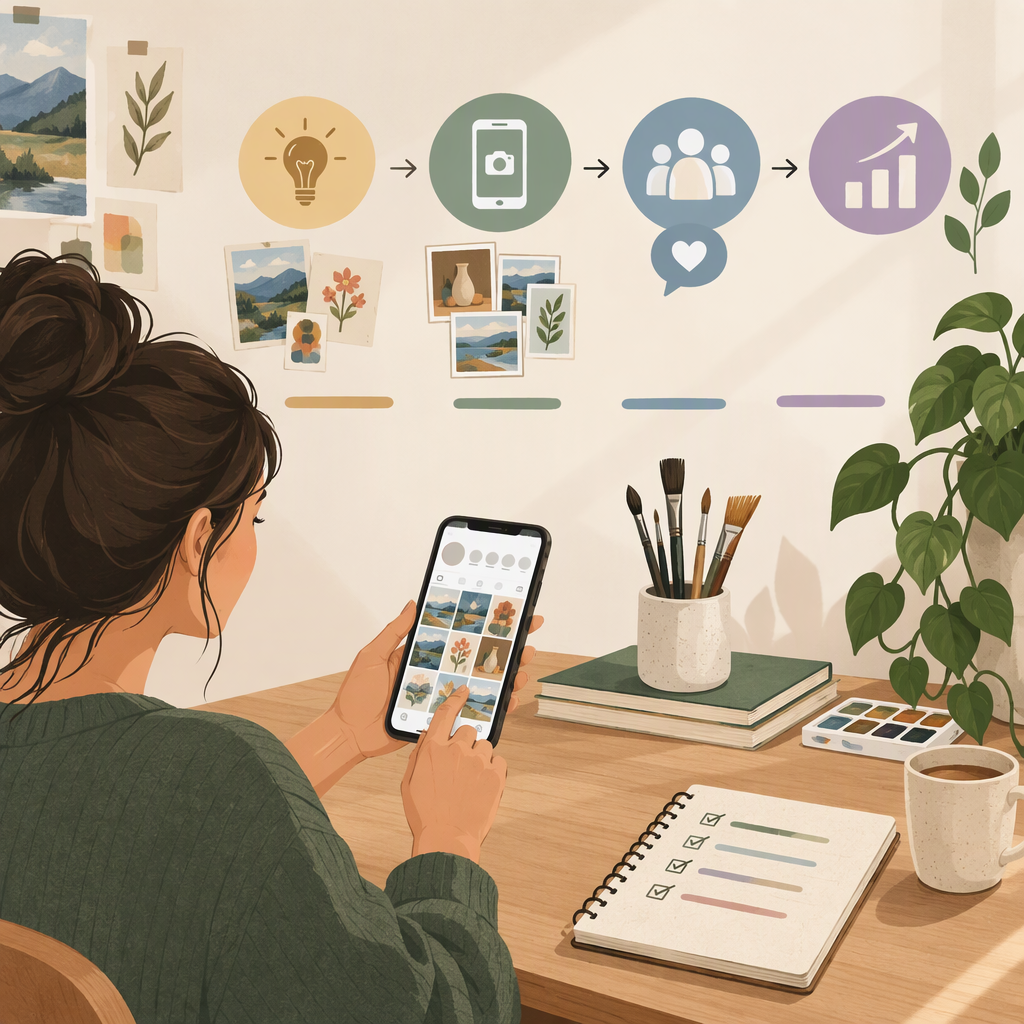
How to Grow Your Art Instagram: A Practical, Sustainable Plan
Growing an art Instagram account is a process of helping the right people understand your work, giving them useful reasons to return, and learning from what they respond to. There is no guaranteed posting schedule, format, hashtag, or growth rate. Start with a clear audience and profile, try a manageable mix of art-related posts, participate genuinely in relevant communities, and review attention separately from new follows.
1. Choose an Audience and Set a Baseline
Before changing your profile or posting more, write down:
- What you make: for example, watercolor landscapes, ceramic figures, or digital character art.
- Who might care: potential collectors, fellow artists, local art fans, people who enjoy a particular subject, or another group that genuinely fits your work.
- What following you offers: finished pieces, process, ideas, materials, or a continuing view of a project.
- One practical goal: such as reaching more people who are interested in your medium or getting more profile visits that turn into follows. Treat it as a direction, not a promised result.
Record a starting point before you experiment: your follower count, recent post performance, and any available account or post insights. Compare like with like—for example, several posts made during the same trial, rather than one unusually successful post against your whole account history.
2. Make Your Profile Easy to Understand
A prospective follower should be able to tell quickly what kind of art you make and what they can expect if they follow. Review your profile as if you had never seen it:
- Does the name or bio make your artistic focus understandable?
- Does the bio give a concise reason to follow, such as seeing new work, process, or a particular theme?
- Do the visible posts represent the work you want to be known for?
- Is it easy to identify which pieces are yours and understand their subject or context?
These are clarity checks, not claims about how Instagram ranks accounts. Avoid trying to fit every interest or keyword into a bio; prioritize the description that best matches the work you plan to share.
For individual posts, add enough context to make the art legible to someone who does not know you. A caption might identify the medium, subject, idea, or one decision in the process. If a work is part of a series, say what connects it to the others. Useful context helps people decide whether the account is for them; it does not guarantee reach.
3. Pick a Small Set of Art Content to Test
You do not need to turn every studio hour into content. Choose a few approaches that fit your work and capacity, then observe which ones attract the people you want. Ideas to test—not proven high-performing formats—include:
- A finished piece with a short note about its subject or intent.
- A detail alongside the complete work, so viewers can see both texture and composition.
- A brief look at a process decision, material, or work in progress.
- A post connecting several works through a recurring theme or series.
- A question that invites a genuine response about the artwork, rather than engagement for its own sake.
Choose a trial cadence you can maintain without undermining your art practice. For example, you might plan two posts a week for three weeks, alternating finished work and process notes. That is an illustrative test plan, not an optimal schedule. If it is too demanding, reduce it; if it is comfortable, continue and compare the results. Keep a simple note of what you posted and how each post performed.
Instagram announced a Best Practices section in the Professional Dashboard covering creation, engagement, reach, monetization, and guidelines, with general and personalized tips. Its announcement specifically described guidance on subjects such as posting frequency, attention, hashtags, and Reels. If this section is available to you, it can provide Instagram’s own current, account-specific guidance; do not assume every account sees identical tips or that following any tip guarantees growth. (about.fb.com)
4. Help Relevant People Encounter Your Work
Make community participation part of the routine only if it is useful and sustainable. Follow artists, galleries, groups, or local creative communities that genuinely relate to your work. Leave specific, thoughtful comments when you have something to say, and respond to people who engage with your art. Consider a collaboration only when there is a natural shared subject or audience and both artists have a clear contribution.
These actions take time, and they may lead to conversation, profile visits, follows, or none of those. Treat them as ways to participate in an art community—not as a guaranteed growth mechanism or a shortcut to recommendations. Measure whether the attention is relevant: are people engaging with the work, asking about the process, or following because they want to see more of it?
5. Review Attention and Follows Separately
At the end of a trial, compare the posts and review whatever insights are available to you. Instagram’s Help Center describes insights for account and individual-content performance, with views, interactions, new followers, and shared content among the information shown. It also says availability and navigation can depend on account and dashboard context; the instructions describe public accounts and separate paths for professional and personal accounts. Menu labels and access may change, so use the current in-app dashboard if yours differs. (meta.com)
Use a simple review:
- Attention: Which posts received more views or other signs that people encountered the work?
- Follow-through: Which posts coincided with new followers or other signs that viewers wanted to see more?
- Context: Did a particular subject, explanation, or process view seem to draw responses from the audience you hoped to reach?
- Next test: Choose one change for the next set of posts—such as the subject, the amount of process context, or the caption—and keep other choices reasonably similar.
For example, if process posts received attention but few new follows, do not immediately conclude that process content is ineffective. Check whether the profile makes your broader body of work clear and whether the posts explain why someone might want to return. Then test one adjustment. This is a way to reason about your own results, not evidence that a particular change will work for everyone.
Avoid treating likes, views, or a single post as proof of lasting audience growth. If numbers are low or inconsistent, extend the trial or make the next test simpler; small samples can be noisy. Instagram’s Best Practices announcement also points creators to its in-app guidance on reach and engagement metrics, which may be more useful than generic claims about an algorithm. (about.fb.com)
A Simple Starting Checklist
- Describe the kind of art you make and the people you hope will care about it.
- Make your profile and recent work easy to understand at a glance.
- Choose a few post ideas and a schedule you can realistically sustain.
- Add context that helps a new viewer understand each piece.
- Participate genuinely in relevant art communities, without expecting guaranteed follows.
- Record a baseline, review several posts together, and change one thing at a time.
The best next step is not to chase every trend. It is to make your art and its context clear, publish at a pace you can keep up, and use your own results to decide what to try next.