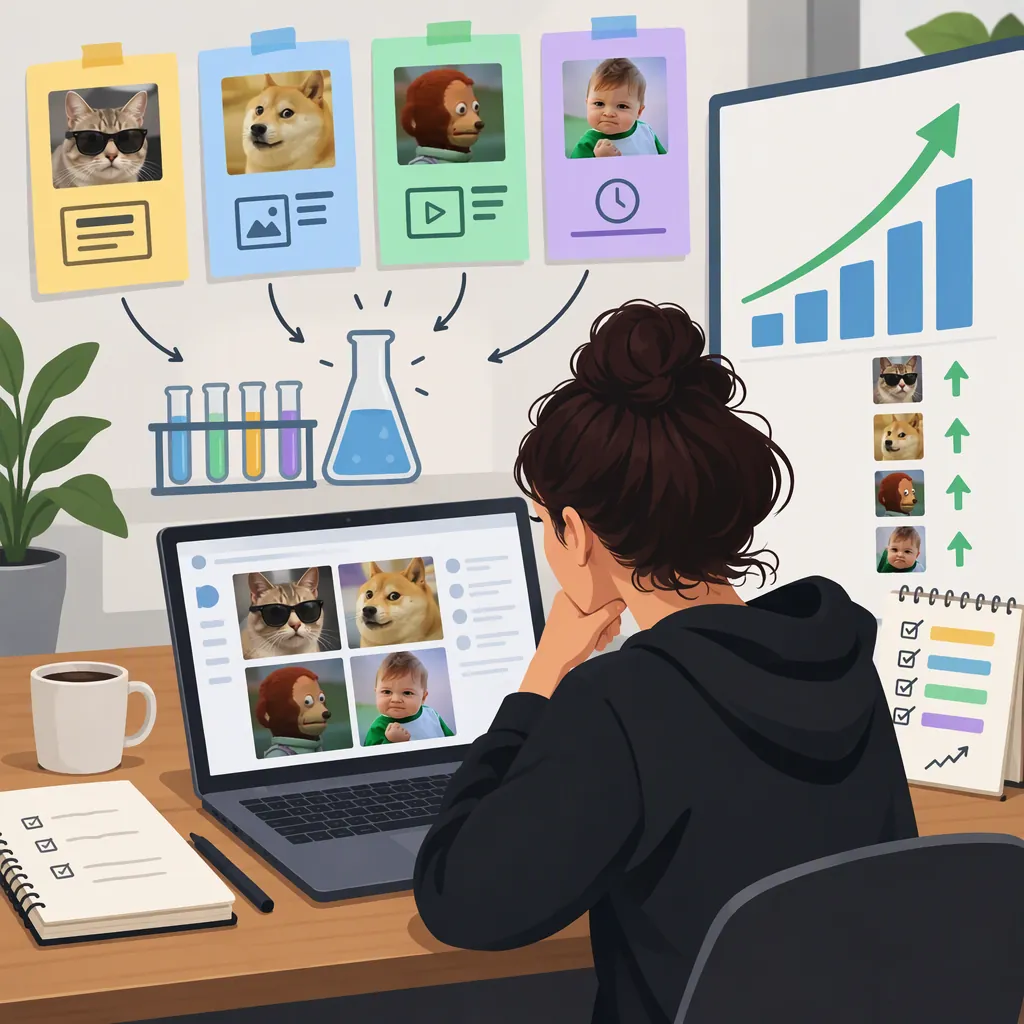
How to Grow Your Meme Page with Focused Experiments
To grow your meme page, define who the jokes are for, build repeatable content formats, publish at a sustainable pace, and test ways to reach relevant audiences. Review reach, profile visits, follows, and comment themes separately so you can decide what to repeat, revise, or pause. Treat this as an experiment process—not a guaranteed growth formula.
The framework below is platform-neutral. Use only the publishing features and analytics available on your platform; the suggested formats, schedules, and review windows are planning choices, not proven algorithm advantages.
Give Your Page a Clear Comedy Focus
Start with an audience and a recognizable point of view rather than a follower target. Choose a subject you can keep writing about, such as student routines, workplace awkwardness, a hobby, or another shared experience.
Write a one-sentence description of the page. Use it to decide whether a draft belongs. You can experiment outside that focus, but label those posts in your notes so you can review them separately.
Make the profile understandable without requiring visitors to decode an inside joke:
- Choose a readable name.
- Write a plain-language bio explaining the subject and tone.
- Where the platform allows it, feature posts that represent what you intend to publish regularly.
For example, “Memes about everyday cooking mistakes for enthusiastic home cooks” gives you a specific audience and a useful boundary for choosing jokes. It is a planning example, not a tested positioning formula.
Audience and Voice Worksheet
- This page is for: ______
- The shared experience we joke about: ______
- Our tone is: ______
- Three recurring subjects: ______
- Topics or treatments we will avoid: ______
- Draft bio: Memes about ______ for people who ______.
Build Formats You Can Keep Making
Choose two or three formats to test, such as a short caption over an original image, a two-panel contrast, or a recurring fictional character. These are creative options, not formats proven to receive preferential distribution.
For each draft, check the setup, punchline, and readability. Try removing words that explain a joke already conveyed by the image. Preview the post at phone size before publishing.
Keep a backlog of situations and punchlines rather than copying whichever post is currently popular. For a cooking-focused page, your idea list might include forgotten ingredients, recipe substitutions, and unrealistic preparation times. Each subject could support several distinct jokes.
Prefer material you created or have permission to use. Do not treat attribution as a substitute for permission. If you adapt a trend, contribute a distinct joke and review the underlying material’s usage conditions. Avoid exposing private information or directing harassment at identifiable people.
Pre-Publication Checklist
- Identify the intended audience.
- State the setup and punchline separately.
- Remove unnecessary explanation.
- Check text readability at phone size.
- Confirm the source and permission for reused material.
- Check for private information or targeted abuse.
- Record the format and topic in the test log.
Test Content and Distribution Separately
Set a publishing schedule you can maintain while leaving time to write, edit, and reply. Treat the schedule as a practical constraint, not an algorithm requirement.
Choose one question for each content test:
- Does a shorter caption work better for this recurring format?
- Which subject draws comments about the intended joke?
- Does a particular posting window fit your audience?
Keep other choices reasonably similar where possible. Comparing unrelated posts may give you ideas, but it cannot isolate why one performed differently. Even a carefully organized comparison is not proof of causation.
Run a Relevant-Conversation Experiment
For distribution, test participation in conversations where your intended audience already discusses the subject. Use relevance—not just the size of the conversation—as your selection criterion.
For a home-cooking meme page, a possible experiment would be:
- Find a relevant discussion. Look for a conversation about cooking mishaps, rather than an unrelated popular post. Check whether participants are discussing the experiences your page covers.
- Check the rules and tone. Do not post promotional material where it is prohibited or where humor would be inappropriate.
- Contribute something self-contained. Add a specific, relevant observation or an original joke that makes sense without requiring someone to visit your page.
- Record what you did. Note the discussion topic, contribution, date, and any available responses or attributable profile visits.
Avoid repetitive promotional comments, unsolicited mass messages, and inserting your page into every reply. This experiment tests whether relevant participation produces useful interaction; it does not guarantee exposure or followers.
Plan a Small Collaboration
Choose a potential collaborator by audience fit and compatible humor, not follower count alone. Review recent posts and comments: would someone who enjoys that account reasonably understand your subject and tone?
A test could be a jointly written two-part meme about a shared topic. Before publishing, agree on:
- The concept and each participant’s contribution.
- Permission to use images and other material.
- Attribution and which accounts will publish each part.
- Publication timing and the metrics each participant is willing to share.
Record available reach or views, responses, profile visits, and post-attributed follows. Mark unavailable metrics as unavailable. If several changes happen at once, such as a collaboration and a new format, do not assume you know which caused the result.
Review Reach, Followers, and Community Signals
Use whatever analytics your platform actually provides. Keep these measurements distinct:
| Measurement | How to use it in your review |
|---|---|
| Reach or views | Record the platform’s reported metric and definition; do not treat reach and views as interchangeable. |
| Profile visits | Record separately where available; they are not the same as follows. |
| Post-attributed follows | Use only when the platform explicitly reports follows attributed to that post. |
| Account net follower change | Record for a defined period as account-level context, not as a result attributable to one post. |
| Comment themes | Note whether responses concern the joke, request another installment, or discuss something unrelated. |
Choose a consistent review window, such as seven days after each post. That window is an organizational choice, not a recommended platform standard. Compare several posts within a format before deciding whether to continue it.
If post-attributed follows are unavailable, write “unavailable.” Do not assign the account’s weekly follower increase to whichever post received the most views.
Simple Content Experiment Log
Use one row per post. Add profile visits or other metrics only if your platform provides them.
| Post | Topic and format | Variable tested | Review date | Reach or views, labeled | Post-attributed follows | Comment themes | Next action |
|---|---|---|---|---|---|---|---|
| ______ | ______ | ______ | ______ | ______ | ______ | ______ | ______ |
Keep a separate account-level record:
| Review period | Starting followers | Ending followers | Net change | Other activity during the period |
|---|---|---|---|---|
| ______ | ______ | ______ | ______ | ______ |
Hypothetical Review Example
The following numbers are invented solely to demonstrate a review process. They are not benchmarks or expected outcomes. Assume all posts were reviewed after seven days.
| Format | Views across three posts | Post-attributed follows | Comment themes | Possible decision |
|---|---|---|---|---|
| Two-panel recipe mishaps | 900, 1,100, 1,000 | Unavailable | Several specific cooking stories and requests for more | Repeat the format with new situations. |
| Recurring kitchen character | 850, 950, 900 | Unavailable | Repeated questions about what the character means | Revise the setup, then test again. |
| Broad trending joke | 2,800, 600, 500 | Unavailable | Mostly unrelated discussion; few responses to the page’s subject | Pause it for the next cycle. |
Suppose the account also moved from 200 to 218 followers during that period. Record +18 net followers in the account-level log. Without post-attribution data, you cannot credit those followers to any particular format.
The first format is worth another test because several posts prompted relevant responses—not because it crossed a universal view threshold. The second suggests a clarity problem to investigate. The third had one high-view post, but that alone does not establish a repeatable way to attract the intended audience.
Turn Feedback into the Next Publishing Cycle
Read comments for qualitative clues and reply when you have something useful or funny to add. You can invite ideas without demanding tags, shares, or follows.
At each review, choose one action:
- Repeat: Make another installment of a format with several encouraging results.
- Revise: Change one element, such as an unclear setup or overly long caption.
- Pause: Set aside a format that is difficult to sustain or repeatedly attracts responses unrelated to your intended focus.
For the next cycle, write down the question you are testing before publishing. A single strong post is a reason to investigate, not proof of a growth formula.
Set Goals Without Relying on Growth Promises
Brandon King’s Amazon listing for How to Grow a Meme Page advertises growth from zero to 100,000 Instagram followers in three months or less and describes coverage of profile choices, paid post ads, and unpaid growth. The listing describes the book’s promises; it does not establish that those outcomes are typical or reproducible, or validate the experiments in this guide. [citation-1]
Set an initial goal around work you control: prepare a backlog, complete a manageable publishing cycle, test a relevant distribution approach, and document the results. Keep any follower target separate from that work plan, and do not treat a deadline as a promised outcome.
FAQ
How Often Should I Post on My Meme Page?
Choose a frequency you can sustain without skipping writing, editing, permission checks, or replies. Review that schedule after a complete publishing cycle. If maintaining it reduces content quality or leaves no time to learn from results, adjust it rather than treating frequency as an algorithm rule.
How Do I Tell Whether Reach or Follow Conversion Needs Attention?
Review several posts using the same available metrics. If exposure is limited relative to your own recent comparable posts, test content presentation or relevant distribution. If exposure is stronger but post-attributed follows remain limited, inspect whether the profile and featured posts clearly explain what someone would get by following.
These are diagnostic questions, not confirmed causes. If post-attributed follows or profile visits are unavailable, acknowledge that you cannot isolate the conversion step.
How Should I Choose a Collaboration Partner?
Look for overlap in audience interests and compatible humor. Review recent content and discussion rather than selecting solely by account size. Start with a small, clearly defined project, agree on permissions and attribution, and record whatever results are available without assuming the collaboration caused all account growth.
Is There a Proven Timeline for Growing a Meme Page?
The cited book listing does not establish a reliable growth timeline or your likelihood of achieving its advertised outcome. [citation-1] Use publishing and review milestones for planning, and treat follower growth as an outcome to measure rather than a deadline you can guarantee.