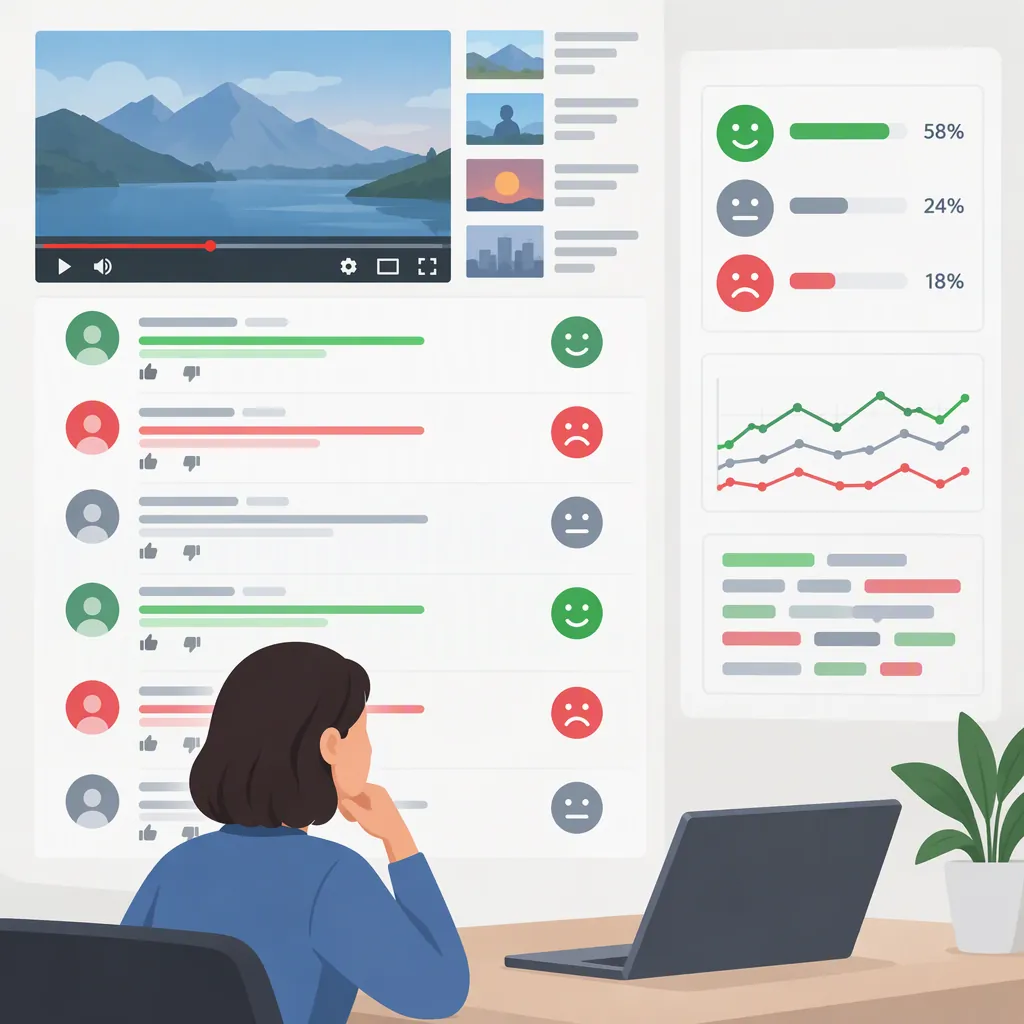
How to Analyze and Interpret YouTube Comment Sentiment
Sentiment analysis of YouTube comments classifies expressed opinions, commonly as positive, negative, or neutral. A useful workflow collects public comments, prepares the text, assigns labels, checks those labels against human review, and summarizes results by topic. Interpret the output as feedback within the collected comments—not a verdict on every viewer or proof of what caused a video's performance. The supplied overview describes collection, cleaning, classification, testing, and visualization. [citation-2]
Define What the Sentiment Is About
Start with a specific question: Are commenters reacting to the explanation, production quality, a featured product, or the subject being discussed?
The distinction matters when a comment contains several opinions. Determ's overview recommends splitting comments with contrasting statements into individual units and describes topic-based sentiment classification. [citation-2]
For example, the invented comment “The explanation was clear, but the background music was distracting” contains positive feedback about clarity and negative feedback about audio. Treating it as one overall label would obscure the useful distinction.
For an initial analysis, use a small topic list such as explanation, pacing, audio, visuals, and subject matter. Keep sentiment and topic in separate fields. If you also need emotion labels such as anger or joy, define them separately rather than treating them as synonyms for negative or positive sentiment.
Analysis Question Template
Question: What do public comments say about [specific aspect] in [video or video group]?
Collection window: [start date] through [end date].
Unit of analysis: [whole comment or topic-specific statement].
Sentiment labels: positive, negative, neutral, mixed, needs review.
Topics: [defined topic list].
Interpretation boundary: Results describe the collected comments, not all viewers.
Collect Public Comments and Preserve Context
Document the videos, collection dates, selection method, and whether your dataset includes replies. Do not assume that a retrieved dataset contains every comment.
A public GitHub project describes fetching YouTube comments through the YouTube Data API and analyzing them with a pretrained model. Its README also advises keeping API keys secure and observing usage limits. That description is an implementation example, not independent verification of completeness or accuracy. [citation-3]
For a public-only analysis, exclude private messages and nonpublic account data. Retain only the identifiers needed to deduplicate records and trace your analysis; avoid including usernames in a published report unless there is a clear reason.
Keep an unchanged copy of the original text alongside the analysis version. Determ's overview recommends removing repetitive text and irrelevant material during preparation. [citation-2] Apply those decisions selectively: do not remove a negation, emoji, or punctuation mark merely because it looks like noise. If you split a comment into statements, preserve a link to its original context.
Record exclusions, including duplicates, spam-like repetition, unsupported languages, and empty text. Describe the exclusion rules without claiming that repetition proves automated activity.
Comment Review CSV Header
record_id,video_id,collected_at,posted_at,is_reply,original_text,analysis_text,language,topic,predicted_sentiment,reviewed_sentiment,review_reason,exclusion_reason
Choose a Method and Define the Labels
The supplied overview distinguishes rule-based, machine-learning-based, and hybrid sentiment analysis. Rule-based methods use predefined language rules or lexicons; supervised machine-learning methods learn from labeled examples; hybrid approaches combine elements of both. [citation-2]
Choose a method based on your analysis needs, then evaluate it on the actual comment language and topics. The provided sources do not establish a universally best model or an accuracy rate for your dataset.
Use explicit labeling rules:
- Positive: Expresses approval of the identified target.
- Negative: Expresses criticism or dissatisfaction with that target.
- Neutral: Provides information or asks a question without clear evaluative language.
- Mixed: Contains both approval and criticism about the same analysis unit.
- Needs review: The target or meaning is too uncertain to label confidently.
These are suggested review rules, not a claim that every automated system supports five categories. If a model only returns positive, negative, and neutral, maintain mixed and needs-review as separate human-review fields. Do not quietly count uncertain comments as neutral.
Check Ambiguous Labels Before Summarizing
Testing is part of the workflow described in the supplied overview, including revisiting training when test results are inadequate. [citation-2] For your analysis, reserve comments for human review rather than relying only on examples used to adjust the model or rules.
Review examples from every predicted category, together with ambiguous statements, replies that depend on context, and each language included in the report. Keep a separate record of disagreement types so you can distinguish a wrong sentiment label from a wrong topic assignment.
Use these invented examples to clarify review decisions:
| Example | Suggested Review Decision |
|---|---|
| “Great, another tutorial that skips the important step.” | Review for sarcasm rather than accepting “great” as approval. |
| “I disagree with the speaker, but the interview was well conducted.” | Separate sentiment toward the speaker's position from sentiment toward the interview. |
| “What microphone is this?” | Neutral unless surrounding context supplies an evaluative meaning. |
| “That ending was sick.” | Review the intended meaning of the slang. |
Record corrections and reasons. If reviewers cannot agree, retain the uncertainty rather than manufacturing a definitive label.
Human Review Checklist
- Identify the target of the opinion.
- Read the original comment and any necessary public thread context.
- Check negation, sarcasm, slang, and contrasting statements.
- Verify that the language is within the analysis scope.
- Assign sentiment and topic separately.
- Record disagreement or uncertainty.
- Keep reviewed examples separate from examples used to tune the method.
Interpret Counts, Topics, and Changes Carefully
The supplied sources describe visualizing sentiment distributions with charts. [citation-2] Before making a chart, decide exactly what each count represents: comments, topic-specific statements, or another defined unit.
For a labeled-comment percentage, calculate:
positive share = positive comments ÷ all comments included in that breakdown × 100
List the categories included in the denominator. If mixed or unresolved comments are excluded, show their counts separately. If you split comments into multiple statements, label the output as statement-level sentiment rather than comment-level sentiment.
Prefer a table with counts and percentages alongside any chart. Break down sentiment by topic so that an overall label does not hide a recurring audio complaint or a well-received explanation.
When comparing videos or time periods, keep collection windows, reply handling, language scope, label rules, and analysis units as consistent as possible. Treat differences as descriptive unless you have a separate basis for causal conclusions.
A sentiment label is also not an authenticity judgment. In the supplied DeepLearning.AI discussion, a participant asks whether a comment analyzer can distinguish real users from click farms; the supplied thread provides no answer. It therefore does not establish that capability. [citation-4] Report repetitive or suspicious-looking patterns as observations, not proof of coordinated manipulation.
Result Summary Template
Scope: [videos, dates, languages, and reply handling].
Retrieved records: [count].
Excluded records: [count and reasons].
Analysis unit: [comments or topic-specific statements].
Sentiment breakdown: [counts, percentages, and denominator].
Mixed or unresolved units: [count].
Topic findings: [reviewed patterns].
Validation: [review method and observed disagreements].
Limitations: [coverage, selection, context, and language limits].
Conclusion: Within the collected material, [finding]. This does not establish the opinion of all viewers or explain changes in video performance.
Turn Reviewed Feedback into Testable Questions
Use reviewed topic patterns to identify questions for the next video, not to make sweeping claims about audience satisfaction. For example, repeated, verified criticism about pacing could justify testing a shorter introduction. Positive comments about examples could justify testing another worked example. These are suggested experiments, not promised performance improvements.
Keep the evidence boundary visible in the report: what was collected, what was reviewed, and what remains uncertain. Do not describe a negative-comment increase as a reputation crisis solely because a sentiment chart changed.
Source limitations also matter. The supplied IJRASET paper describes a YouTube comment-analysis workflow, but its conclusion and references discuss sorting-algorithm visualization rather than the stated sentiment-analysis topic. It should not be used to establish model accuracy or audience outcomes. [citation-1] The commercial overview and project README likewise do not validate your particular dataset.
FAQ
Is Sentiment Analysis the Same as Emotion Analysis?
For this workflow, sentiment means evaluative direction—positive, negative, or neutral—while emotion labels describe feelings such as anger or joy. The supplied IJRASET text discusses both types of labels, but it does not establish that a sentiment classifier automatically supports emotion detection. Define and validate them separately. [citation-1]
Which Model Is Best for YouTube Comment Sentiment?
The provided sources do not establish a universally best model. They describe rule-based, machine-learning, and hybrid approaches, plus a project using a pretrained model. Compare candidate methods against human-reviewed comments from your own language and topic scope rather than assuming one approach is always more accurate. [citation-2] [citation-3]
How Should I Handle Comments with Both Praise and Criticism?
Separate topic-specific statements when that matches your analysis question, while preserving the original comment. Alternatively, retain a mixed label in your review layer. The supplied overview recommends splitting contrasting opinions into individual units; make clear whether your final percentages count comments or statements. [citation-2]
Can Sentiment Analysis Identify Fake or Coordinated Comments?
Do not infer authenticity from sentiment labels alone. The supplied community thread asks about distinguishing real users from click farms but contains no answer establishing that capability. Any authenticity assessment needs evidence beyond whether a comment sounds positive or negative. [citation-4]