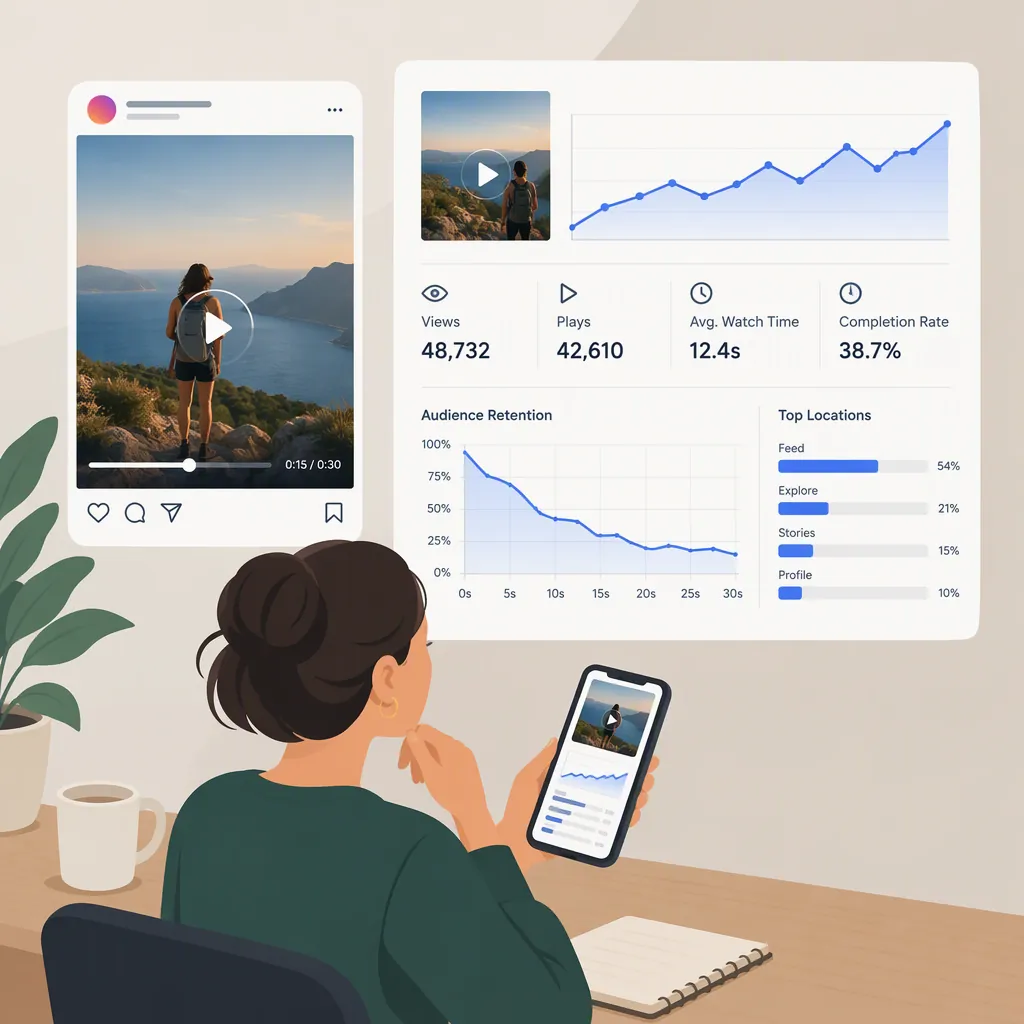
How to View and Interpret Instagram Video Ad Analytics
For paid Instagram video campaigns, use Meta Ads Manager rather than treating organic Instagram Insights as your ad report. Start with the campaign goal, then review delivery, video engagement, clicks, and the relevant outcome together. Strike Social identifies Ads Manager as the reporting tool for paid Instagram campaigns and lists metrics including reach, impressions, frequency, link clicks, video plays, and ThruPlays. Its definitions are useful context, but confirm the exact metric labels in your report before comparing results. [c3]
Choose the Right Report for Paid Performance
Keep paid advertising results separate from organic content performance. Strike Social distinguishes Instagram Insights for organic reporting from Meta Ads Manager for paid Instagram advertising analytics. [c3]
For a video ad review, use this reporting sequence:
- Identify the campaign, ad set, and video ads you want to evaluate.
- Set a consistent reporting period.
- Confirm that the data represents Instagram delivery, rather than assuming a broader campaign total is Instagram-only.
- Record the objective and the outcome you intend to assess.
- Include delivery, video engagement, and outcome metrics in the same review.
This is a reporting checklist, not a verified current click-by-click interface walkthrough. The supplied sources do not establish today's menu labels or account-specific metric availability.
A 2019 LeadsBridge article describes older Instagram Insights tabs and promoted-post reporting. Do not treat that older navigation as a current interface guide. [c2]
Report Scope Checklist
- Reporting period: __________
- Campaign / ad set / ad: __________
- Instagram delivery scope: __________
- Objective: __________
- Primary outcome: __________
- Video length: __________
- Exact metric labels: __________
- Attribution settings, if applicable: __________
- Known reporting limitations: __________
Match the Metrics to the Campaign Goal
Choose the primary measure before ranking ads. Strike Social recommends aligning Instagram ad reporting with campaign objectives rather than treating sales or conversions as the only useful results. [c3]
| Review Goal | Metrics to Consider | Interpretation Question |
|---|---|---|
| Delivery and awareness | Reach, impressions, frequency, CPM | How broadly and repeatedly was the ad delivered, and at what cost? |
| Video engagement | Video plays, short-duration plays, ThruPlays, cost per ThruPlay | Which viewing threshold did the audience reach? |
| Website traffic | Link clicks, link-click CPC, a clearly labeled CTR | Did the ad generate the intended click action? |
| App acquisition | App installs, cost per app install | What did each reported install cost? |
These metric groups are drawn from Strike Social's reporting discussion. [c3] For another outcome, such as purchases or leads, specify that outcome in your review rather than substituting views or likes.
As an analysis practice, use a primary outcome metric to judge the objective and supporting metrics to investigate the pattern. Do not label an ad successful solely because it has the largest play count.
Read Video Metrics by Their Exact Definitions
Avoid using “views” as an undefined umbrella term. The supplied Strike Social guide lists several different video measures, including video plays, two-second continuous plays, three-second plays, and ThruPlays. It describes ThruPlays as plays to completion or for at least 15 seconds. [c3]
That distinction matters when reading a report:
- Video plays: Review the play count using the report's stated definition; do not assume it means completion.
- Short-duration plays: Record the threshold explicitly so that a two-second measure is not compared with a three-second measure.
- ThruPlays: Interpret the result alongside video length. Under the cited definition, a qualifying play of a longer video need not represent full completion.
- Cost per ThruPlay: Use it to assess the cost of that viewing threshold, not as a substitute for cost per purchase or lead.
Check the current report's metric descriptions before applying these definitions. The provided video-metric reference was updated in January 2025; it does not verify every current label or reporting behavior. [c3]
Compare Ads with Consistent Denominators
Strike Social defines reach as unique users exposed to an ad, impressions as total ad displays, and frequency as average exposures per user. It also distinguishes cost per link click from cost per thousand impressions. [c3]
For your own calculations, state the numerator and denominator explicitly. The formulas below are analysis calculations, not a claim that every dashboard uses the same labels or precision.
Compare ads using the same reporting period, delivery scope, click type, viewing threshold, and outcome definition. For conversion comparisons, also record attribution settings. Treat differences in those conditions as limitations rather than silently combining the results.
Do not divide by zero. If a denominator is zero or unavailable, report the calculated metric as unavailable instead of inventing a value.
Transparent Reporting Formulas
Using values from the same reporting scope:

CPM = spend / impressions × 1,000
Cost per link click = spend / link clicks
Link-click rate (%) = link clicks / impressions × 100
Calculated cost per ThruPlay = spend / ThruPlays
Calculated cost per selected outcome = spend / selected outcomes

For each calculation, record the exact input labels. Calculate only when the denominator is greater than zero. Do not relabel link-click rate as an unspecified CTR.
Turn Reporting Patterns into Testable Questions
Use the report to frame the next question, not to assign a cause without evidence. The following are suggested interpretations, not platform benchmarks or guaranteed diagnoses:
- More impressions without a comparable increase in reach: Review frequency before describing the change as audience expansion.
- Strong early-play counts but fewer qualifying longer plays: Consider testing the opening, pacing, or video length. First confirm that the viewing thresholds are comparable.
- More video engagement but little movement in the primary outcome: Revisit whether the video is serving the campaign objective; do not equate attention with business results.
- More link clicks but weak reported outcomes: Investigate the destination and measurement setup before concluding that the creative is the only issue.
Write down the observation, plausible explanations, missing information, and one controlled change to test. Avoid universal “good” CTR or cost-per-view targets: the supplied references do not establish a benchmark appropriate to every Instagram video campaign.
Video Ad Review Note
Primary objective: __________
Observed result and reporting period: __________
Comparison conditions: __________
Supporting delivery and video metrics: __________
Plausible explanations, not proven causes: __________
Missing evidence or measurement concerns: __________
One proposed test: __________
Primary metric for evaluating the test: __________
FAQ
Where Should I View Paid Instagram Ad Analytics?
Strike Social identifies Meta Ads Manager as the tool for paid Instagram advertising analytics and Instagram Insights as the dashboard for organic performance. Confirm that your report covers the Instagram delivery you intend to analyze. The supplied sources do not verify current button-by-button navigation. [c3]
Does a Thruplay Always Mean Someone Watched the Entire Video?
Not under the definition in the supplied Strike Social guide, which describes a ThruPlay as a play to completion or for at least 15 seconds. For a longer video, that threshold need not mean full completion. Check the definition shown in your current report. [c3]
What Is the Most Important Instagram Video Ad Metric?
There is no single metric for every campaign. Strike Social recommends matching reporting to the objective. Choose a primary measure for the intended result, then use delivery, viewing, and click metrics to interpret it. A high play count alone should not be your evidence that a sales-focused campaign met its goal. [c3]