Instagram Unfollow Analysis: Understanding Unfollowers and Audience Loss
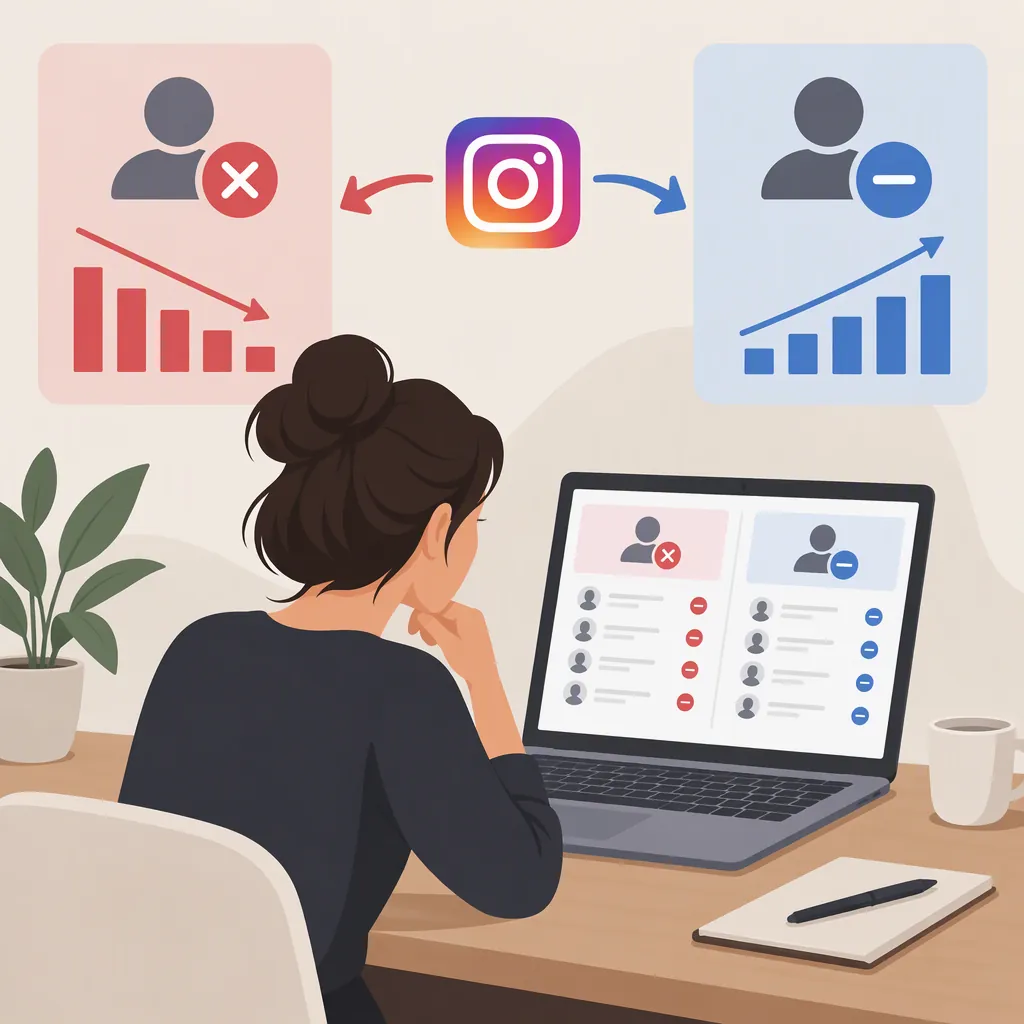
Instagram unfollow analysis should separate accounts that do not follow you back from accounts that appeared in an earlier follower list but are absent from a later one. The first measures reciprocity; the second measures observed audience loss over an interval. FollowBuddy describes comparing followers with a previous audit, while InstagramUnfollowers describes checking who does not follow you back. Neither result, by itself, explains why someone left.
Unfollowers Are Not the Same as Non-Followers
Start by defining the question you want to answer:
- Who does not follow me back? Compare the accounts you currently follow with your current followers. This identifies non-reciprocal connections, not necessarily former followers.
- Who is missing from my earlier follower list? Compare an earlier follower snapshot with a later snapshot. This identifies observed losses between those observations.
- How much did my audience change? Compare follower totals. This measures net change, not the identities or number of all departures.
The distinction matters when reading tool results. The InstagramUnfollowers repository describes its purpose as finding accounts that do not follow you back. FollowBuddy separately describes comparing followers against a previous audit to find unfollowers. Their descriptions should not be treated as interchangeable. [c2] [c1]
A current non-follower list alone cannot establish that an account previously followed you. Likewise, absence from a later snapshot is an observation—not proof of a deliberate unfollow or its cause.
Measure Loss Separately from Net Growth
For two complete, comparable follower snapshots, use these analytical definitions:
| Measure | Calculation | Meaning |
|---|---|---|
| Observed losses | Accounts in the earlier list but not the later list | Previously observed followers now absent |
| Observed additions | Accounts in the later list but not the earlier list | Newly observed followers |
| Net change | Later follower count minus earlier follower count | Overall audience-size change |
| Snapshot loss rate | Observed losses divided by the earlier follower count, multiplied by 100 | Share of the starting audience absent later |
If the earlier follower count is zero, leave the loss rate undefined. These are snapshot calculations, not claims about an Instagram-provided metric.
Record the observation dates and whether both lists are complete. When using usernames as identifiers, verify identity before labeling an apparent disappearance as a lost follower. If you cannot establish that the snapshots are comparable, report the result as uncertain.
Two snapshots also leave a gap: they do not reveal an account that followed and then unfollowed entirely between observations. A historical comparison therefore describes differences between recorded states, not a complete event history. FollowBuddy's stated previous-audit comparison illustrates this snapshot-based approach. [c1]
Follower Change Review Template
Earlier observation date:
Later observation date:
Earlier follower count:
Later follower count:
Observed additions:
Observed losses:
Net change:
Snapshot loss rate:
Are both lists complete and comparable?:
Identity checks or unresolved differences:
Content or campaign changes during the interval:
Interpretation and remaining uncertainty:
Match the Tool Result to Your Question
The supplied sources describe different kinds of tracking. Read their result labels before using them to assess audience loss.
| Source | What Its Public Description Says | Interpretation Limit |
|---|---|---|
| FollowBuddy | Compares followers with a previous audit | A historical comparison needs an earlier observation. [c1] |
| InstagramUnfollowers | Checks who does not follow you back through a browser-based workflow | Non-reciprocity is not evidence of a previous follow. [c2] |
| DolphinRadar Activity Tracker | Describes recent follows, unfollows, and likes for public accounts | Its page does not establish the completeness or accuracy of an individual report. [c3] |
| Unfollower Tracker for Top Photo App | Lists non-followers, recent unfollowers, mutual connections, and Excel export | These are listing claims; the supplied description does not explain the historical detection method. [c4] |
These summaries are not recommendations or independently tested results. Do not assume that a tool's use of “unfollowers” means it supplies a complete historical record.
Interpret Changes Without Assigning Motives
For creator analysis, treat follower loss as a signal to investigate—not a verdict on a post or a person's intentions. Keep the comparison interval consistent, record relevant content changes, and look for repeated patterns before proposing an explanation. A departure list alone does not establish dissatisfaction, suspicious behavior, or a causal link to a campaign.
Separate reviewing data from taking account actions. The InstagramUnfollowers README describes running code in a logged-in browser session and selecting accounts to unfollow; it also includes a use-at-your-own-risk disclaimer. This article does not reproduce that console workflow or verify its safety claims. [c2]
Similarly, “no password needed” and local-processing statements should not be treated as independent security guarantees. FollowBuddy makes no-password claims, while the Chrome extension listing makes local-data and privacy claims. The supplied pages do not independently validate those assurances. [c1] [c4]
Keep analysis limited to information you are authorized to access, retain only what you need, and avoid publishing lists of individual departures. Use the results to review audience trends rather than to pressure people to follow again.
FAQ
Does “Does Not Follow You Back” Mean Someone Unfollowed You?
No. It describes a current non-reciprocal connection. Establishing an observed loss requires evidence that the account was in an earlier follower list. InstagramUnfollowers describes checking follow-back status, while FollowBuddy describes comparison with a previous audit.
Can a Current Follower List Reveal All Past Unfollowers?
No. A current list alone does not show earlier membership. Even two snapshots show only the difference between those observations, not every follow and unfollow during the interval. FollowBuddy's public description refers to comparison with a previous audit, not reconstruction of an unlimited past history.
Does Public-Account Tracking Include Private Instagram Accounts?
Not according to DolphinRadar's activity-tracker page: it explicitly says its service works with public accounts and does not track private accounts. That statement applies to DolphinRadar, not automatically to every comparison tool.
Are the Referenced Tools Verified Safe or Officially Connected to Instagram?
The supplied sources do not independently verify safety. FollowBuddy, InstagramUnfollowers, and DolphinRadar explicitly disclaim affiliation with Instagram. Their feature and privacy descriptions should be read as source claims, not guarantees or evidence of official approval.