Amazon Affiliate Program for YouTube: Overview and Channel Fit
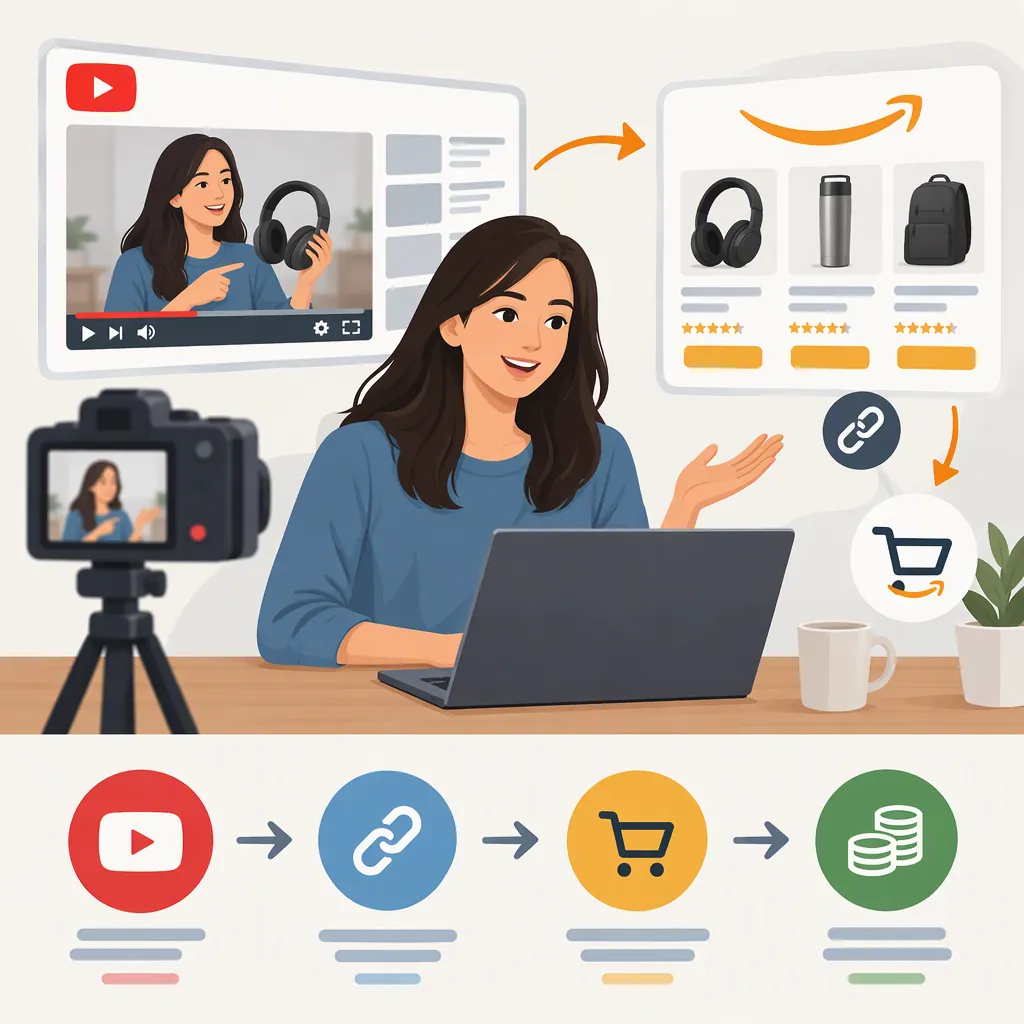
For YouTube creators, the Amazon affiliate program generally means Amazon Associates: using affiliate product links alongside videos and potentially earning commissions from qualifying purchases. The video gives viewers context; the link provides a route to a product. Views and clicks alone are not a guarantee of commission income. [source_1]
It is worth evaluating when products naturally help answer your audience’s questions, your recommendations are supported, and link maintenance is manageable. Editorial fit and program eligibility are separate decisions: a relevant channel is not necessarily an approved channel.
How Amazon Associates Works with YouTube
A third-party YouTube guide describes this basic workflow: [source_1]
- Apply to Amazon Associates with information about your channel and planned promotional activity.
- Obtain affiliate product links for products relevant to your content.
- Publish links alongside videos, subject to the applicable placement and disclosure requirements.
- Potentially earn commissions from qualifying purchases through those links.
- Review reporting information to understand clicks, conversions, and results.
This is an overview, not a verified application or compliance procedure. The guide’s suggestions about approval, link placement, and disclosures should not be treated as current official requirements.
What the Available Sources Establish
The YouTube guide supports the general affiliate model and examples of content formats. The official Amazon Associates Central reference provides navigation to the Operating Agreement, Program Policies, Program Help, Commission Income Statement, and Reports—but not the detailed terms themselves. Consequently, the available evidence does not establish current US eligibility, approval deadlines, permitted placements, commission rates, or attribution rules. [source_1] [source_2]
The sections below distinguish practical channel-fit judgments from participation conditions that remain unconfirmed.
Is It a Good Fit for Your Channel?
Reviews, comparisons or ranked lists, tutorials, and unboxings are examples of YouTube content that can connect a viewer’s question with products. The guide describes these formats, but it does not establish that any one of them will produce a particular result. [source_1]
Use editorial relevance—not the number of available linking opportunities—to assess suitability.
| Consideration | Question to ask | Implication |
|---|---|---|
| Product relevance | Does the product help answer the video’s main question? | Leave out links whose connection to the topic is weak. |
| Recommendation evidence | Can you support the recommendation without implying testing or ownership that did not happen? | Gather evidence or narrow the claim before recommending. |
| Audience needs | Is buying something necessary, or could a non-purchase solution work? | Explain relevant alternatives, including the option not to buy. |
| Editorial independence | Can you discuss drawbacks and limitations? | Keep the video useful even when the conclusion discourages a purchase. |
| Maintenance | Can someone review descriptions and links when products or recommendations change? | Include that ongoing work in the suitability decision. |
A Brief Fit Comparison
A hypothetical tutorial about choosing a microphone for a recording setup has a clear reason to discuss products. Affiliate links may fit if the comparisons are supported and the applicable rules are satisfied.
An unrelated gadget added to a commentary video solely to create a linking opportunity has a weaker editorial purpose. Leaving it out preserves the focus of the video.
Your Planning Decision
- Evaluate participation further when product relevance, evidence, and maintenance capacity are all present.
- Resolve evidence gaps first when products fit the topic but recommendations are not adequately supported.
- Leave affiliate links out for now when the connection is forced or the added work is not justified.
These are planning judgments, not Amazon approval criteria.
Participation Conditions That Remain Unconfirmed
The third-party guide discusses applying with channel information, descriptions, pinned comments, disclosures, and account review. Those suggestions do not establish permission or eligibility under current Amazon or YouTube rules. [source_1]
For a creator considering the US program, the following questions remain unanswered by the available official reference. [source_2]
| Participation condition | What needs an authoritative answer |
|---|---|
| Channel eligibility | Whether your channel meets current application and content requirements, including any audience or activity thresholds. |
| Application and review | What information is required, how approval works, and whether deadlines or qualifying-activity requirements apply. |
| Publishing properties and placements | How your channel must be identified and whether each intended location, such as descriptions or pinned comments, is permitted. |
| Affiliate identification and disclosures | What Amazon requires and what separate disclosure obligations apply to the video and its links. |
| Commission eligibility | Which transactions qualify, which rates apply, and how attribution works. |
| Use of Amazon content | What restrictions apply to product images, pricing, and other Amazon-provided material. |
Amazon Associates Central is the available starting point for the Amazon portion of this review. Its Operating Agreement, Program Policies, Program Help, and Commission Income Statement navigation entries identify materials to investigate; the navigation labels themselves are not evidence of specific rules. Confirm that any terms reviewed apply to the US marketplace and record the document and review date. [source_2]
YouTube rules and disclosure obligations require a separate authoritative review. Neither supplied reference establishes their specific requirements, and a blog’s suggested disclosure wording is not proof of compliance.
Bottom line: these sources support evaluating the model, but they are insufficient to determine whether a particular channel can participate or whether a proposed implementation is compliant.
Workload and Income Expectations
The guide describes purchase-linked commissions but does not substantiate an earnings forecast for a particular YouTube channel. Its optimistic income language should not be treated as a guarantee. [source_1]
Separate the work you can estimate from the income you cannot yet predict:
- Video production: Research, scripting, filming, and editing.
- Affiliate administration: Policy review, link preparation, disclosure review, and ongoing maintenance.
- Uncertain receipts: Commission income that may result from qualifying purchases.
For an initial assessment, estimate the additional affiliate-related work separately from work the video already requires. If you later participate, compare actual results with that additional effort rather than assuming that more views, more links, or a particular format will make participation worthwhile.
No specific commission rate or earnings estimate is established by the available references. [source_1] [source_2]
FAQ
What Is the Amazon Affiliate Program Used with YouTube?
It is Amazon Associates. The model involves placing affiliate product links alongside relevant YouTube content and potentially earning commissions from qualifying purchases. Current participation and implementation requirements must be confirmed separately. [source_1]
Can a Small YouTube Channel Qualify?
These sources do not provide a reliable eligibility answer. The third-party guide suggests that a large channel is not necessary, but the official reference does not establish thresholds or approval conditions. Channel size alone therefore cannot determine qualification here. [source_1] [source_2]
Can Amazon Affiliate Links Go in Descriptions or Pinned Comments?
The YouTube guide suggests both locations. The available official reference does not confirm permission for either, so neither placement is verified here under current Amazon and YouTube requirements. [source_1] [source_2]
What Commission Rate Should a Creator Expect?
No current rate is established by these sources. Amazon Associates Central includes a Commission Income Statement navigation entry, but the supplied reference does not show rates or qualifying conditions. [source_2]
Which Types of Videos Are Worth Evaluating?
Reviews, comparisons or ranked lists, tutorials, and unboxings are examples described in the guide. They are worth evaluating when products genuinely serve the viewer’s question—not because the format guarantees clicks, purchases, or income. [source_1]
Sources
-
[source_2] Amazon.com Associates Central