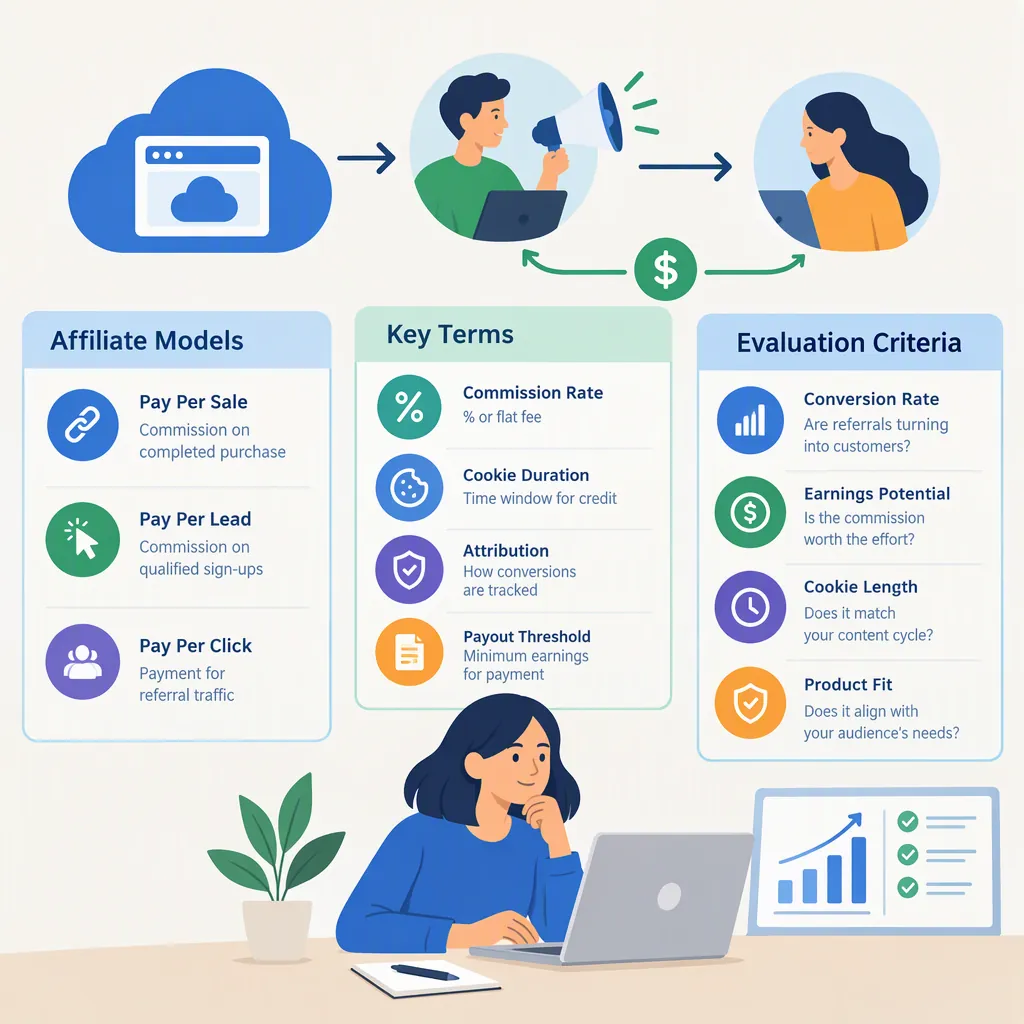
Saas Affiliate Marketing: How to Evaluate Programs
SaaS affiliate marketing is a referral arrangement in which a publisher or partner can earn a commission for an attributed software-related action or purchase. Payment models vary: software program directories distinguish recurring, limited recurring, upfront, and lead-based payments, while B2B affiliate arrangements can include milestones such as demo completions or contract signings. The key is to verify what qualifies for payment, how referrals are attributed, and how long commissions continue—not simply compare advertised rates. [c1] [c2]
Understand the Commission Model
An affiliate commission is not necessarily a share of every future subscription payment. SaaS Affiliate separates listings into percentage-based recurring payments, limited recurring payments, percentage-based upfront payments, fixed upfront payments, and cost-per-lead payments. These categories demonstrate variation; they do not establish the current terms of any individual program. [c1]
When evaluating a program, distinguish four questions:
- Trigger: Does a qualified lead, completed demo, paid subscription, or another event create a commission?
- Basis: Is payment a fixed amount or a percentage of a defined transaction value?
- Duration: Is payment one-time, limited to a specified period, or tied to eligible renewals?
- Conditions: Which exclusions, approval steps, or reversals apply?
PartnerStack's B2B affiliate page describes event-based rewards and commissions tied to subscriptions, renewals, and expansion revenue. Treat these as examples of possible program design, not terms that every SaaS affiliate receives. [c2]
Evaluate Audience Fit Before Commission Rates
A useful starting point is the software problem your audience needs to solve. The SaaS Affiliate directory organizes programs into categories including accounting and invoicing, CRM, customer support, project management, and marketing. Its stated approach is to connect programs with the services a publisher offers or the content they create. [c1]
Use that categorization as a research aid rather than an endorsement. For each candidate, identify the intended reader, the task they need to complete, and the questions they would need answered before choosing software.
A neutral comparison should explain selection criteria and limitations. Avoid calling a product the best merely because it offers a larger commission. If your information comes only from public documentation, describe it as a documentation-based comparison rather than a hands-on review.
Audience Fit Worksheet
Complete one worksheet per candidate program:
- Audience and role:
- Problem the audience needs to solve:
- Relevant software category:
- Questions the content should answer:
- Public sources available:
- Important limitations or unknowns:
- Reason to include the software independent of commission:
Check Attribution and Payment Terms
Separate the referral journey from the payment decision. PartnerStack describes tracking across clicks, conversions, and revenue, including lead progression through a CRM. This illustrates why a click, a lead, and a commission should not be treated as interchangeable events. [c2]
Before relying on a program, record its written answers to the following questions:
- What event qualifies, and which customers are eligible?
- How long is the attribution window?
- Which referral gets credit when multiple partners are involved?
- What happens if a prospect switches devices or purchases through a sales representative?
- Are renewals, upgrades, or annual payments eligible?
- How are refunds, cancellations, and disputed transactions handled?
- When are commissions approved and paid, and is there a minimum payout?
- Which promotional methods are permitted?
These are evaluation questions, not claims about a particular program. If the supplied public page does not answer them, mark them as unverified rather than infer favorable terms.
Program Terms Record
| Field | Verified Terms | Source and Review Date |
|---|---|---|
| Qualifying event | Not yet verified | Record source |
| Commission basis and duration | Not yet verified | Record source |
| Attribution window and credit rule | Not yet verified | Record source |
| Refund and cancellation treatment | Not yet verified | Record source |
| Approval and payout schedule | Not yet verified | Record source |
| Permitted promotional methods | Not yet verified | Record source |
Plan Useful Content and Conservative Economics
For educational content, organize the explanation around the reader's decision: what the software category does, who might need it, what to compare, and what remains unknown. Suggested formats include a terminology guide, a requirements checklist, or a comparison based on documented capabilities. Clearly distinguish verified information from assumptions, and make any actual compensation relationship visible without implying one exists where it does not.
For planning, use a conditional calculation rather than an income promise:
Potential commission = eligible attributed payment amount × commission rate.
For recurring arrangements, calculate each eligible billing period separately. Do not assume that every referral converts, remains subscribed, qualifies for every renewal, or produces an approved payout. Keep content-production costs and promotional expenses separate from gross commission.
The supplied references do not establish a reliable earnings forecast for a new publisher. They support identifying payment structures and research questions, not predicting personal results. [c1] [c2]
Treat Directories and Rankings as Starting Points
A program directory can help identify candidates, but a listing is not a substitute for current program terms. Likewise, a ranked article is not proof that a program is suitable for your audience.
Hatchwise's supplied roundup includes an editorial notice stating that some featured companies have affiliate or business relationships with the site and that those relationships can affect presentation. That notice is a reason to examine ranking criteria and verify terms independently—not evidence that every listed detail is incorrect. [c3]
This guide uses a directory, a vendor's B2B affiliate page, and a commercial roundup. It does not independently verify tracking accuracy, payout reliability, program acceptance, or current commission offers. Where those details matter, preserve the uncertainty instead of converting promotional descriptions into established facts.
FAQ
Do All Saas Affiliate Programs Pay Recurring Commissions?
No. The SaaS Affiliate directory distinguishes recurring and limited recurring payments from upfront and lead-based payments. Check the specific program's written terms rather than assume a subscription product produces recurring affiliate income. [c1]
Does a Referral Need to Become a Paying Customer?
It depends on the program. PartnerStack describes event-based models that can reward milestones such as demo completions or contract signings. Verify the qualifying event and approval conditions before treating a referral as payable. [c2]
Is a Best-Programs List Enough to Choose a Program?
No. Use it to identify research candidates, then evaluate audience fit and current terms. The supplied Hatchwise roundup discloses commercial relationships that can affect presentation, so its ranking should not be treated as an independent guarantee of suitability. [c3]