Cpo Affiliate Marketing: How Pay-Per-Sale Works
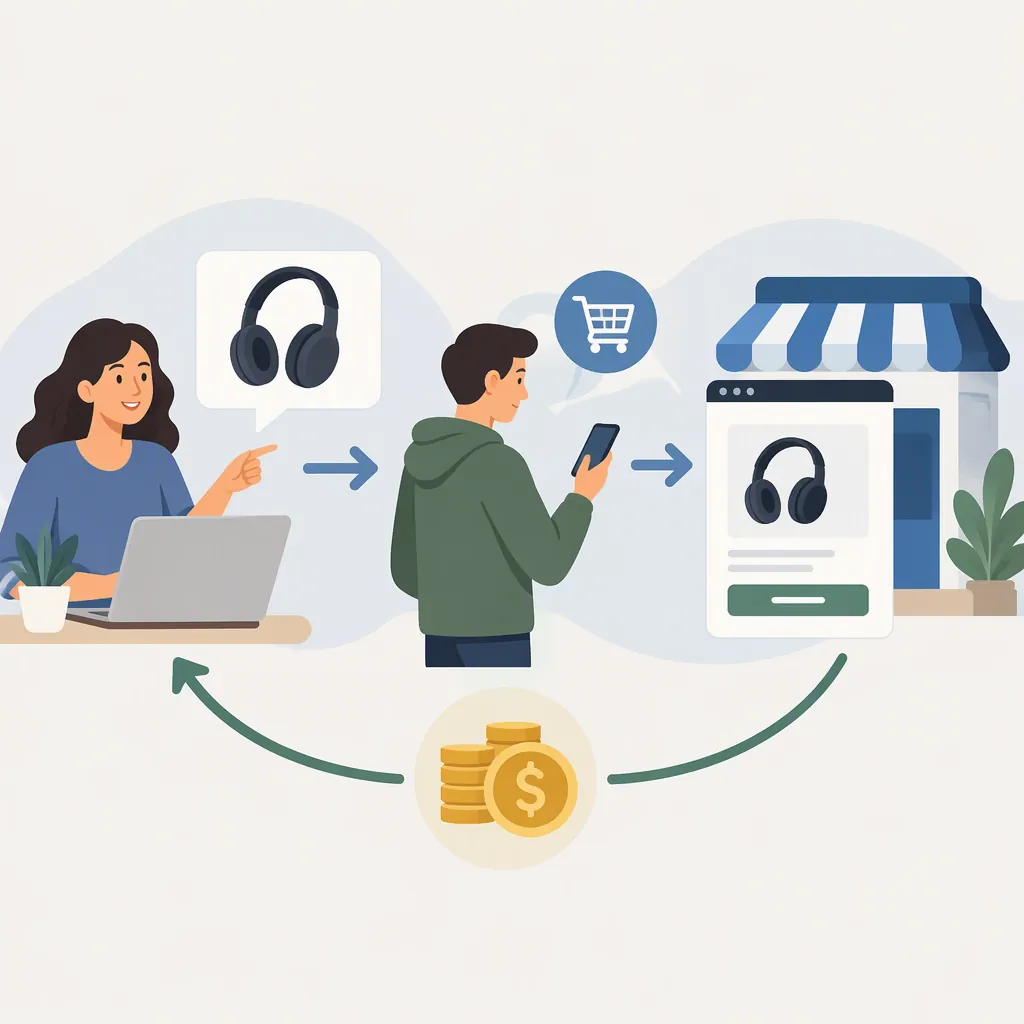
For this article, CPO affiliate marketing means a pay-per-order or pay-per-sale arrangement: an affiliate earns compensation when a referred purchase meets the program’s agreed conditions, rather than merely generating a lead or an impression. The provided references support purchase-based affiliate compensation but do not explicitly define CPO, so this is a working definition, not a universal naming standard. Compensation can be expressed as a percentage of sales or as a fixed payment for a purchase action. [cpa]
The Payment Trigger Is a Purchase
The central distinction is what earns compensation. In a purchase-based arrangement, a referral must produce a completed purchase; traffic or interest alone is not the payment event. The CPA reference describes sales as an action for which payment occurs when a purchase is completed through an affiliate’s referral. [cpa]
A useful way to understand the mechanism is to separate three questions:
- Did a purchase occur? Define the purchase event being measured.
- Was it attributed to this affiliate? Identify the evidence and attribution rule used to credit the referral.
- Does it qualify for payment? Read the agreement’s eligibility and approval conditions.
These questions form a review framework, not a description of any particular program. A recorded order should not be treated as proof of an approved or paid commission without checking the applicable terms.
Payment-Event Definition Worksheet
Complete from the written program terms:
- Purchase event that qualifies: ______
- Referral evidence accepted: ______
- Rule used to credit the affiliate: ______
- Eligibility and approval conditions: ______
- Event that makes payment due: ______
- Unanswered questions: ______
How Purchase-Based Payment Differs from CPA, Cpl, and CPM
| Term | Event or basis described in the references | What to check |
|---|---|---|
| Purchase-based affiliate compensation | A completed sale, with compensation expressed as a sales percentage or a purchase-action payment | Which purchases qualify and how compensation is calculated |
| CPA: Cost Per Action | A defined action, which may include a purchase, registration, or download | The exact action specified in the agreement |
| CPL: Cost Per Lead | A generated lead | What counts as an eligible lead |
| CPM: Cost Per Mille | One thousand ad impressions | Whether this is an advertising expense or publisher revenue |
CPA is broader than purchase-only compensation: the reference includes several possible conversion events. CPL focuses on lead generation, while CPM prices impressions rather than completed sales. [cpa] [cpl] [cpm]
Also separate how traffic is bought from how an affiliate is paid. Legiit describes an affiliate buying advertising on a CPM basis while promoting a CPA offer. In that arrangement, the advertising expense and affiliate earnings use different triggers. Paying for impressions does not itself establish that a commission has been earned. [cpm]
Separate Commission from Cost per Order
The advertiser’s cost metric and the affiliate’s commission are related, but they are not automatically the same number. The CPA reference calculates a cost-per-action metric by dividing campaign spending by conversion events. It also describes percentage-of-sales affiliate compensation. [cpa]
For a purchase-only analysis, define the calculation explicitly:
Measured cost per qualifying order = included campaign costs ÷ qualifying orders
Percentage-based commission = commissionable sales amount × agreed commission rate
Fixed purchase payment = qualifying purchases × agreed payment per purchase
Here, “included campaign costs,” “qualifying orders,” and “commissionable sales amount” are inputs that must be specified, not assumed.
Hypothetical arithmetic example: Suppose an agreement sets an 8% commission on a $100 commissionable sale. The commission would be $8. Separately, suppose included campaign costs total $240 and produce 20 qualifying orders. The measured cost per order would be $12. These are illustrative inputs, not market rates, customer results, or earnings forecasts.
If qualifying orders equal zero, the cost-per-order formula cannot produce a finite result; report the spending and zero orders separately.
Calculation Worksheet
Record the measurement period: ______
Define included campaign costs: ______
Define qualifying orders: ______
Enter included costs: ______
Enter qualifying order count: ______
If the order count is greater than zero, divide costs by orders.
Calculate affiliate commission separately using the agreement’s fixed payment or percentage formula.
Label all assumptions and exclude any unsupported earnings forecast.
Review Attribution, Eligibility, and Payment Terms
Attribution deserves separate attention from the commission rate. The CPA reference identifies tracking and attribution as challenges in performance-based affiliate marketing. That supports caution, but it does not establish a universal tracking-loss percentage for a particular program. [cpa]
Use the following questions to evaluate a purchase-based agreement:
- What referral methods are recognized: links, codes, or another documented method?
- How long after a referral can a purchase receive credit?
- How are competing referrals resolved?
- Are all products and purchasers eligible?
- What sales amount is used for percentage commissions?
- How are cancellations, refunds, and disputed transactions handled?
- When does a commission become approved, and when is it payable?
- Is there a payment threshold, and what records support reconciliation?
These are recommended review questions, not claims that every program uses these provisions.
Evidence limitation: The supplied sources discuss CPA, CPL, CPM, and sales-based affiliate compensation. They do not provide a dedicated CPO definition or the terms of any specific pay-per-sale agreement. No universal commission rate, attribution window, approval period, or income expectation can be established from them.
FAQ
Is Cpo the Same as CPA?
Not necessarily. This article uses CPO as a working label for purchase-based compensation. CPA means cost per action and can refer to purchases or other defined events, such as registrations and downloads. The supplied references do not explicitly define CPO, so the agreement’s payment event matters more than the acronym. [cpa]
Does Pay-Per-Sale Always Mean a Percentage Commission?
No. The CPA reference describes both percentage-of-sales affiliate compensation and fixed compensation for specified actions, including purchases. A purchase-based agreement therefore needs to state both the qualifying event and the payment calculation. [cpa]
Does Generating a Lead Earn a Pay-Per-Sale Commission?
A lead alone is not the purchase event in the working pay-per-sale definition used here. CPL compensates lead generation, while purchase-based compensation requires a qualifying sale. A separate lead-payment provision would need to be stated in the agreement. [cpl] [cpa]